
Why the Capital Stack Got Simpler, and Smarter
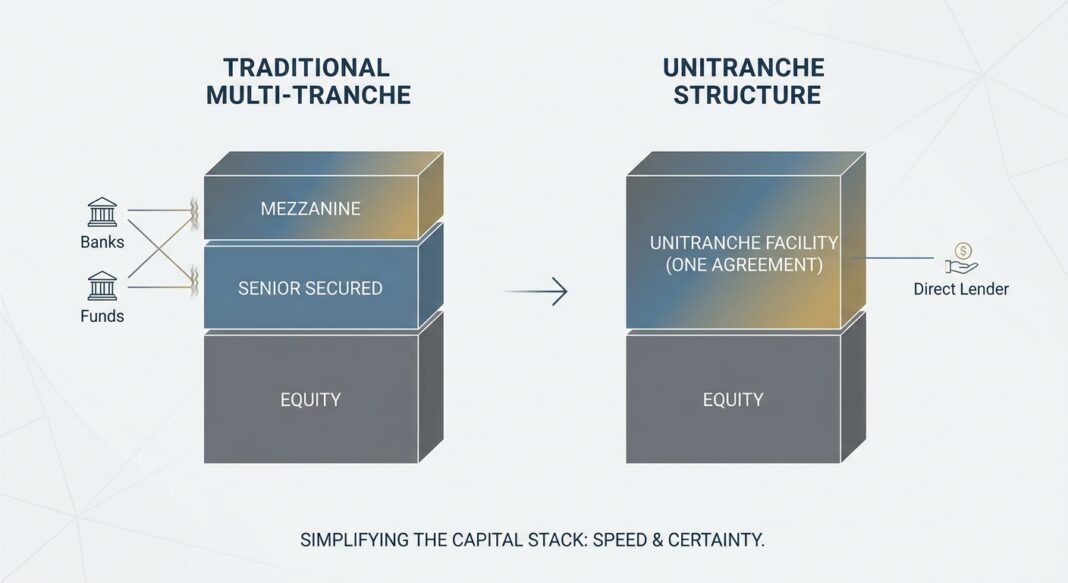
When a private equity sponsor needs to finance an acquisition, the traditional playbook required assembling multiple layers of debt: a senior secured term loan from a bank, a subordinated mezzanine tranche from a separate fund, and then equity on top. Each layer came with its own credit agreement, its own lender relationship, and its own intercreditor negotiation. For middle-market deals, typically companies with $5M to $75M in EBITDA, that complexity could stretch timelines past the point where sellers lost patience.
Enter the unitranche loan: a single-tranche financing structure that collapses what would otherwise be multiple layers of the capital stack into one instrument, one credit agreement, and one lender relationship. CT Acquisitions (June 2026) notes that unitranche now dominates the lower middle-market direct lending channel, and the numbers bear that out. According to the same source, the market grew from roughly $20 billion in annual issuance in 2015 to over $200 billion in 2025 as direct lenders displaced traditional bank syndication for sub-$1B EBITDA borrowers.
Understanding how this structure actually works (mechanically, economically, and strategically) is essential for both investors allocating to private credit funds and operators evaluating their financing options in 2026.
What a Unitranche Loan Actually Is
At its core, a unitranche loan is a single acquisition loan that combines senior debt and mezzanine or subordinated debt into one instrument with one lender and one credit agreement. The borrower sees a single facility, makes a single set of payments, and manages a single lender relationship. The structure typically supports total leverage of 4x to 6x EBITDA, with a blended all-in interest rate in the 8% to 11% range (SOFR + 500–700 basis points in the current environment).
What makes unitranche structurally interesting is what happens behind the curtain. In many cases, the unitranche lender internally tranches its position through a private Agreement Among Lenders (AAL): specifically a first-out / last-out (FOLO) structure. CT Acquisitions explains it clearly: one lender or fund holds the first-out (senior-equivalent) piece, and another holds the last-out (subordinated-equivalent) piece. The borrower never sees this internal split. They see one credit agreement, one administrative agent, one set of payments. The AAL only activates in a default scenario, where it governs recovery waterfalls.
Crestmont Capital describes the economics precisely: the first-out lender receives principal payments first and holds priority claim on collateral, earning a lower yield in exchange for less risk. The last-out lender’s capital is repaid only after the first-out tranche is satisfied, higher risk, higher yield. The borrower, however, pays a single blended rate to one counterparty.
A Concrete Example: Traditional Stack vs. Unitranche
Consider a hypothetical acquisition of a software business with $10M in EBITDA and a $60M enterprise value (6.0x multiple). Here is how the financing might be structured under two approaches:
Traditional Multi-Tranche Structure:
- Senior Secured Term Loan: $21M (35% of EV) at SOFR + 350 bps ≈ 7.8% all-in
- Mezzanine Debt: $9M (15% of EV) at 13%–15% all-in (often with equity kickers)
- Sponsor Equity: $30M (50% of EV)
- Total Lenders: 2 separate credit agreements, 2 intercreditor negotiations, potential for lender conflict in a stress scenario
Unitranche Structure:
- Unitranche Facility: $30M (50% of EV) at SOFR + 575 bps ≈ 9.75% blended all-in
- Sponsor Equity: $30M (50% of EV)
- Total Lenders: 1 credit agreement, 1 relationship, closing in as little as 3–4 weeks
The unitranche rate is higher than the senior-only rate. But the sponsor avoids mezzanine equity dilution, compresses the closing timeline, and eliminates intercreditor friction. As Private Equity Bro notes, the structure emerged because sponsors value speed and certainty over the lower headline rates available in broadly syndicated loans, and the borrower trades a modestly higher all-in cost for deal certainty, faster execution, and fewer counterparties to manage.
Current Market Relevance: Where Unitranche Fits in 2026
The unitranche market is operating in a structurally favorable environment for direct lenders, driven by persistent bank tightening, rising deal flow, and institutional capital scaling into private credit. Here is what the current data shows:
| Metric | Data Point | Source |
|---|---|---|
| LMM Unitranche Spread | SOFR + 500–700 bps (8%–11% all-in) | CT Acquisitions, Jun 2026 |
| Upper Middle Market Unitranche Spread | SOFR + 425–475 bps | ABF Journal / Capstone Partners, Aug 2025 |
| Direct Lending First-Lien Yield Floor (2026) | 8.0%–8.5% (unlevered) | Morgan Stanley Investment Management, Dec 2025 |
| Private Credit Global AUM | >$2 trillion (forecast $3.4T by 2030) | PwC Global Private Credit Survey, May 2026 |
| Bank C&I Lending Standards (Q1 2026) | Tighter for all firm sizes; moderate net share tightening | Federal Reserve SLOOS, April 2026 |
The bank tightening backdrop is the structural engine behind unitranche growth. The Federal Reserve’s April 2026 SLOOS reported that banks, on net, tightened standards for all categories of loans to non-depository financial intermediaries over the past year: including tighter covenants, higher risk premiums, and lower maximum credit line sizes. For middle-market borrowers who have historically relied on bank revolvers and term loans, this tightening creates a persistent demand gap that direct lenders and unitranche providers are filling.
On the demand side, Lord Abbett (June 2026) notes that 2025 surpassed the prior 2021 high in annual global M&A activity, with early 2026 data showing deal value remaining strong in the first quarter. More M&A deals means more demand for acquisition financing, the exact use case where unitranche structures shine. Meanwhile, Hamilton Lane (April 2026) points out that wider spreads, higher-for-longer rates, and bank retrenchment are improving pricing and terms for disciplined lenders, a combination that rewards unitranche providers with strong credit selection.
Decision Framework: Investors and Operators
For Investors Evaluating Private Credit Funds with Unitranche Exposure:
- Evaluate covenant quality. Unlike broadly syndicated loans, where, according to ABF Journal, over 90% of senior syndicated loans carry no meaningful maintenance covenants, most middle-market unitranche facilities retain at least one financial maintenance covenant. Investors should confirm the covenant package, not just the spread.
- Understand whether you are first-out or last-out. In a FOLO structure, the risk and recovery profile differs meaningfully between positions. A fund holding last-out exposure has higher yield but mezzanine-equivalent downside in a default.
- Stress-test borrower leverage. Northleaf Capital (May 2026) projects the annualized default rate rising from 1.5% in 2025 to 2.0% by year-end, with the IT sector facing elevated LTV pressure as AI concerns weigh on valuations. Portfolio-level leverage and sector concentration matter.
- Assess manager execution speed as a signal. Private Capital Global notes that private credit closes in roughly four weeks while bank syndication requires six to eight weeks, managers who win deals on speed must also demonstrate disciplined underwriting, not just fast closing.
For Operators and Business Owners Evaluating Unitranche Financing:
- Model the true all-in cost. The headline spread is not the full picture. Original issue discount (OID), prepayment fees, and amendment fees materially increase the effective cost over the loan life. Operators should model a full three-to-five year hold scenario before comparing unitranche to a traditional senior-plus-mezzanine stack.
- Value certainty of execution. In competitive M&A processes, a committed unitranche term sheet from a single direct lender can be more valuable than a theoretically cheaper but slower bank-syndicated deal. Speed and certainty have real economic value.
- Understand the covenant package before you sign. A single maintenance covenant, typically a maximum net leverage ratio, tested quarterly can create significant operational constraints. Understand the headroom and the amendment process before closing.
Key Takeaways
- Unitranche is a structural simplification, not just a pricing story. The core value proposition is collapsing a multi-tranche capital stack, with its intercreditor complexity, into a single instrument with one lender and one credit agreement.
- The FOLO mechanism is invisible to the borrower but critical for investors. First-out and last-out positions within a unitranche carry meaningfully different risk profiles; investors in private credit funds should understand which position their fund typically holds.
- Bank retrenchment is a structural tailwind. The Federal Reserve’s SLOOS data confirms sustained bank tightening across C&I lending, a durable demand driver for direct lenders offering unitranche facilities to middle-market borrowers.
- All-in cost transparency matters. Unitranche pricing in 2026 ranges from roughly SOFR + 425 bps for upper middle-market credits to SOFR + 700 bps for lower middle-market names. Operators must model OID and fees, not just the spread, to understand their true cost of capital.
- The market has scaled dramatically. From $20 billion in annual issuance in 2015 to over $200 billion in 2025, the unitranche market reflects a structural shift in how middle-market companies access growth and acquisition capital, one that shows no sign of reversing.


