
Why Borrowers Are Choosing One Loan Over Two
If you have spent any time reviewing a leveraged buyout term sheet or a middle-market acquisition financing, you have probably encountered the word unitranche. It sounds like jargon, but the idea behind it is refreshingly practical: instead of negotiating a first-lien loan with Bank A and a second-lien loan with Bank B (each with its own attorneys, its own covenants, and its own closing timeline) a borrower signs a single loan agreement with a single agent and draws a single blended-rate facility. One loan. One lien. One set of documents.
That simplicity is not just administrative convenience. It has structural, pricing, and strategic implications for every party in the transaction. For investors evaluating private credit funds, understanding unitranche mechanics is essential to assessing where risk actually lives inside a portfolio. For business operators considering a recapitalisation or acquisition, knowing how unitranche pricing compares to split-lien alternatives can materially affect the cost and flexibility of the capital you take on. This article walks through both perspectives, grounded in current market data.
What a Unitranche Loan Actually Is
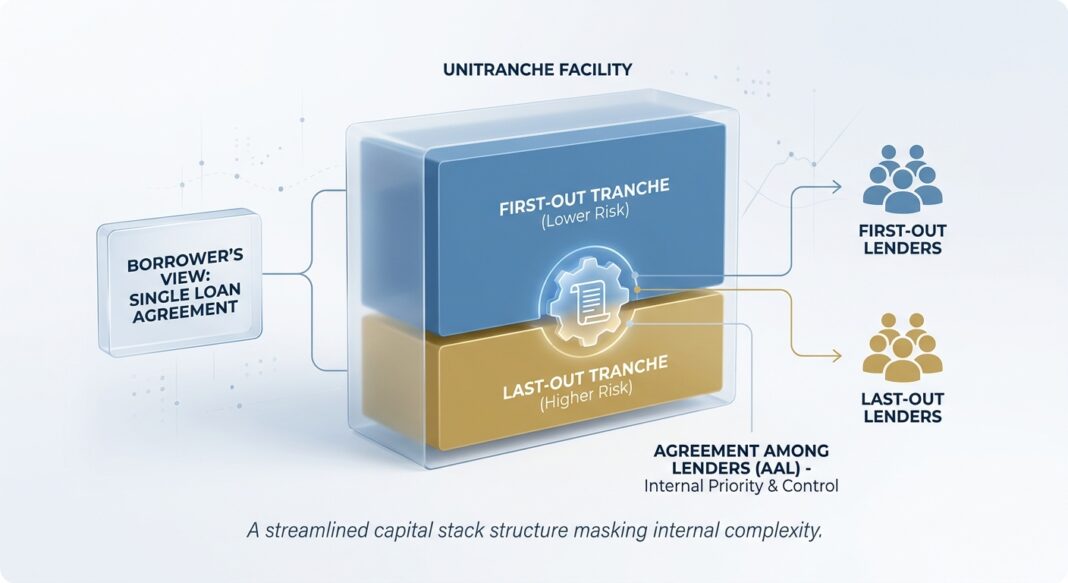
A unitranche facility is a single secured credit facility in which two or more groups of lenders share the same security interest on a borrower’s collateral but privately agree among themselves on payment priority and other inter-lender arrangements. As explained in a July 2026 Mayer Brown analysis, the structure is designed to give the "first-out" lender reduced risk and correspondingly lower return, while the "last-out" lender accepts increased risk in exchange for a higher effective interest rate, all while the borrower sees a single facility at a blended rate.
The mechanism that makes this work is called an Agreement Among Lenders (AAL). The AAL is a private intercreditor document, separate from the main credit agreement, that establishes the payment waterfall between first-out and last-out participants, governs voting rights on amendments, and controls who directs enforcement of remedies when a borrower is in distress. The borrower is typically not a party to the AAL and interacts only with the primary credit agreement.
It is important to distinguish a unitranche from a traditional first-lien/second-lien structure. In a first/second lien deal, two separate liens exist on the collateral and two distinct groups of secured parties govern their relationship through an intercreditor agreement. In a unitranche, as noted in Mayer Brown’s 2026 guidance, there is a single lien shared by all lenders, the subordination is contractual, not structural. That distinction matters in a workout.
How It Works: A Concrete Example
Suppose a private equity sponsor is acquiring a manufacturing business for $50 million. The sponsor contributes $20 million in equity (40% of enterprise value) and needs $30 million in debt (60% LTV). Under a traditional split-lien structure, this might look like:
- First-lien term loan: $20 million at SOFR + 350 bps (~8.2% all-in at current rates)
- Second-lien term loan: $10 million at SOFR + 750 bps (~12.2% all-in)
- Two lenders, two law firms, two intercreditor negotiations, a longer closing timeline
Under a unitranche structure, a single direct lender (or a club of lenders behind a common agent) provides the full $30 million at a blended rate, say SOFR + 500 bps (~9.7% all-in). Internally, the AAL splits the facility: a bank or more conservative lender takes a $15 million first-out tranche at a lower effective rate (say SOFR + 325 bps), while the direct lender holds the $15 million last-out tranche at a higher effective rate (say SOFR + 675 bps). The borrower sees only the blended 500 bps spread.
The borrower’s advantages are concrete: faster execution, fewer counterparties, and often a lower weighted-average cost of debt than maintaining two separate tranches with two separate fee structures. As described by APS BDC’s 2026 SEC filing, borrowers in a unitranche can negotiate the entire debt financing with a single counterparty, and last-out lenders typically receive higher effective interest rates and greater voting rights than second-lien lenders would receive in a comparable split-lien deal.
Current Market Reality: Where Unitranche Pricing Stands in 2026
Unitranche structures are not just theoretically dominant; they are the empirical norm in lower middle-market lending. According to CTA Acquisitions citing S&P Global Market Intelligence (2026), roughly 80% of lower-middle-market leveraged buyouts completed in 2025 used a unitranche structure rather than a syndicated bank loan.
On pricing, the current environment reflects a market that has tightened from post-pandemic peaks but is now re-widening. According to Kadenwood Group citing PitchBook LCD data (September 2026), new-issue private credit spreads averaged 502 basis points over the three months to 31 August 2026, up from 475 bps in Q1 2026. Notably, 52% of sponsor-backed direct lending deals were priced between 500–549 bps in that period, compared to just 25% in Q1, a meaningful mid-market repricing within a single year.
On an all-in yield basis, Valuation Research Corporation’s Q2 2026 Private Markets Update reported that unitranche yields range broadly between 9.00% and 9.75%: down roughly 250 basis points from the 11.5%–12.5% peaks of late 2023, but still well above pre-2022 historical ranges of approximately 7%–8%.
The broader context is one of scale. According to Preqin’s 2026 Global Alternatives Report, global private credit assets under management reached approximately $1.7 trillion at the start of 2026, up from $970 billion in 2019. The PwC Private Credit Survey 2026 places the market above $2 trillion when broader strategies are included, with a base-case growth forecast to $3.4 trillion. Unitranche direct lending remains the largest strategy within that universe, accounting for approximately 55% of the $195 billion raised globally in 2025, per Preqin.
| Metric | Value | Source |
|---|---|---|
| Avg. new-issue private credit spread (3 months to Aug 2026) | 502 bps over SOFR | Kadenwood / PitchBook LCD, Sep 2026 |
| Unitranche all-in yield range (Q2 2026) | 9.00%–9.75% | Valuation Research Corp., Jul 2026 |
| Private credit premium over broadly syndicated loans (Aug 2026) | 162 bps | Kadenwood / PitchBook LCD, Sep 2026 |
| Share of lower-MM LBOs using unitranche (2025) | ~80% | CTA Acquisitions / S&P Global, 2026 |
| Global private credit AUM (start of 2026) | ~$1.7 trillion | Preqin 2026 Global Alternatives Report |
On the bank lending side, the macro environment reinforces the structural case for private credit. The Federal Reserve’s July 2026 SLOOS reported broadly unchanged standards for commercial and industrial loans, but the April 2026 survey flagged that banks had tightened standards across all categories of non-depository financial institution (NDFI) loans over the prior year: raising premiums on riskier loans, adding stricter covenants, and shortening maximum maturities. That backdrop keeps a meaningful segment of middle-market borrowers structurally underserved by bank channels, sustaining demand for the private credit alternative.
Decision Framework: How to Think About Unitranche
For Investors Evaluating Private Credit Funds
When reviewing a fund’s portfolio, investors consider whether the manager is holding first-out or last-out exposure, because the economics and risk profile differ significantly even within the same unitranche facility. Last-out positions earn a higher yield but absorb losses before first-out lenders in a workout. Evaluating factors include:
- Tranche position transparency: Does the manager disclose whether holdings are first-out or last-out? Some BDC filings, including Prospect Capital’s March 2026 10-Q, explicitly identify last-out tranche exposure and its subordinated payment priority.
- AAL control rights: Last-out lenders typically hold majority voting rights on amendments and enforcement. Investors evaluate whether the manager has negotiated adequate control provisions to direct a restructuring.
- Spread adequacy vs. risk taken: With new-issue spreads currently averaging 502 bps but the premium over syndicated loans at 162 bps, investors assess whether the illiquidity premium compensates for subordination risk in a last-out position.
- Sector concentration: As noted in the PitchBook April 2026 US Private Credit Monitor, credit stress is accelerating particularly in the Commercial Services and Software sectors, making sector exposure within unitranche portfolios a key diligence dimension.
For Business Operators Evaluating Unitranche Financing
Operators and their advisors evaluate unitranche against split-lien alternatives on four dimensions:
- Speed and certainty of execution: A unitranche with a single lender and one set of documents typically closes faster than a first/second lien deal requiring two sets of negotiations and an intercreditor agreement.
- All-in cost: The blended unitranche rate sits between the first-lien and second-lien rates. For businesses that would otherwise need a second-lien tranche, unitranche may offer a lower blended cost and fewer fees.
- Covenant flexibility: Unitranche documents, particularly in sponsor-backed deals, often offer more flexibility than bank facilities. As the PitchBook 2025 private credit outlook noted, private lenders have increasingly competed on negative covenant flexibility to win business from the broadly syndicated market.
- Refinancing risk: Operators weigh the fact that unitranche lenders hold the entire debt position, which simplifies amendment discussions but concentrates negotiating power with a single counterparty at maturity.
Key Takeaways
- One loan, hidden complexity: A unitranche looks simple to the borrower (one rate, one agent, one closing) but the Agreement Among Lenders creates meaningful subordination distinctions that investors must understand before assuming all "first-lien" private credit is equivalent.
- Spreads are moving wider: After years of compression, new-issue unitranche spreads rose from 475 bps in Q1 2026 to 502 bps by August 2026, per PitchBook LCD data, a material shift that changes the economics of both new originations and fund return projections.
- Last-out is not second-lien: Last-out lenders in a unitranche typically hold stronger voting rights and control over enforcement than second-lien lenders in a traditional split structure, a structural advantage that partially offsets their subordinated payment priority.
- Bank retreat sustains demand: With the Federal Reserve’s April 2026 SLOOS showing banks tightening all terms on NDFI loans (including stricter covenants and higher risk premiums) the middle market remains structurally reliant on private credit unitranche as a primary financing channel.
- Scale creates new dynamics: With global private credit AUM near $1.7–$2 trillion and unitranche dominant in lower-middle-market LBOs, the product has shifted from niche to systemic. Investors and operators alike are navigating a market that is simultaneously maturing, repricing, and attracting regulatory scrutiny for the first time.


