
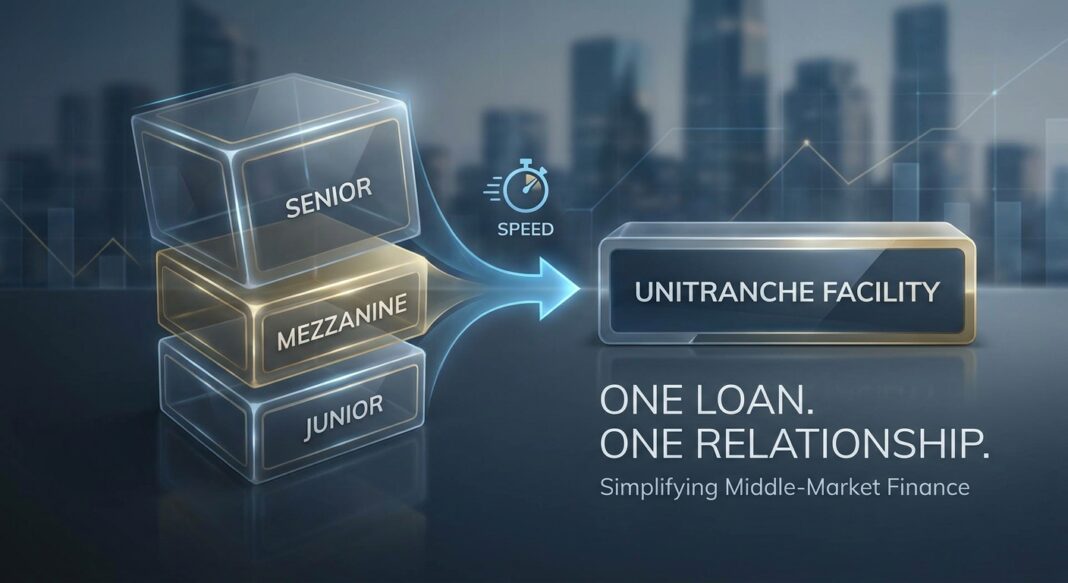
One Loan. Two Risk Profiles. A Structural Revolution in Middle-Market Finance.
In a traditional leveraged buyout, a borrower negotiates with a senior bank lender, a mezzanine provider, and sometimes a second-lien creditor: each with separate documents, separate covenants, separate enforcement rights, and separate closing timelines. The result is often a financing process measured in months, not weeks.
The unitranche loan upended that architecture. By collapsing what would otherwise be distinct debt layers into a single credit facility, unitranche financing offers borrowers one loan agreement, one blended interest rate, and one lender relationship to manage. For middle-market companies navigating competitive acquisition processes, that simplicity is not just convenient; it is frequently decisive.
Today, unitranche has become the dominant debt instrument in sponsor-backed middle-market transactions. Understanding its mechanics (both what the borrower sees on the surface and what happens among lenders behind the curtain) is foundational knowledge for any investor evaluating private credit funds or any business owner considering growth capital options.
What Is a Unitranche Loan and How Does It Work?
A unitranche loan is a hybrid debt instrument that combines senior and subordinate debt into a single, unified credit facility. The name itself is instructive: uni means one, tranche means a layer of debt. Instead of separately negotiating a senior facility and a mezzanine facility with different lenders at different rates, a borrower receives the entire debt package in one instrument, typically from a single direct lender or a small club of private credit funds.
From the borrower’s perspective, the structure is clean: one loan, one set of documents, one interest payment. There is no intercreditor agreement to negotiate between competing creditor groups. However, when multiple lenders participate, the picture behind the scenes is more nuanced.
In a bifurcated unitranche structure, lenders privately divide the loan into two layers through an Agreement Among Lenders (AAL):
- First-Out (FO) Tranche: Lower risk, lower yield. This layer receives priority in cash flows and principal repayment. It behaves like a traditional senior loan.
- Last-Out (LO) Tranche: Higher risk, higher yield. This layer is subordinate in the payment waterfall. It functions economically like mezzanine debt, but appears as part of a first-lien instrument to the borrower.
Critically, the borrower sees none of this internal waterfall; they execute a single credit agreement. The AAL is a private arrangement governing how lenders allocate economics and remedies among themselves, including recovery priorities in a bankruptcy scenario.
A Concrete Example: The Math of a Unitranche vs. a Split Structure
Consider a private equity sponsor acquiring a manufacturing business with $10 million in EBITDA at a 6.0x purchase multiple, implying a $60 million enterprise value. The sponsor contributes $20 million in equity (roughly 33% of the capital structure). The remaining $40 million is debt, financed at 4.0x EBITDA.
Traditional Two-Layer Structure:
- Senior Bank Term Loan: $25M at SOFR + 300 bps (first lien, tightest covenants)
- Mezzanine / Second Lien: $15M at a fixed 12% (subordinated, separate document set)
- Total process time: 8–12 weeks; two separate negotiations; two intercreditor agreements
Unitranche Alternative:
- Single Unitranche Facility: $40M at a blended rate of SOFR + 500 bps (one document; one lender relationship)
- Behind the scenes, the AAL splits this into a $25M First-Out piece and a $15M Last-Out piece held by different private credit funds
- Total process time: 3–5 weeks; single point of negotiation
The borrower pays a modestly higher blended rate than on the senior-only piece, but gains speed, certainty, and simplicity: three variables that can determine whether a sponsor wins a competitive auction. The lenders, meanwhile, privately manage their own risk/return allocation without exposing the borrower to intercreditor friction.
Current Market Relevance: Unitranche in 2025–2026
The unitranche structure did not emerge in a vacuum; it was born out of bank retrenchment after the 2008 financial crisis, and it continues to thrive wherever bank lending tightens.
The Federal Reserve’s most recent data confirms that dynamic remains firmly in place. According to the Federal Reserve April 2026 SLOOS, banks reported tighter lending standards for commercial and industrial loans across firms of all sizes during Q1 2026, with the most widely reported changes including higher premiums on riskier loans, stricter covenants, and lower maximum credit line sizes. That tightening trend has persisted across multiple consecutive survey periods. The KPMG SLOOS Summary (August 2025) noted that nearly 10% of banks tightened C&I lending standards for large and middle-market firms in Q2 2025, citing an uncertain economic outlook and concerns about legislative and regulatory changes.
Into that gap, private credit (and unitranche specifically) has expanded aggressively. According to Preqin data reported via S&P Global (November 2025), private credit AUM is estimated at approximately $2.28 trillion in 2025, forecast to nearly double to $4.5 trillion by 2030. Industry data cites the Cliffwater Direct Lending Index at 9.3% total returns for 2025, with 10.4% interest income, materially above public fixed income benchmarks.
On pricing, market conditions are shifting in lenders’ favor. According to Lord Abbett’s 2026 Midyear Outlook (June 2026), citing PitchBook data, spreads have widened by roughly 50 to 100 basis points since late 2025, with new loans also carrying better credit structures: less leverage, more covenants, and tighter documentation. PitchBook / LCD (March 2026) tracked a real-deal example: the $4.815 billion WWEX Group unitranche loan, led by Ares Capital across 33 lenders, which priced at SOFR + 575 bps, a notable widening from sub-500 levels that dominated 2024 and most of 2025.
Meanwhile, Valuation Research Corp.’s Q2 2026 Private Markets Update notes that unitranche yields remained broadly stable on a spot basis through mid-2026, with three-month Term SOFR at 3.69% in June, meaning all-in yields on unitranche facilities continue to sit in the high-single to low-double-digit range.
| Metric | Data Point | Source |
|---|---|---|
| US Private Credit AUM (2025) | ~$2.28 trillion | S&P Global / Preqin, Nov 2025 |
| Unitranche Spread (WWEX Group, Q1 2026) | SOFR + 575 bps | PitchBook / LCD, Mar 2026 |
| Spread Widening Since Late 2025 | +50 to +100 bps | Lord Abbett / PitchBook, Jun 2026 |
| CDLI Total Returns (2025) | 9.3% (10.4% interest income) | Cliffwater CDLI, 2025 |
| Banks Tightening C&I Standards (Q1 2026) | Net tighter across all firm sizes | Federal Reserve SLOOS, Apr 2026 |
Decision Framework: Investors and Operators
For Investors Evaluating Private Credit Funds:
- Ask where in the unitranche the fund sits. A fund primarily holding Last-Out positions is taking on more subordinated risk than one holding First-Out positions, even if both call their loans “unitranche” or “first lien.” The AAL structure is the determining document.
- Evaluate the blended yield against the risk layer. First-Out positions should price closer to pure senior direct lending (SOFR + 300–400 bps); Last-Out positions typically target SOFR + 650–800 bps or higher to compensate for subordinated exposure.
- Review the AAL terms, not just the loan agreement. Recovery economics in a restructuring are governed by the AAL; this document defines actual downside protection, control rights, and enforcement sequencing.
- Consider the bank tightening cycle as a structural tailwind. Continued SLOOS tightening across C&I and NDFI categories reinforces demand for non-bank unitranche solutions, supporting deal volume and lender bargaining power.
For Business Owners and Operators Considering Unitranche:
- Prioritize unitranche when speed matters more than rate optimization. In a competitive M&A process or time-sensitive recapitalization, the ability to close in weeks rather than months can justify the modestly higher blended rate versus a bank-led senior facility.
- Understand that one lender relationship has two sides. A single direct lender can move faster and be more flexible on structure, but they also have concentrated control in any amendment or restructuring scenario. Evaluate the lender’s workout history, not just their term sheet.
- Model the all-in cost carefully. With Term SOFR at 3.69% (as of June 2026) and unitranche spreads broadly in the SOFR + 450–575 bps range, total coupon costs sit in the 8%–9.5% range, a meaningful input for any leverage model or acquisition underwrite.
Key Takeaways
- Unitranche collapses the capital stack into one instrument. From the borrower’s perspective: one loan, one rate, one counterparty. From the lender’s perspective: a privately divided First-Out / Last-Out structure governed by an Agreement Among Lenders (AAL).
- Speed and certainty are the primary value propositions. Unitranche structures can close in 3–5 weeks versus 8–12 weeks for traditional senior/mezz structures, making them decisive tools in competitive M&A processes.
- Bank tightening is structural fuel for unitranche demand. The Federal Reserve’s April 2026 SLOOS confirmed continued C&I tightening, reinforcing the structural gap that private credit was built to fill, and continues to fill at scale.
- Pricing is shifting lender-friendly after years of spread compression. Following a prolonged period of sub-SOFR+500 pricing, unitranche spreads have widened 50–100 bps since late 2025, with some large transactions clearing at SOFR + 575 bps, improving risk-adjusted economics for investors.
- The AAL is the document that actually matters in distress. Investors and borrowers alike should read the Agreement Among Lenders carefully; it governs payment priority, amendment control, and recovery allocation when the simple surface structure becomes complicated.


