
Why One Loan Changed Everything
Walk into any middle-market leveraged buyout today and you are unlikely to find a traditional three-layer debt stack (senior, mezzanine, second lien) each with its own lender group, counsel, covenant package, and intercreditor fight. What you will almost certainly find instead is a unitranche loan: a single facility, a single interest rate, a single set of documents, and one relationship to manage. This structural innovation now dominates the private credit market, and understanding how it actually works (both above and below the surface) is essential for every investor evaluating private credit funds and every business owner or CFO considering whether to use one.
The timing matters. The January 2026 Federal Reserve Senior Loan Officer Opinion Survey (SLOOS) confirmed that banks tightened their lending standards for commercial and industrial loans to firms of all sizes during the fourth quarter of 2025. That continued tightening keeps the structural advantage of private credit (and the unitranche in particular) firmly intact heading into mid-2026.
What a Unitranche Actually Is
A unitranche is a single-facility debt structure that combines what would traditionally be separate senior and subordinated debt layers into one loan with one set of documents, one interest rate, and one lender relationship. The borrower signs one credit agreement. There is no intercreditor agreement to negotiate. The entire capital structure below equity collapses into a single instrument.
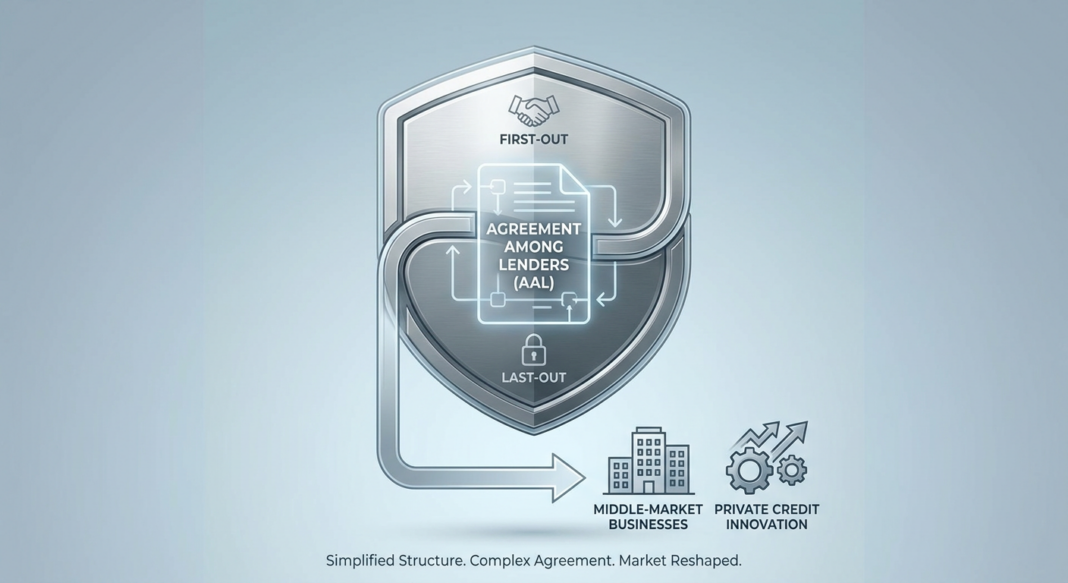
That simplicity is the borrower’s experience. The lender’s experience is more nuanced. While the borrower sees a single facility, lenders often bifurcate the economics among themselves. In an Agreement Among Lenders (AAL), the unitranche is privately divided into a “first-out” tranche and a “last-out” tranche. The first-out lender receives priority of payment and lower risk, similar to a traditional senior lender. The last-out lender absorbs more risk and earns a higher spread, similar to a mezzanine position. This structure lets multiple lenders with different risk appetites participate in the same deal without creating complexity for the borrower. The borrower makes one payment, but behind the curtain, the economics are allocated according to the AAL waterfall.
A unitranche facility carries a blended senior and junior interest rate and is documented in a single loan agreement with a single set of collateral documents granting liens for the benefit of all lenders in the facility. The Agreement Among Lenders (AAL) is the private contract that makes it work. The AAL sets forth the inter-lender terms with respect to, among other key features, sharing and allocation of interest and fees, rights to direct enforcement of remedies, caps and limits on additional debt and protective advances, voting rights of each group of lenders on credit agreement amendments, and negotiated triggering events upon which the waterfall for distributions would shift to allocate payments and collateral recoveries, first to the first-out tranche, and second to the last-out tranche.
How It Works: A Concrete Example
Consider a private equity sponsor acquiring a software company for $700 million: a 14x multiple on $50 million of EBITDA. The sponsor contributes $300 million in equity and needs to raise $400 million in debt. A bank might offer SOFR + 3.75% to 4.00%, but will likely cap its exposure at roughly $200 million, or 4x EBITDA. That leaves a $200 million funding gap that a traditional bank cannot or will not fill.
Enter the unitranche. A private credit fund offers a single $400 million facility at SOFR + 5.25%: a blended rate that reflects the combined senior and subordinated risk in the structure. The borrower signs one credit agreement, pays one rate, and manages one relationship. Behind the scenes, the unitranche may be bifurcated: a bank or first-out lender might hold $150 million at SOFR + 3.75% (the lower-risk senior slice), while the private credit fund holds $250 million as the last-out lender at a higher spread that compensates for the subordinated exposure. The details contained within the AAL are kept confidential from the borrower.
The borrower gains immediate clarity on cost of capital: no “market flex” provisions, no syndication risk, no delayed closing. Because unitranche loan transactions typically have no “market flex” provisions, the borrower has greater certainty over the all-in interest cost of the transaction. Execution speed represents a competitive advantage: private credit can close within four weeks while bank deals may require six to eight weeks for syndication. In a competitive auction, that speed differential can decide who wins the deal.
Current Market Relevance
The unitranche is not a theoretical construct; it is the dominant deal structure in today’s middle market. Here is what the data shows as of mid-2026:
| Metric | Data Point | Source |
|---|---|---|
| Unitranche / direct lending new-issue spread (Q1 2026 majority) | Below SOFR + 550 bps (84.4% of LBO deals) | Capstone Partners / PitchBook, Q1 2026 |
| Expected spread drift upward | +25–50 bps for lower-quality or difficult sectors | PitchBook U.S. Credit Markets Quarterly Wrap, Q1 2026 |
| Bank C&I tightening (Q1 2026) | Tighter standards for firms of all sizes | Federal Reserve SLOOS, April 2026 |
| First lien loan yield forecast (direct lending, 2026) | 8.0%–8.5% trough, upper half of 12-year range | Morgan Stanley Investment Management, Dec. 2025 |
| BCRED senior secured debt / avg. loan-to-value | 97% senior secured; avg. 41% LTV | Blackstone Private Credit Fund (BCRED), Form 8-K, 2026 |
| Private credit 10-year net IRR (through June 2025) | 8.6%, outperforming leveraged loans by ~3 ppts | Callan, 2Q25 Private Credit Performance, Dec. 2025 |
The April 2026 SLOOS confirmed tighter lending standards and basically unchanged demand for C&I loans to firms of all sizes during the first quarter of 2026. That means the structural gap between what banks will lend and what sponsors and operators actually need continues to feed unitranche demand. Meanwhile, for much of 2025, spreads in the private credit market plateaued at their lowest level since the decade began, with market participants hoping that increased deal volume would improve supply/demand dynamics. Now, credit conditions are becoming more lender-friendly, and these conditions are already materializing in wider loan spreads. While 84.4% of new-issue spreads of LBOs financed in the direct lending market priced below SOFR + 550 bps, spread pricing will likely tick up 25–50 basis points, particularly for deals that are lower in quality or in difficult-to-finance sectors, according to a PitchBook survey in its U.S. Credit Markets Quarterly Wrap Q1 2026 report.
Large-platform private credit lenders continue to demonstrate the structural health of the model. Underlying fundamentals remain healthy, with borrowers delivering average LTM EBITDA growth of 11% year-over-year and a roughly 40% improvement in interest coverage over the past two years, which now stands at 2.2x. Across Blackstone’s North America Direct Lending strategy, the firm has invested more than $164 billion over nearly two decades with less than 10 basis points of annualized realized losses.
Decision Framework
For Investors Evaluating Private Credit Funds
- Ask about AAL terms: When a fund holds last-out positions, the risk profile differs meaningfully from a pure first-lien portfolio. Investors should understand what percentage of a fund’s book is first-out versus last-out, and how the fund handles remedies control in a distress scenario.
- Assess covenant inclusion: Unitranche facilities typically include maintenance covenants, which is a meaningful advantage for lenders compared to the broadly syndicated loan market where covenant-lite has become standard. A fund that negotiates strong covenants gains earlier warning signals and greater leverage in restructuring.
- Evaluate manager scale: Larger platforms with proprietary sourcing, deep diligence capabilities, and seasoned restructuring teams are better positioned to originate and manage unitranche positions across cycles. Loss rates and non-accrual percentages are the key performance metrics to benchmark.
For Business Owners and CFOs Considering a Unitranche
- Quantify the speed premium: If unitranche financing can close 30 to 45 days faster than a syndicated alternative, sponsors often justify 50 to 100 basis points of extra spread by avoiding financing gaps, broken syndications, or delayed closings that jeopardize purchase agreements. Model that explicitly against the deal timeline.
- Know when it fits: Unitranche is typically preferred when speed and certainty of execution matter, such as competitive auction processes where a financing contingency could cost the deal. It also works well for buy-and-build strategies that require delayed-draw term loans and M&A baskets with predictable funding.
- Know when to look elsewhere: Issuers with near-term public-market refinancing catalysts that can achieve tighter spreads in the broadly syndicated loan market or bond markets should consider those options. If your credit profile qualifies for BSL pricing, the cost difference can be material over a five-year hold.
Key Takeaways
- One loan, two risk layers: A unitranche looks like a single facility to the borrower but is privately divided into first-out (lower risk, lower spread) and last-out (higher risk, higher spread) tranches governed by an Agreement Among Lenders, a document the borrower never sees.
- Speed is the defining advantage: Private credit unitranches can close in as little as four weeks versus six to eight weeks for syndicated bank deals, a difference that can determine who wins a competitive acquisition.
- Bank tightening sustains demand: Consecutive SLOOS surveys through Q1 2026 confirm that banks continue to tighten commercial lending standards, structurally reinforcing demand for private credit unitranche solutions, especially for middle-market borrowers.
- Spreads are widening, lender terms are improving: After a prolonged period of borrower-friendly pricing, 2026 data indicates spread widening is underway, particularly for lower-quality credits. Investors entering today may benefit from improved economics relative to 2024–2025 vintage loans.
- Covenant discipline is a hidden edge: Unlike broadly syndicated loans, where roughly 90% of new issuance remains covenant-lite, private credit unitranches commonly retain maintenance covenants, giving lenders earlier intervention rights and meaningfully better recovery potential in a stressed credit environment.


