
Why One Tranche Changed Everything
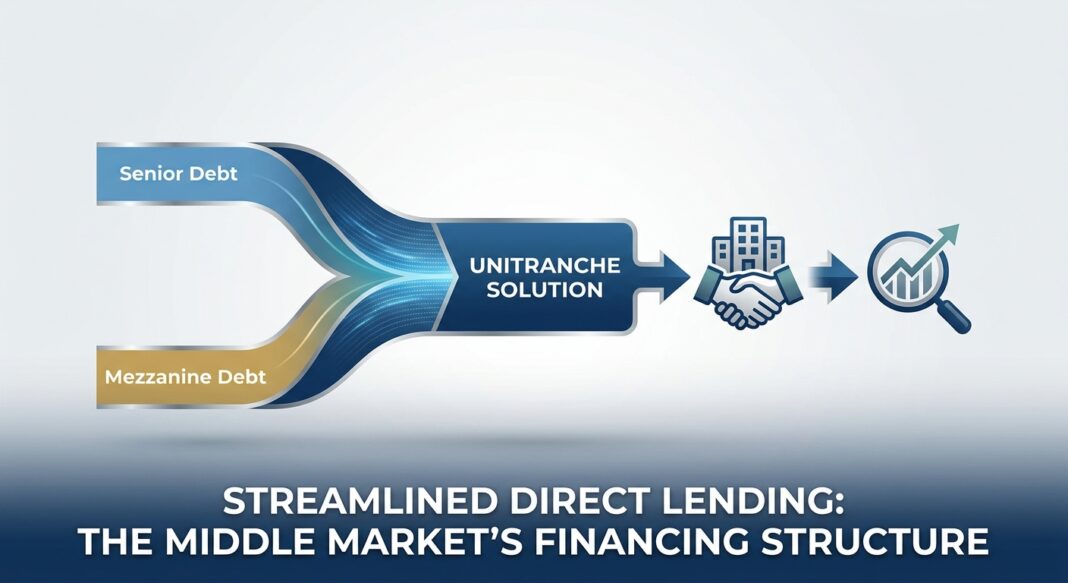
If you have watched a private-equity-backed acquisition close in the last five years, there is a good chance the debt behind it was a unitranche loan: a single instrument that collapses what used to be two or three separate debt tranches into one credit agreement, one lender relationship, and one blended interest rate. For business owners evaluating acquisition financing and for investors allocating to private credit funds, understanding how unitranche works (and why it now dominates the middle market) is foundational to understanding private credit itself.
The structure did not emerge by accident. It was a direct response to the friction, cost, and complexity of traditional capital stacks. And in 2026, with bank lending standards tightening for the fourth consecutive quarter, the unitranche loan has become more relevant than ever as the primary financing vehicle for sponsor-backed middle-market transactions.
What a Unitranche Loan Actually Is
A unitranche facility combines senior secured debt and subordinated (mezzanine) debt into a single loan with one blended interest rate, governed by one credit agreement. The borrower interacts with a single lender or a small club of lenders, signs one set of documents, and makes one stream of interest payments. As Taft Law explains, the structure gives borrowers “one-stop shopping for senior and subordinate debt financing” under a unitary credit agreement.
Behind the scenes, when multiple lenders participate, they often execute a confidential Agreement Among Lenders (AAL): the unitranche equivalent of an intercreditor agreement. The AAL creates a first-out / last-out (FOLO) waterfall: in normal times, all lenders receive scheduled interest; in a default or bankruptcy, first-out holders get paid in full before last-out holders recover anything. Crucially, as noted by the American Bar Association, the AAL, not an intercreditor agreement, “dictates the economic and control rights of the various lender groups” because all lenders share a single lien. The borrower typically does not see the AAL and is not a party to it.
This matters for both lenders and operators. For lenders, the AAL defines their real economic position. For borrowers, the unified structure means faster closings, lower legal costs, and fewer counterparties to manage after close.
How It Works: A Concrete Example
Consider a private equity sponsor acquiring a manufacturing business with $10 million in EBITDA at a 7x purchase price of $70 million. Under a traditional capital stack, the financing might look like this:
- Senior secured bank term loan: $28M (4.0x EBITDA) at SOFR + 300 bps (~6.7% all-in)
- Mezzanine debt: $14M (2.0x EBITDA) at a fixed 13–14%
- Sponsor equity: $28M (40% of purchase price)
This structure requires two separate credit agreements, two sets of covenants, one intercreditor agreement, separate legal counsel for each lender group, and typically 90–120 days to close. According to CTA Acquisitions, negotiating a senior-plus-mezzanine stack with an intercreditor agreement typically adds $300,000–$600,000 in legal fees alone.
Now compare the unitranche alternative:
- Unitranche term loan: $42M (6.0x EBITDA) at SOFR + 550–600 bps (~9.2–9.7% all-in in mid-2026)
- Sponsor equity: $28M (40% of purchase price)
The all-in interest cost is higher than the senior-only tranche but meaningfully lower than blended senior-plus-mezzanine pricing. The structure closes in 30–45 days rather than 90–120, with roughly half the legal fees. The borrower trades a modest pricing premium for execution certainty: a trade that PE sponsors, operating on tight deal timelines, consistently make. As CTA Acquisitions notes, sponsors “willing to pay 50–100bps over a senior+sub structure get a single lender, a single credit agreement, a 60-day close instead of a 120-day close, and zero intercreditor friction” on future add-on acquisitions.
Current Market Reality
The unitranche structure now dominates the middle market. According to CTA Acquisitions (June 2026), the unitranche market grew from roughly $20 billion in annual issuance in 2015 to over $200 billion in 2025 as direct lenders displaced bank syndication for sub-$1 billion EBITDA borrowers. Mordor Intelligence sizes the broader private credit market at $1.75 trillion in 2025, with direct lending, of which unitranche is the dominant instrument, accounting for 65.85% of that total.
Pricing has shifted materially since the post-COVID tightening cycle. According to Valuation Research Corporation (July 2026), overall unitranche yields range between approximately 9.00% and 9.75% in mid-2026, down roughly 250 basis points from late-2023 peak levels of 11.5%–12.5%, but still well above the pre-2022 historical range of 7%–8%. Separately, PitchBook LCD (March 2026) reported that the largest share of private credit deals tracked in 2025 priced below SOFR+500, with most landing between SOFR+450–499: though a notable recent deal, WWEX Group’s $4.815 billion unitranche led by Ares Capital, priced at SOFR+575 in Q1 2026, signaling that spreads are now widening.
That widening is lender-friendly. According to Lord Abbett (June 2026), citing PitchBook data, spreads have widened by roughly 50–100 basis points since late 2025, and new loans are increasingly coming with improved structural protections: “less leverage, more covenants, fewer PIK requests, and tighter documentation.”
Meanwhile, the Federal Reserve’s April 2026 SLOOS confirmed that banks tightened lending standards for commercial and industrial loans of all sizes in Q1 2026, with the most widely reported changes including higher premiums on riskier loans, stricter covenants, and lower maximum credit line sizes. That bank retrenchment continues to drive middle-market borrowers toward direct lenders and unitranche structures.
| Metric | Value | Source |
|---|---|---|
| Unitranche yield range (mid-2026) | 9.00%–9.75% | Valuation Research Corp., July 2026 |
| Private credit AUM (US, 2025) | $2.0+ trillion | Preqin via CTA Acquisitions, 2025 |
| Unitranche annual issuance (2025) | $200B+ | CTA Acquisitions, June 2026 |
| Direct lending share of private credit | 65.85% (2025) | Mordor Intelligence, March 2026 |
| Spread widening since late 2025 | +50–100 bps | Lord Abbett / PitchBook, June 2026 |
| Bank C&I lending standards Q1 2026 | Tighter (all firm sizes) | Federal Reserve SLOOS, April 2026 |
Decision Framework
For Investors Evaluating Private Credit Funds
Investors considering allocations to direct lending funds that deploy primarily through unitranche structures consider several structural dimensions. First, where does the fund sit within the AAL? A lender holding last-out positions accepts more risk than one holding first-out positions, even though both appear as “first-lien” on portfolio summaries. Second, does the fund use maintenance covenants? According to Private Equity Bro, unitranche loans are maintenance-covenant instruments with at least one leverage covenant tested quarterly, typically set with a 25–35% cushion over the sponsor’s base case, a meaningful structural protection compared to covenant-lite broadly syndicated loans. Third, how is the portfolio marked? Valuation opacity in direct lending is a systemic concern flagged by the Financial Stability Board in May 2026. Investors evaluate whether managers use independent third-party valuation and how quickly they recognize credit deterioration. Finally, what is the manager’s deployment discipline? McKinsey’s analysis found that the top 25 managers accounted for approximately 72% of total closed-end fundraising in 2025, concentrating capital and deal flow at scale.
For Business Owners and Operators
Operators evaluating unitranche financing weigh execution certainty against all-in cost. The structure is most compelling when a deal has tight timing requirements, when the borrower wants to avoid the complexity of managing multiple lender relationships post-close, and when EBITDA is in the $5M–$75M range, the core unitranche sweet spot. According to CTA Acquisitions, businesses above $300M enterprise value often find broadly syndicated loans price 100–200 bps cheaper. Below $25M enterprise value, SBA 7(a) loans plus seller financing frequently offer better economics. For asset-heavy businesses with significant receivables or equipment, asset-based lending may provide more leverage per dollar of collateral. Operators also consider covenant structure carefully: Private Capital Global notes that private credit lenders in 2025 require interest coverage ratios typically exceeding 2.0x, with stronger deals achieving 2.5x–3.0x, meaning borrowers need to model realistic downside scenarios before committing to a unitranche structure.
Key Takeaways
- One tranche, two economic positions: A unitranche loan appears as a single instrument to the borrower but may contain a hidden first-out / last-out split between lenders via the Agreement Among Lenders. Investors evaluate which position their fund holds.
- Speed and certainty have a price: Unitranche financing typically costs 50–100 bps more than equivalent bank senior debt, but closes 30–60 days faster and eliminates intercreditor friction, a trade many sponsors willingly make to protect acquisition timelines.
- The market is repricing toward lenders: After years of borrower-friendly compression, unitranche spreads widened 50–100 bps since late 2025 and new deal structures are coming with stronger covenants and lower leverage, the best entry conditions for disciplined lenders since 2023.
- Bank retrenchment is a structural tailwind: The Federal Reserve’s April 2026 SLOOS confirmed continued tightening of bank commercial lending standards, sustaining demand for direct lending and unitranche solutions among middle-market borrowers who cannot access the broadly syndicated market.
- Size and fit matter: Unitranche is not universal. Businesses evaluate whether their size, asset base, and timing make a unitranche genuinely optimal, or whether bank facilities, SBA loans, or syndicated markets offer superior economics for their specific situation.


