
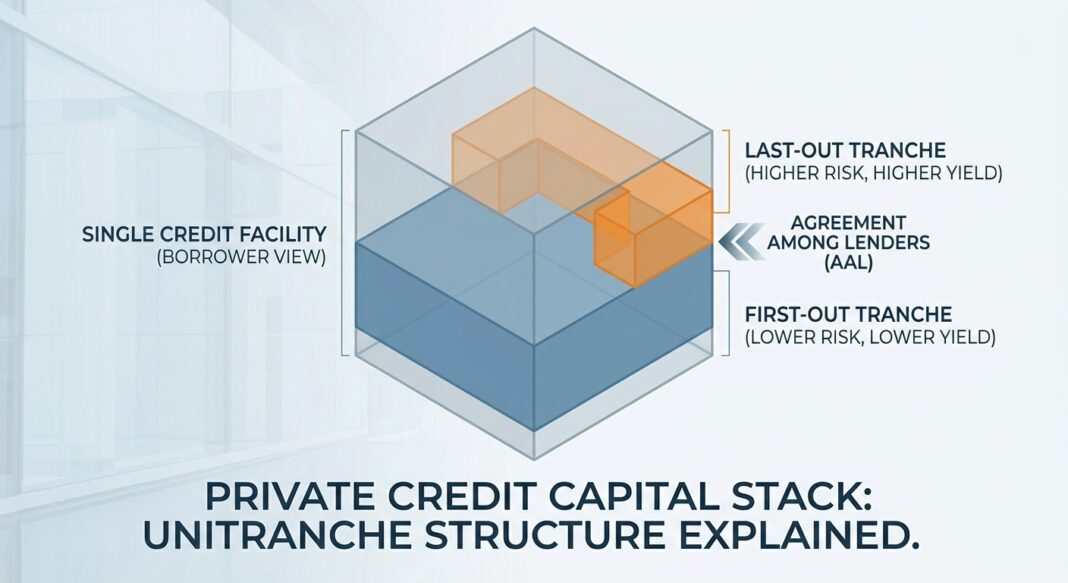
One Loan, Two Realities
Most business owners and first-time private credit investors encounter unitranche debt and see only what the structure is designed to show them: a single loan, a single interest rate, and a single point of contact. That clean exterior is intentional, and it conceals a sophisticated internal architecture that has quietly become the dominant financing engine of the U.S. middle market.
Unitranche is a private credit structure that packages what would traditionally be separate senior and subordinated debt facilities into one unified loan under one credit agreement. The borrower negotiates with one agent, signs one set of documents, and makes one periodic payment. The complexity lives elsewhere, inside a private contract between lenders called an Agreement Among Lenders (AAL), and the borrower often has no visibility into its terms.
Understanding how unitranche actually works (and why it has grown so dominant) is foundational knowledge for both investors evaluating private credit funds and operators deciding how to finance their next acquisition or growth initiative. The structure is neither inherently good nor bad for either party. It is a tool, and like any tool, its value depends entirely on how it is used and whether the user understands what they are holding.
The Mechanism: One Loan, Two Realities
In a traditional leveraged buyout or acquisition financing, a borrower might layer two or three separate debt facilities: a first-lien senior term loan from a bank, a second-lien or mezzanine tranche from a credit fund, and perhaps a revolving credit facility. Each layer carries its own credit agreement, its own covenants, its own counsel, and, critically, its own intercreditor agreement governing how the two sets of lenders relate to each other in a default. Coordinating between senior and junior lenders in a workout is notoriously slow and expensive.
Unitranche eliminates that friction for the borrower. As Mayer Brown (July 2026) explains, rather than creating two distinct tranches with separate credit agreements and intercreditor arrangements, the first-out/last-out structure achieves a form of internal subordination within a single credit facility. The borrower sees one clean credit agreement; the risk layering happens in the AAL, which is a private contract among lenders that the borrower typically never sees and has no say in.
Inside the AAL, as described by Glacier Lake Partners (August 2026), lenders divide into two groups with fundamentally different risk-return profiles:
- First-Out Lenders: Paid first from shared collateral proceeds in a liquidation or default. They accept a lower effective yield in exchange for reduced loss risk. The first-out tranche is often structured as a revolving credit facility.
- Last-Out Lenders: Take more downside risk, absorbing losses before first-out lenders if collateral falls short, and receive a meaningfully higher effective return as compensation. The last-out tranche is typically the larger term-loan-style portion of the facility.
The borrower owes one blended rate. Behind the scenes, the AAL privately redistributes cash flows between the two groups according to negotiated payment waterfall mechanics.
How It Works: A Concrete Example
Consider a private equity sponsor acquiring a software business with $15 million in annual EBITDA at a 7x multiple, resulting in a $105 million enterprise value. The sponsor puts up $50 million in equity and seeks $55 million in debt financing. Here is how two paths compare:
Traditional Two-Layer Structure:
- Senior bank term loan: $35 million at SOFR + 275 bps (all-in ~7.0%)
- Mezzanine tranche: $20 million at 12.5% fixed
- Two credit agreements, two sets of covenants, two counsel fees, intercreditor negotiations adding 4–6 weeks to close
- Blended cost of debt: approximately 9.0%
Unitranche Structure:
- Single facility: $55 million at SOFR + 500 bps (all-in ~9.2% at current benchmark rates)
- One credit agreement, one set of covenants, one administrative agent
- Closes in 2–3 weeks; sponsor certainty of execution preserved throughout auction process
- Internal AAL splits the facility: $15M first-out (bank at ~7.5%) and $40M last-out (direct lender at ~10.0%)
The borrower pays approximately 20 basis points more in all-in cost but eliminates weeks of execution risk, legal complexity, and the ongoing operational burden of managing two creditor groups. For a competitive auction where a losing bid costs more than 20 bps, that trade-off is often obvious.
According to CT Acquisitions (June 2026), the standard prepayment schedule on a 2026 unitranche runs 102/101/par over years one, two, and three, a feature operators must model carefully when evaluating refinancing windows.
Current Market Reality
Unitranche is not a niche instrument. It has become the structural backbone of middle-market private credit at scale.
According to Valuation Research Corporation (July 2026), unitranche structures continue to dominate new issuance, with coupon spreads generally ranging from 4.75% to 5.50% over benchmark, and overall yields ranging between approximately 9.00% and 9.75%, down roughly 250 basis points from late 2023 peak levels but still above pre-2022 historical ranges.
More recent data from Kadenwood (September 2026), citing PitchBook LCD, shows that new-issue private credit spreads averaged 502 basis points over the three months to August 31, 2026, up from 475 basis points in Q1, with over half of all sponsor-backed direct lending deals priced between 500 and 549 bps, compared to just 25% of deals in Q1. The premium a U.S. borrower pays for private credit over a comparable syndicated loan widened to approximately 162 basis points.
The deals getting done at scale confirm the structure’s maturity. As reported by Angel Investors Network (August 2026), a Thoma Bravo-backed transaction in March 2026 secured a $4.815 billion unitranche with Ares Capital as administrative agent and a 33-lender club that included Blackstone, Blue Owl, Apollo, and Oaktree: deals at that scale, once exclusive to bank syndication, are now routine for direct lenders.
The broader market context matters, too. The Federal Reserve’s July 2026 SLOOS reported basically unchanged standards for C&I loans to firms of all sizes in Q2, with stronger demand from large and middle-market firms. Meanwhile, the April 2026 SLOOS showed that banks tightened standards on loans to non-depository financial institutions across all categories over the prior year, meaning the bank channel feeding some first-out unitranche positions is itself being stress-tested.
| Metric | Data Point | Source |
|---|---|---|
| Unitranche coupon spread range | SOFR + 4.75% to 5.50% | VRC, July 2026 |
| All-in unitranche yield range | ~9.00% – 9.75% | VRC, July 2026 |
| New-issue private credit avg spread | 502 bps (Aug 2026) | Kadenwood / PitchBook LCD, Sep 2026 |
| Private credit premium vs. syndicated | 162 bps (Q3 2026) | Kadenwood / PitchBook LCD, Sep 2026 |
| Global private credit AUM | $2 trillion+ (2025) | CT Acquisitions / Preqin, 2026 |
| Cliffwater Direct Lending Index return | 8.7% (calendar 2025) | CT Acquisitions / Cliffwater, 2026 |
Decision Framework: Investors and Operators
For Investors evaluating private credit funds: Position within the unitranche structure matters enormously to realized returns. A fund exclusively holding last-out positions in a portfolio of unitranches is taking materially different risk than one holding first-out positions or mixed exposure. Investors consider asking managers which position their fund typically occupies, how that is disclosed in the AAL, and whether the fund’s stated yield premium compensates for that position’s first-loss exposure. According to Lord Abbett (June 2026), citing PitchBook, spreads have widened by roughly 50 to 100 basis points since late 2025, and new loans are increasingly coming with better credit structures, suggesting the current entry point may favor disciplined lenders with dry powder.
For Operators and Business Owners evaluating unitranche: The primary consideration is not the interest rate in isolation; it is the total cost of execution certainty. As Angel Investors Network (August 2026) notes, the spread premium is the toll direct lenders charge for speed and certainty. Operators evaluate unitranche most favorably when: (1) a transaction timeline is compressed; (2) the business has complex financials that require bespoke lender diligence rather than broad syndication; or (3) future add-on acquisitions require permissive baskets and delayed-draw term loan access that bank syndications rarely offer. Operators with collateral-rich balance sheets or near-term public refinancing catalysts may find better alternatives in bank or syndicated markets, where pricing currently runs approximately 150–160 basis points tighter.
Key Takeaways
- Simplicity for borrowers, complexity for lenders: The unitranche structure presents one loan to the borrower while lenders privately allocate risk, return, and control through an Agreement Among Lenders (AAL), a document the borrower typically never sees.
- First-out vs. last-out is the critical risk distinction: First-out lenders receive lower yields but are paid first in liquidation; last-out lenders absorb initial losses but earn higher returns. Investors evaluating private credit funds consider asking explicitly which position the fund typically occupies.
- Pricing has widened in 2026: New-issue private credit spreads averaged 502 bps in the three months to August 2026, up from 475 bps in Q1, according to PitchBook LCD, a meaningful shift that improves the risk-return profile for new capital deploying today.
- Execution certainty has real dollar value: The ~150–160 bps premium over syndicated loans reflects speed, confidentiality, and certainty of close, factors that can determine whether a competitive acquisition bid succeeds or fails.
- Bank competition is real but incomplete: Banks clawed back roughly half of large buyout financing in 2025, but the $50M–$200M enterprise value middle market remains dominated by unitranche direct lenders, the segment where speed and relationship capital still outprice marginal spread savings.


