
Why One Loan Now Does the Work of Two
If you have ever closed a leveraged finance deal, you know the choreography: negotiate a first lien term loan with one group of lenders, layer a second lien or mezzanine tranche on top with a different group, then spend weeks aligning two intercreditor agreements, two sets of covenants, two closing checklists, and two tables of fees. For middle-market companies, that complexity was often the deal itself, the capital was technically available, but the friction made it brutally slow.
Unitranche financing reengineered that process. It is now the dominant structure in U.S. private credit new issuance, and understanding how it actually works (mechanically, economically, and legally) is essential for any investor evaluating direct lending funds or any operator considering a private credit facility.
This article teaches the full mechanism: what a unitranche is, how the internal payment waterfall functions, what the current market looks like in mid-2026, and how both lenders and borrowers should evaluate whether the structure fits their situation.
What Is a Unitranche Loan?
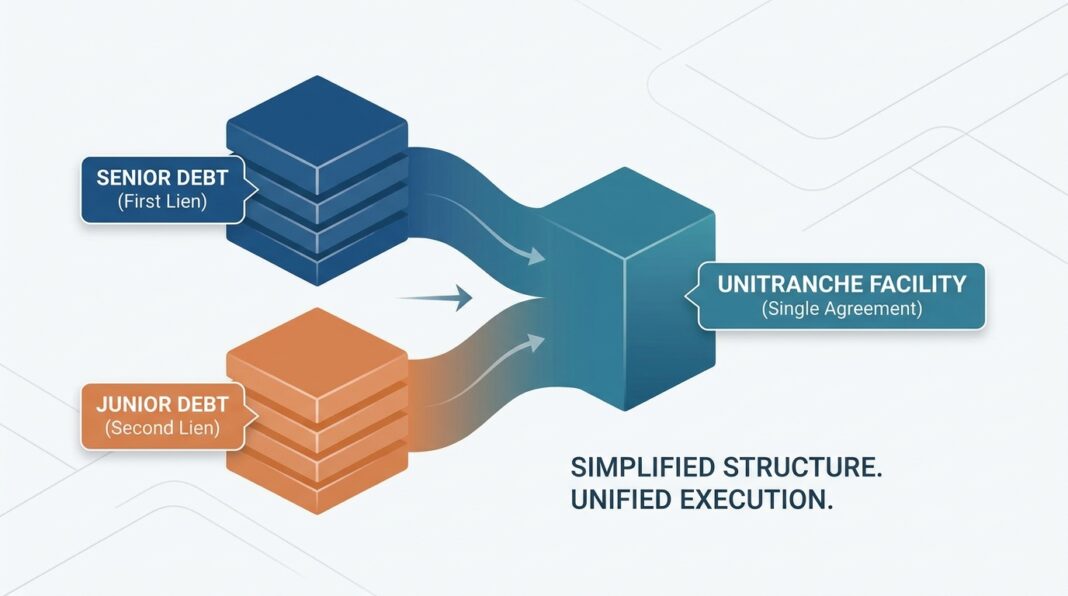
Unitranche debt is a single secured credit facility that internally blends what would traditionally be separate first lien and second lien debt into one loan agreement. Wall Street Prep describes it precisely: unitranche debt combines senior and subordinated debt into one credit facility under a single credit agreement, with a single set of collateral documents granting liens for the benefit of all lenders in the facility.
From the borrower’s perspective, the experience is simple: one lender relationship, one interest rate, one closing process, one set of loan documents. From the lender’s perspective, the picture is more nuanced. The loan is frequently divided into first-out and last-out tranches governed by an Agreement Among Lenders (AAL). The AAL establishes the internal payment waterfall, who gets paid first if the borrower runs into trouble, without creating a second lien or a separate intercreditor agreement visible to the borrower.
This distinction matters. As Mayer Brown (July 2026) explains, in a first lien/second lien deal there are two separate liens on collateral governed by an intercreditor agreement between two distinct groups of secured parties, but in a unitranche arrangement, there is only one lien, and payment priority is governed purely by the AAL among the lenders themselves. The borrower sees one deal; the lenders have privately agreed on the risk allocation behind the scenes.
How It Works: A Concrete Example with Numbers
Consider a private equity sponsor acquiring a software company with $15 million of EBITDA at a 10x purchase multiple, a $150 million enterprise value. The sponsor contributes $60 million in equity (40%) and needs $90 million in debt (6.0x EBITDA).
Traditional bifurcated structure:
- First lien term loan: $60 million at SOFR + 375 bps (senior risk)
- Second lien term loan: $30 million at SOFR + 775 bps (junior risk)
- Two credit agreements, two counsel teams, two sets of covenants
- Blended rate at current SOFR (~3.69%): approximately 8.6% all-in
- Timeline to close: 60–75 days
Unitranche alternative:
- Single facility: $90 million at SOFR + 500 bps (blended senior/junior risk)
- One credit agreement, one closing process
- All-in rate at current SOFR: approximately 8.7%, nearly identical economics, sharply lower friction
- Timeline to close: 30–45 days
Behind the curtain, the private credit manager may bifurcate the $90 million internally, allocating $60 million to a first-out tranche at a lower spread and $30 million to a last-out tranche at a higher spread, to attract different investor groups within its own fund. As Financial Edge Training notes, the loans are often broken down into bifurcated structures representing first-out payments (less risk, lower yield) and last-out payments (elevated risk, higher yield). The borrower sees none of this. They see one rate and one closing.
The cost premium the borrower pays, roughly 50–125 basis points above a comparable bifurcated structure, is effectively a fee for speed, certainty, and simplicity.
Current Market Reality: Unitranche in Mid-2026
Unitranche is not an exotic niche product. It is the default architecture of the private credit market. Here is what the data shows right now:
| Metric | Current Level | Source |
|---|---|---|
| Unitranche all-in yield range (mid-2026) | 9.00% – 9.75% | VRC Q2 2026 |
| Unitranche coupon spread range | SOFR + 475 – 550 bps | VRC Q2 2026 |
| 3-month Term SOFR (June 2026) | 3.69% | VRC Q2 2026 |
| Direct lending spread premium vs. syndicated loans | ~100–150 bps | Alternative Fortune, July 2026 |
| U.S. private credit AUM (2025 crossing point) | $2 trillion+ | CT Acquisitions / Preqin 2025 |
Unitranche yields have declined roughly 250 basis points from their late-2023 peak of approximately 11.5%–12.5%, but they remain materially above pre-2022 historical ranges of approximately 7%–8%, according to Valuation Research Corporation’s Q2 2026 Private Markets Trends report.
On the supply side, Northleaf Capital (Q1 2026) notes that direct lending continues to generate high single-digit unlevered asset returns, an attractive premium relative to public credit markets, with spreads in the private credit market adjusting more slowly than the broadly syndicated loan market during periods of volatility.
The broader banking context reinforces why unitranche demand persists. The Federal Reserve’s July 2026 SLOOS reported that bank lending standards for C&I loans remained basically unchanged in Q2 2026, steady, not loose. Notably, the April 2026 SLOOS specifically flagged that banks tightened standards on loans to non-depository financial institutions, including business credit intermediaries and private equity funds, with higher premiums on riskier loans and stricter covenants. This partial bank retrenchment from sponsor-backed lending continues to channel deal flow toward private credit unitranche lenders.
Lord Abbett’s 2026 Midyear Outlook characterizes the current environment as a “lender-friendly reset”: spreads are wider, covenants and documentation are improving, and managers with dry powder can be more selective about the credits they choose to finance.
Decision Framework
For Investors Evaluating Private Credit Funds with Unitranche Exposure
Unitranche exposure is not monolithic. Investors evaluating a direct lending fund consider several factors specific to this structure:
- First-out vs. last-out concentration: A fund heavy in last-out positions is carrying junior credit risk at a senior-looking label. Ask managers what percentage of their unitranche book is last-out, and at what spread those positions were originated.
- AAL enforcement risk: The Agreement Among Lenders has not been stress-tested in a major bankruptcy cycle to the same degree as traditional intercreditor agreements. Funds with proprietary AAL language and legal precedent carry less documentation risk.
- Vintage sensitivity: Loans originated at SOFR + 450 in a 2025–2026 market lock in economics for their loan life. As Preqin data shows, direct lending net IRRs have ranged from 8%–10% for pooled vintages, with top-quartile funds delivering 11%–13%. Vintage selection within the rate cycle matters enormously for realized returns.
- Covenant quality: The 2026 lender-friendly reset has improved documentation. Investors in newer vintages benefit from stricter maintenance covenants relative to 2021–2022 issuance.
For Operators and CFOs Evaluating a Unitranche Facility
A unitranche is not automatically the right choice. Operators and their advisors weigh the following:
- Use unitranche when: Speed and closing certainty are critical (competitive M&A), the company has limited appetite to manage two lender groups, or the deal size is below $300 million where bifurcated syndication becomes inefficient.
- Consider bifurcated when: EBITDA exceeds $75 million and a fully syndicated first lien is achievable at meaningfully tighter spreads. As Penfund observes, bifurcated structures that maximize incremental first lien baskets can finance add-on acquisitions at first lien cost rather than the blended unitranche rate, a material advantage for acquisition-heavy strategies.
- Total cost vs. friction cost: The 50–125 bps premium on a unitranche buys operational simplicity. For a company closing four acquisitions per year, that simplicity has quantifiable value.
Key Takeaways
- A unitranche is not simpler than it looks; it is simpler for the borrower, not the lender. Behind the single credit agreement sits an AAL that allocates risk between first-out and last-out lender groups. Investors must understand which position their fund holds.
- Unitranche currently yields 9.00%–9.75% all-in at SOFR + 475–550 bps in mid-2026, down materially from 2023 peaks but still above pre-2022 ranges, representing a durable income premium over investment-grade alternatives.
- Bank retrenchment from sponsor lending continues to sustain deal flow. The Fed’s 2026 SLOOS data shows banks tightening standards on NDFI loans, the structural gap that private credit unitranche lenders are filling has not closed.
- For operators, the unitranche premium is a fee for speed and certainty, not an inefficiency. In competitive auction processes, the ability to close in 30–45 days versus 60–75 days can determine whether a deal is won or lost.
- The 2026 lender-friendly reset is real. Covenants are tighter, documentation is improving, and selective lenders with dry powder are better positioned than the vintage loans made at peak competition in 2021–2022. Investors evaluating new commitments enter under structurally better terms than those made at the cycle’s trough of lender discipline.


