
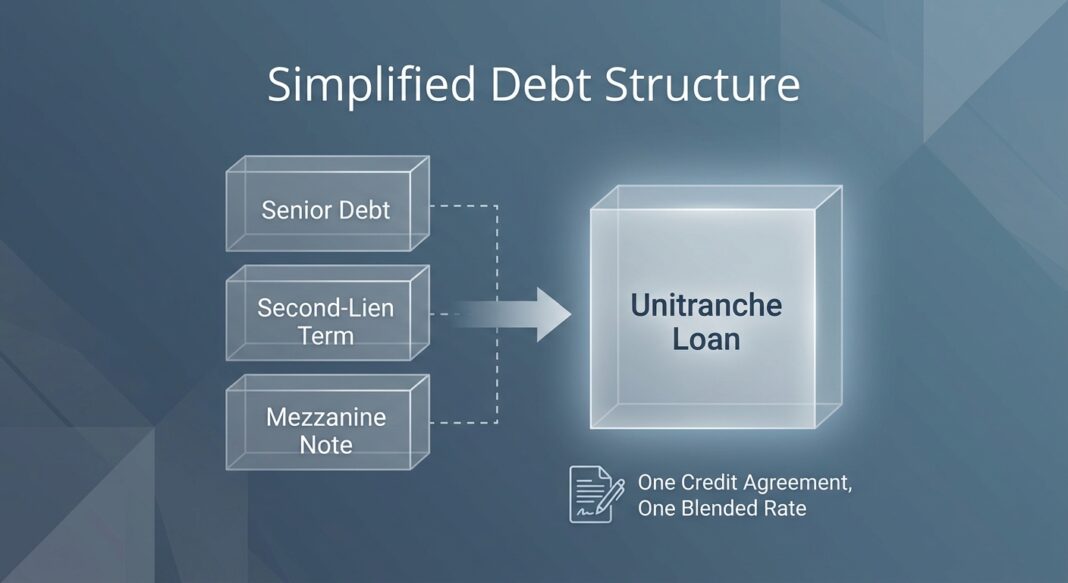
One Loan, One Lender, One Credit Agreement
Walk into any middle-market acquisition deal today and there is a better-than-even chance the debt financing looks nothing like the layered bank syndications of twenty years ago. Instead, you will find a single document, a single lender relationship, and one blended interest rate covering what would historically have required a senior bank tranche, a second-lien term loan, and sometimes a mezzanine note as well. That structure is the unitranche loan, and it has quietly become the defining financing instrument of private credit’s rise.
Understanding how unitranche works is not optional knowledge for anyone operating in or investing around the lower and middle market. According to CTA Acquisitions (2026), roughly 70 to 80 percent of acquisitions in the $25 million to $200 million enterprise value range now use at least partial unitranche funding. That dominance reflects genuine structural advantages for both borrowers and lenders, but those advantages come with mechanics that every participant must understand clearly.
What a Unitranche Loan Actually Is
A unitranche loan is a single secured credit facility that combines what would otherwise be multiple tranches of debt (senior, second-lien, and occasionally mezzanine) into one instrument with one credit agreement and one interest rate paid by the borrower. As documented in multiple SEC filings by business development companies (BDCs) in 2026, unitranche financing combines multiple debt tranches into a single financing governed by a single credit agreement and security agreement signed by all lenders and the borrower.
The borrower-facing simplicity, however, masks internal complexity among lenders. Behind the scenes, the participating lenders (often two or more private credit funds) sign a separate document called an Agreement Among Lenders (AAL). As explained by Mayer Brown (July 2026), the AAL creates internal subordination within that single lien: a “first out” lender takes lower risk and lower yield, while a “last out” lender takes higher risk and higher yield. The borrower never deals with this split directly; they see only one loan, one rate, and one set of covenants.
This is the critical distinction from traditional first-lien/second-lien structures. In a first/second-lien deal, two separate liens compete through an intercreditor agreement. In a unitranche, there is only one lien on the collateral, and payment priority flows through the AAL rather than through separate security interests.
How the Numbers Work: A Concrete Example
Consider a private equity sponsor acquiring a manufacturing business with $10 million in EBITDA at a 6x multiple, a $60 million enterprise value. The sponsor contributes $20 million in equity (33% of the capital structure) and needs $40 million in debt financing.
Under a traditional two-tranche structure, the sponsor might negotiate:
- A $25 million senior bank term loan at SOFR + 300 bps (roughly 7.3% all-in)
- A $15 million second-lien or mezzanine note at 13–15%
- Two sets of legal documents, two lender relationships, and an intercreditor agreement
Under a unitranche structure from a single direct lender, the same sponsor receives:
- A $40 million unitranche term loan at a blended rate of approximately SOFR + 525–550 bps: roughly 9.5–10% all-in at current base rates
- One credit agreement, one lender call, one covenant package
- Typical leverage of 4x EBITDA, with total debt-to-EBITDA at 4.0x
The borrower pays slightly more than a pure senior rate, but meaningfully less than blended senior-plus-mezz pricing, and eliminates substantial legal, administrative, and coordination costs. The direct lender, meanwhile, earns a premium over bank lending in exchange for holding the full stack and accepting some structural subordination risk in the last-out position.
Current Market Conditions: What the Data Shows
The unitranche market in late 2026 reflects a period of spread normalization after significant compression in 2024–2025. Key data points across verified sources:
| Metric | Current Level | Source |
|---|---|---|
| Unitranche spread, new-issue LMM (Q1 2026) | ~SOFR + 525 bps | PitchBook LCD via CTA Acquisitions, 2026 |
| All-in unitranche coupon range | 9.5%–10.5% | CTA Acquisitions, June 2026 |
| Ares Q1 2026 new deal spread range | SOFR + 500–550 bps | Ares Management commentary, Q1 2026 |
| Bank C&I lending standards, Q3 2026 | Net 0.0% tightening | Federal Reserve SLOOS via FRED, Q3 2026 |
| Private credit global AUM (start of 2026) | ~$1.7 trillion | Preqin 2026 Global Alternatives Report |
| Preqin private credit AUM forecast (2030) | $4.5 trillion | Preqin Global Reports 2026, via Private Markets Insights |
The spread context matters. Ares Management noted in Q1 2026 that new investment spreads had widened to approximately SOFR + 500–550 bps, about 50–100 bps above the 2025 tights, signaling a partial reset toward more attractive risk-adjusted returns for lenders after the aggressive repricing cycle of 2024.
The bank lending backdrop provides important context for why private credit unitranche remains relevant. The Federal Reserve’s July 2026 SLOOS reported that bank lending standards for most commercial loan categories remain at the tighter end of the range since 2005, even as Q3 2026 net tightening for C&I loans reached 0.0%, meaning the stock of tighter conditions from prior quarters persists even if banks have stopped actively tightening further. That structural gap between what banks will lend and what sponsors need continues to open the door for private credit unitranche solutions.
Decision Framework
For Investors Evaluating Unitranche Exposure
- Understand the AAL: Whether a fund holds first-out or last-out exposure materially changes the risk profile. Last-out investors bear equity-like stress in a recovery scenario, but earn a meaningfully higher spread. Evaluate which position the fund typically targets.
- Assess coverage math: At 4–5x EBITDA leverage, a business needs to sustain significant earnings deterioration before debt service becomes strained. Investors evaluate interest coverage ratios (typically requiring 2.0x or above at origination) and stress-test against revenue declines of 20–30%.
- Look for covenants: Unlike broadly syndicated loans, private credit unitranche deals typically carry a financial maintenance covenant (usually a maximum leverage ratio). This gives lenders an early intervention mechanism before distress becomes default.
- Track spread compression signals: When unitranche spreads tighten significantly below SOFR + 500 bps, the risk-return trade-off compresses. The 2024–2025 repricing cycle is a case study in how quickly competition can erode lender protections.
For Operators and Business Owners Considering Unitranche
- Weigh simplicity against cost: A unitranche carries a higher all-in rate than a pure senior bank loan. The premium, typically 150–250 bps over comparable bank senior debt, buys speed, certainty, flexibility, and a single lender relationship. For time-sensitive acquisitions or businesses that don’t meet bank eligibility criteria, that premium is often rational.
- Evaluate prepayment terms carefully: Unitranche loans typically carry prepayment fees (sometimes called call protection) of 2–3% declining over the first 24 months. Operators planning to refinance quickly or sell within 18 months should model this cost explicitly.
- Covenant negotiation matters: The maintenance covenant in a unitranche is not just a lender protection; it creates a defined engagement point if business performance slips. Operators who negotiate realistic, achievable covenant levels create breathing room; those who accept aggressive leverage ratios effectively hand the lender an option to restructure early.
Key Takeaways
- Unitranche is now the default financing structure for lower and middle-market acquisitions, roughly 70–80% of $25M–$200M EV deals in 2026 use some form of unitranche from a direct lender.
- The borrower sees simplicity; lenders manage complexity internally through the Agreement Among Lenders (AAL), which divides payment priority into first-out and last-out positions without creating separate liens on collateral.
- Pricing in 2026 has partially reset to approximately SOFR + 500–550 bps (roughly 9.5–10% all-in), recovering some ground after the 2024–2025 repricing cycle compressed spreads to multi-year tights.
- Persistent bank tightening creates a structural tailwind: Federal Reserve SLOOS data shows C&I lending standards remain at historically elevated levels relative to 2005 norms, sustaining demand for private credit alternatives.
- Covenant structure is a critical differentiator: Maintenance covenants embedded in unitranche deals give investors early warning and intervention rights that public market lenders do not have, a structural protection that justifies the asset class’s premium over broadly syndicated alternatives.


