
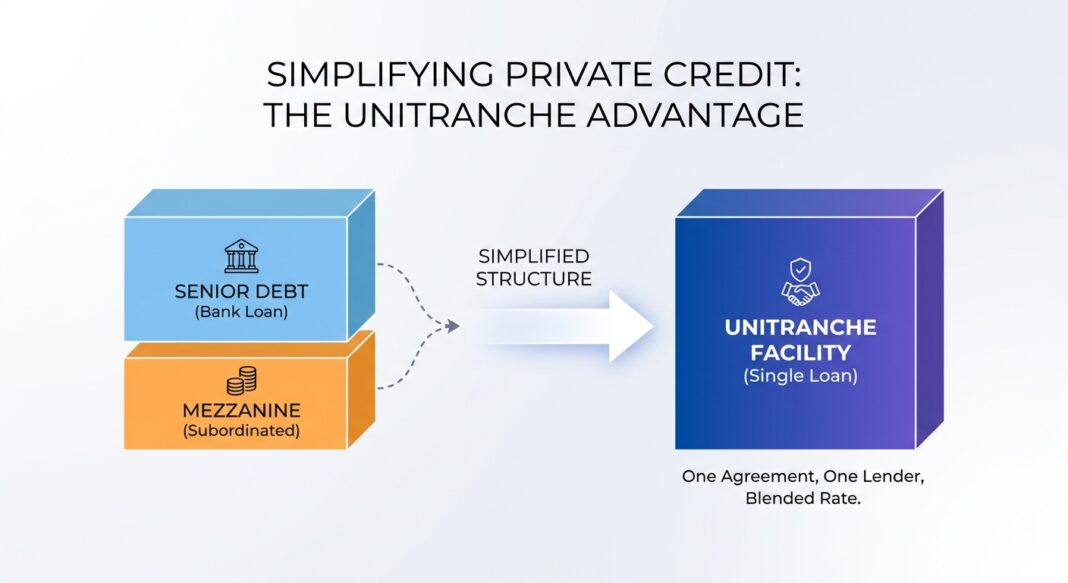
One Loan to Rule the Stack
For decades, the standard recipe for financing a leveraged buyout involved at least two layers of debt: a senior secured bank loan sitting at the top of the capital stack and a mezzanine or second-lien tranche sitting below it. The senior lender got paid first. The mezzanine lender got paid second, and was compensated for that subordination with a higher yield. The borrower managed two separate lenders, two sets of documentation, and two closing timelines.
Then private credit lenders invented the unitranche, and collapsed the entire structure into a single loan.
Today, unitranche facilities dominate middle-market direct lending. Understanding how they work, what they cost, and when they make sense is foundational knowledge for any investor evaluating private credit funds or any business owner considering a non-bank financing solution.
What Is a Unitranche Loan?
A unitranche loan is a hybrid debt instrument that blends the economics of a senior secured first-lien loan and a subordinated mezzanine loan into a single facility, with a single interest rate, a single set of covenants, and a single lender group. Accredited Insight (2025) describes it as combining senior and subordinated debt into one instrument, removing the structural complexity of a two-tranche deal.
Mechanically, the unitranche lender prices the blended loan at a rate somewhere between what a pure senior lender and a pure mezzanine lender would each charge. The borrower pays a single interest rate on the full loan balance. The lender (typically an asset manager, Business Development Company (BDC), or private credit fund) absorbs the full credit risk across the entire loan, from the first dollar to the last.
In some larger deals, two or more lenders share a unitranche facility using an agreement among lenders (AAL). The AAL creates a “first-out” and “last-out” division that is invisible to the borrower but governs how principal and recoveries are split between the lenders if the loan goes into default. From the borrower’s perspective, there is still just one loan. From the investor’s perspective, however, last-out positions carry meaningfully more subordination risk.
CT Acquisitions (June 2026) notes that a typical middle-market leveraged buyout uses 4.5x to 6.5x leverage of debt-to-EBITDA, financed with a senior secured unitranche loan as the primary structure.
How the Numbers Work: A Concrete Example
Consider a private equity sponsor acquiring a $50 million EBITDA software business at a 12x multiple, an enterprise value of $600 million.
Under a traditional two-layer structure, the deal might look like this:
- Senior secured first-lien loan: $300 million at SOFR + 450 bps (approximately 8.5% all-in)
- Mezzanine / second-lien: $75 million at a fixed 13% coupon
- Sponsor equity: $225 million
- Total debt: $375 million | Leverage: 7.5x EBITDA
Under a unitranche structure, the same deal simplifies to:
- Unitranche loan: $325 million at SOFR + 525 bps (approximately 9.25% all-in)
- Sponsor equity: $275 million
- Total debt: $325 million | Leverage: 6.5x EBITDA
The borrower gains simplicity: one term sheet, one diligence process, one closing, one set of reporting obligations. The blended rate of approximately 9.25% is higher than the senior loan alone would have been, but lower than the blended cost of the two-tranche structure (which, weighted, would have been closer to 9.5% to 10%). The lender accepts a slightly lower return versus mezzanine in exchange for deploying more capital, more efficiently, at scale.
This math is precisely why unitranche structures now dominate new issuance in middle-market private credit.
Current Market Relevance
The unitranche’s rise from niche to dominant is reflected clearly in today’s market data.
According to Valuation Research Corporation (Q2 2026), unitranche structures continue to dominate new issuance, with coupon spreads generally ranging from 4.75% to 5.50% over SOFR, approximately 25 basis points higher than year-end 2025 levels. All-in unitranche yields currently range between approximately 9.00% and 9.75%, representing a decline of roughly 250 basis points from late 2023 peak levels, but remaining above pre-2022 historical ranges of approximately 7% to 8%.
Spread pressure has become a defining dynamic. According to Lord Abbett (June 2026), citing PitchBook data, spreads have widened by roughly 50 to 100 basis points since late 2025, with defensive documentation terms also improving, a shift that benefits investors entering new deals today.
The broader market context amplifies this: PwC’s Global Private Credit Survey (2026) reports that private credit has surpassed $2 trillion in global AUM, with a base-case forecast of $3.4 trillion by 2030, driven significantly by direct lending and unitranche facilities. Moody’s (January 2026) projects AUM approaching $4 trillion by 2030 as M&A and LBO activity accelerates, expanding the pipeline for unitranche origination.
On the bank lending side, the Federal Reserve’s July 2026 SLOOS shows C&I lending standards were broadly unchanged in Q2 2026 for large and middle-market firms, a relative stabilization after tighter conditions in Q1. Yet the April 2026 SLOOS revealed that banks tightened standards for non-depository financial institution (NDFI) loans across all categories, with stricter covenants, higher risk premiums, and lower credit line sizes. This tightening of bank credit to private credit intermediaries increases funding costs for BDCs and funds, a dynamic that could compress net interest margins at the margin for unitranche lenders reliant on bank leverage lines.
| Metric | Value | Source |
|---|---|---|
| Unitranche all-in yield range (Q2 2026) | 9.00% – 9.75% | VRC, Q2 2026 |
| Unitranche coupon spread range (Q2 2026) | SOFR + 475–550 bps | VRC, Q2 2026 |
| Spread widening vs. late 2025 | +50 to +100 bps | Lord Abbett / PitchBook, June 2026 |
| Global private credit AUM (2026) | > $2 trillion | PwC Global Private Credit Survey, 2026 |
| Global private credit AUM forecast (2030) | $3.4 – $4.5 trillion | Moody’s / PwC, 2026 |
| C&I bank lending standards (Q2 2026) | Basically unchanged | Federal Reserve SLOOS, July 2026 |
Decision Framework: Investors and Operators
For Investors Evaluating Private Credit Funds and BDCs:
- Ask what share of the portfolio is unitranche vs. first-lien only. Unitranche positions carry more subordination risk than pure first-lien. Accredited Insight notes that some BDCs hold over 60% of their portfolio in unitranche, a material concentration to evaluate.
- Distinguish first-out from last-out in AAL structures. In a shared unitranche, the “last-out” portion absorbs losses first in a restructuring, even though it appears as a single loan line item in fund disclosures.
- Use spread widening as a quality signal. The 50–100 bps widening documented since late 2025 reflects improving lender terms. New vintages entering this environment may carry better structural protections than 2023–2024 originations made under tighter competition for deals.
- Monitor SLOOS data as a leading indicator. Bank tightening toward private credit intermediaries, as seen in the April 2026 SLOOS, can increase leverage line costs for BDCs, which may compress the spread between gross and net yields over time.
For Business Owners and Operators Considering Unitranche Financing:
- Unitranche typically suits businesses with $10M+ EBITDA seeking to avoid the complexity of multi-lender syndicates, especially in acquisition, recapitalization, or growth capital contexts.
- Speed and certainty of execution matter. A single lender negotiating a unitranche can close significantly faster than a syndicated bank deal, a meaningful advantage in competitive M&A processes.
- Evaluate the all-in cost honestly. At today’s 9.00%–9.75% all-in yields, unitranche debt is materially more expensive than investment-grade bank facilities. Operators should evaluate whether the operational flexibility and covenant structure justify the cost premium versus any bank alternative available to them.
- Negotiate covenant headroom explicitly. Private credit lenders typically require financial maintenance covenants (leverage, interest coverage). Ensuring adequate headroom against base-case projections, not just upside scenarios, is critical before signing.
Key Takeaways
- Unitranche collapses complexity. By blending senior and mezzanine debt into one instrument, unitranche facilities reduce closing timelines, simplify documentation, and create a single lender relationship for borrowers.
- Pricing reflects blended subordination. Current all-in unitranche yields of 9.00%–9.75% (SOFR + 475–550 bps) are higher than pure senior bank debt but often lower than a weighted-average two-tranche structure, making the trade-off one of simplicity and access, not pure cost.
- The AAL is the hidden risk layer. In large shared unitranche deals, investors should understand whether their position is first-out or last-out under the agreement among lenders, the difference is materially significant in a default scenario.
- Market terms are shifting in lenders' favor. Spread widening of 50–100 bps and improved documentation since late 2025 create a more favorable environment for investors entering new unitranche positions today compared to 2023–2024 vintages.
- Bank retrenchment is structural, not cyclical. With global private credit AUM exceeding $2 trillion and forecasts pointing toward $3.4–$4.5 trillion by 2030, the unitranche structure sits at the center of a fundamental, long-term reallocation of middle-market lending from banks to private capital markets.


