
One Loan to Rule Them All
Walk into a middle-market buyout negotiation in 2026, and there is a strong chance the debt package on the table is a unitranche loan. Not a first-lien and a second-lien. Not a senior tranche paired with mezzanine. Just one facility (one rate, one set of documents, one closing) that quietly carries the full leverage load of a leveraged buyout.
This structural innovation has quietly become the dominant financing instrument in sponsor-backed private credit, displacing the more complex multi-tranche stacks that defined leveraged finance for decades. According to Valuation Research Corporation’s Q2 2026 Private Markets Update, unitranche structures continue to dominate new issuance in the middle market, with all-in yields ranging between approximately 9.00% and 9.75% as of mid-2026.
But simplicity on the surface masks real complexity underneath. Understanding how a unitranche actually works (and when it benefits each party) is foundational knowledge for any investor evaluating private credit funds or any operator weighing their financing options.
What Is a Unitranche Loan?
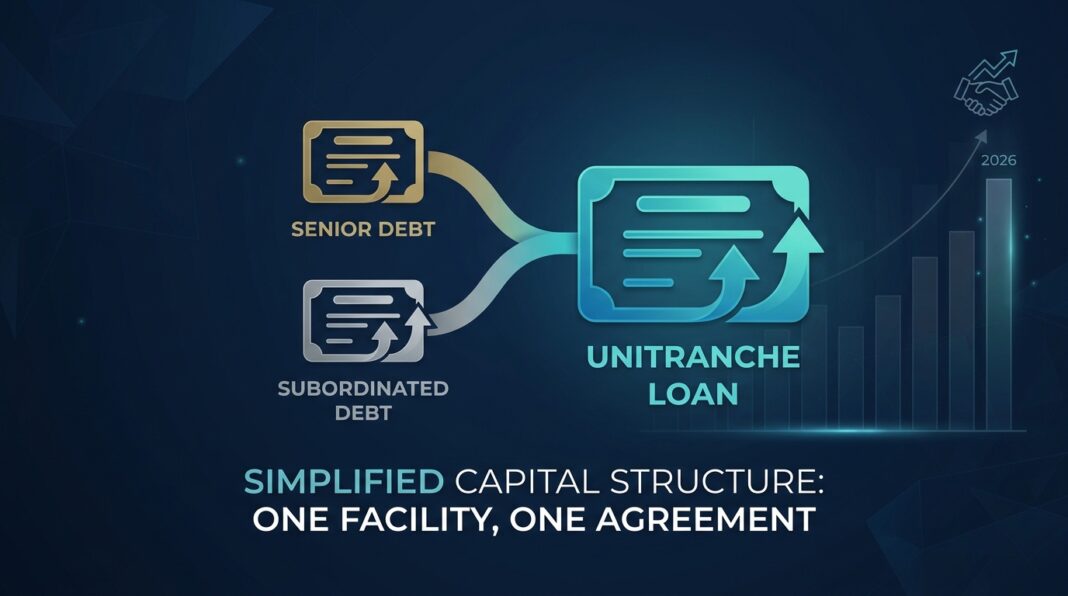
A unitranche loan is a single secured credit facility that combines what would otherwise be separate layers of debt (typically first-lien senior debt and subordinated or second-lien debt) into one blended instrument. The borrower sees only one loan, signs one credit agreement, and pays one blended interest rate.
According to Mondaq’s legal analysis of unitranche mechanics, rather than creating two distinct tranches with separate credit agreements and intercreditor arrangements, the structure achieves a form of internal subordination within a single credit facility. Behind the scenes, when multiple lenders participate, they divide into a First-Out (FO) tranche and a Last-Out (LO) tranche, governed by a confidential Agreement Among Lenders (AAL).
The AAL is the engine room of the unitranche. As explained by Wall Street Prep, the AAL establishes the waterfall payment schedule and the allocation of fees and interest between the first-out and last-out lenders, and crucially, its terms are typically kept confidential from the borrower.
The first-out lender earns a lower yield in exchange for priority repayment, similar in risk profile to a senior lender. The last-out lender earns a higher yield to compensate for absorbing losses first, analogous to a subordinated or second-lien position. Together, they present a single blended rate to the borrower.
How It Works: A Concrete Example
Imagine a private equity sponsor acquiring a software business with $10 million in EBITDA at a 7x multiple, a $70 million enterprise value. The sponsor contributes $28 million in equity (40%) and needs $42 million in debt financing (4.2x leverage).
In a traditional two-tranche structure, the sponsor might layer $30 million of first-lien debt at SOFR + 350 bps and $12 million of second-lien debt at SOFR + 700 bps: two sets of documentation, two sets of counsel fees, two covenant packages to negotiate, and a 60-to-90-day timeline to close.
Under a unitranche structure, a single private credit lender (or a club of lenders) provides the full $42 million at a blended rate of, for example, SOFR + 525 bps. According to CT Acquisitions’ 2026 Unitranche Financing Guide, typical lower-middle-market unitranche credit spreads in 2026 run 500–700 bps over SOFR, and loans also carry an original issue discount (OID) of 2–3%, meaning on a $42 million facility, the borrower may receive $41.2 million at funding but owes the full $42 million in principal.
With 3-month Term SOFR at approximately 3.69% as of June 2026 (per VRC Q2 2026), a SOFR + 525 bps spread produces an all-in coupon of roughly 8.94% before OID. Including the annualized OID benefit, the effective lender yield approaches 9.25%–9.50%, squarely within the range VRC documented for the asset class in Q2 2026.
The borrower trades a modestly higher blended rate for genuine simplicity: one closing, one reporting package, one amendment process if covenants are ever tripped. As noted by Private Equity Bro, if unitranche financing can close 30 to 45 days faster than a syndicated alternative, sponsors often justify 50 to 100 basis points of extra spread by avoiding financing gaps and broken syndications.
Current Market Relevance
The unitranche structure did not emerge in a vacuum. It accelerated in the wake of post-financial-crisis bank retrenchment and has now matured into the backbone of private credit deployment. The macro context in mid-2026 makes the structure more relevant than ever.
| Metric | Data Point | Source |
|---|---|---|
| US unitranche all-in yield (mid-2026) | ~9.00%–9.75% | VRC Q2 2026 |
| Unitranche coupon spread (new issuance) | SOFR + 4.75%–5.50% | VRC Q2 2026 |
| 3-month Term SOFR (June 2026) | ~3.69% | VRC Q2 2026 |
| Middle-market direct lending spread (Q4 2025) | ~SOFR + 500 bps | Octus, 2026 Outlook |
| Global private credit AUM (2025) | $2.1 trillion | PwC Private Credit Survey 2026 |
Bank lending conditions add further tailwind to unitranche demand. The Federal Reserve’s April 2026 SLOOS reported that banks tightened standards for C&I loans to firms of all sizes in Q1 2026, and further reported tighter standards across all categories of non-depository financial institution (NDFI) loans over the past year, a signal that traditional credit channels remain constrained for mid-market borrowers.
That tightening dynamic benefits private credit lenders who can fill the gap. According to Lord Abbett’s 2026 Midyear Outlook, spreads have widened roughly 50 to 100 basis points since late 2025, while new loans are increasingly coming with better credit structures, a lender-friendly reset that enhances the appeal of the asset class. According to Northleaf Capital’s Q1 2026 Private Credit Update, direct lending continues to generate high single-digit unlevered asset returns, representing an attractive premium relative to public credit markets.
Decision Framework
For Investors Evaluating Private Credit Funds
When reviewing a private credit fund’s portfolio, investors consider several questions specific to unitranche exposure:
- First-out or last-out position? The distinction matters enormously in a default. First-out lenders receive payment priority; last-out lenders absorb first-dollar losses. Some BDCs hold meaningful last-out concentrations, a risk that may not be visible in headline portfolio statistics. As noted by Accredited Insight, Ares Capital Corporation’s (ARCC) portfolio holds approximately 62% in unitranche loans, making the FO/LO composition of those holdings a meaningful diligence item.
- Blended yield vs. risk-adjusted yield: A 9.25% unitranche yield can look attractive in the abstract, but investors evaluate whether the underlying leverage, coverage ratios, and collateral justify the spread relative to pure first-lien alternatives.
- Covenant quality: The AAL structure, when well-negotiated, includes financial maintenance covenants, equity cure rights, and amendment control provisions. Funds with stronger documentation practices typically surface better recovery outcomes in stress scenarios.
- Manager discipline: According to PwC’s 2026 Private Credit Survey, private credit is entering its first meaningful credit cycle as a high-profile asset class, with some vintages likely to produce lower returns due to aggressive underwriting. Investors evaluate whether a manager has been tightening or loosening terms across recent originations.
For Business Operators Considering Unitranche Financing
Operators and sponsors evaluate unitranche against alternatives across several dimensions:
- Speed and certainty: Unitranche can close in two to three weeks versus two to three months for a syndicated deal. For time-sensitive acquisitions or competitive processes, that certainty has measurable value.
- Simplicity of ongoing management: One lender relationship, one amendment process, and one financial reporting package reduce administrative burden, particularly important for founder-led businesses or management teams running lean finance functions.
- Prepayment economics: Per CT Acquisitions, standard 2026 prepayment schedules run 102/101/par over the first three years. Operators who anticipate refinancing within that window evaluate whether projected rate savings exceed the prepayment cost.
- When to look elsewhere: Collateral-rich businesses that qualify for asset-based lending, or large companies with syndicated loan market access, may find meaningfully lower all-in costs by bypassing unitranche entirely.
Key Takeaways
- Unitranche is one loan with hidden layers: The borrower sees a single first-lien facility; the Agreement Among Lenders (AAL) privately allocates economics and priority between first-out and last-out lenders.
- All-in yields of 9.00%–9.75% reflect the current rate environment: Coupon spreads of SOFR + 4.75%–5.50% plus OID represent a meaningful premium over syndicated loans, but also a 250 bps decline from 2023 peak levels.
- Bank tightening sustains private credit demand: The Fed’s 2026 SLOOS data confirms banks continue tightening C&I lending standards, keeping mid-market borrowers reliant on private credit channels for debt financing.
- First-out vs. last-out is the key risk distinction for investors: Funds with heavy last-out exposure carry subordinated-equivalent risk that may not be reflected in simplistic yield comparisons, diligence on AAL terms matters.
- Speed is the underwritten premium: Operators pay 50–100 bps above syndicated market rates for deal certainty and execution speed, a premium that is often rational in competitive M&A processes but should be evaluated explicitly against alternatives.


