
Why One Loan Is Replacing Three in the Middle Market
Walk into most middle-market leveraged buyouts today and you will find the same financing tool at the center of the capital stack: a unitranche loan. What was once a niche product engineered for speed-sensitive PE sponsors has become the dominant financing structure in private credit, and for good reason. Valuation Research Corporation (July 2026) confirmed that unitranche structures continue to dominate new private credit issuance, a position that reflects nearly a decade of structural evolution in direct lending markets.
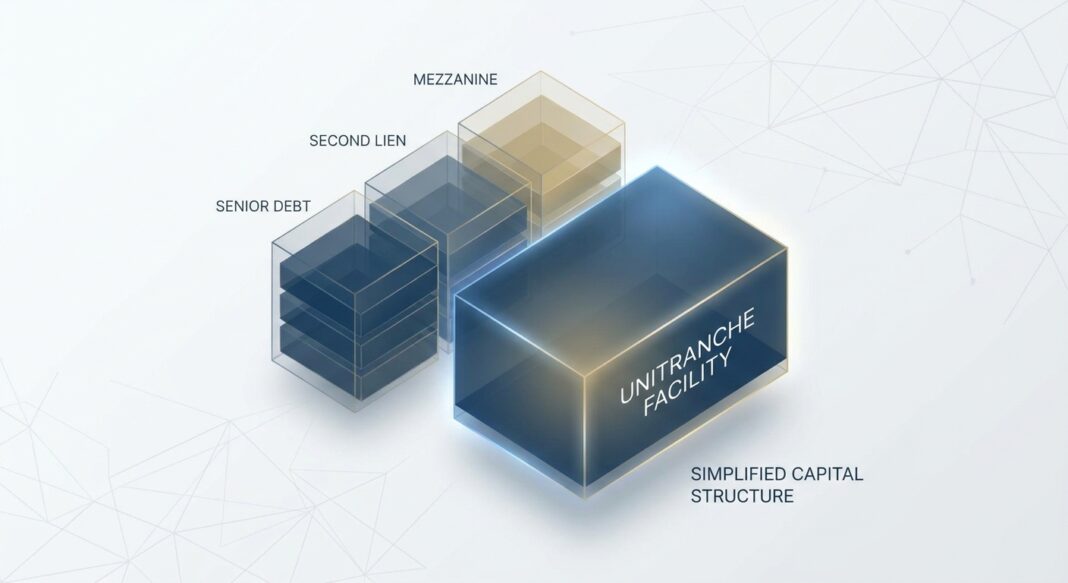
But dominance does not mean simplicity. Unitranche loans are sophisticated instruments that package what used to be three separate negotiations (senior bank debt, second lien, and mezzanine) into a single facility. Understanding how that packaging works, who bears which risk inside the structure, and what current pricing looks like is foundational knowledge for any investor evaluating private credit funds or any operator considering this financing route.
Moody’s (January 2026) projects private credit AUM will exceed $2 trillion in 2026 and approach $4 trillion by 2030. Unitranche is the engine powering much of that growth. This article teaches you exactly how it works.
What Is a Unitranche Loan? The Core Mechanism
Mayer Brown (August 2026) defines a unitranche structure as a single secured credit facility in which two or more groups of lenders share the same security interest on the borrower’s collateral but agree among themselves to a payment priority. From the borrower’s perspective, there is one loan agreement, one blended interest rate, one set of covenants, and one counterparty to manage. From the lenders’ perspective inside the facility, capital is quietly divided into a “first out” (FO) tranche and a “last out” (LO) tranche, each priced differently to reflect different risk exposure.
This internal division is governed by an Agreement Among Lenders (AAL), a document that establishes the payment waterfall, cure rights, and remedies, but is invisible to the borrower. Financial Edge Training notes that the AAL has not been tested in bankruptcy court to the same extent as traditional intercreditor agreements, a structural risk that sophisticated lenders factor into pricing.
The key distinction from a traditional first-lien/second-lien deal: Mayer Brown explains that in a first-lien/second-lien deal, two separate liens on collateral are governed by an intercreditor agreement between distinct groups of secured parties: whereas in a unitranche, there is only one lien, and priority is governed privately by the AAL. That distinction matters enormously in a restructuring scenario, which is why lender-side legal analysis of AAL terms has become increasingly important as the credit cycle matures.
How It Works: A Concrete Example with Numbers
Imagine a private equity sponsor is acquiring a software business with $10 million in EBITDA at a 6x purchase price multiple, a $60 million enterprise value. The sponsor contributes $20 million in equity (33% equity cushion). The remaining $40 million must be financed.
In a traditional structure, that $40 million might require: (1) a $25 million senior bank term loan at Term SOFR + 275 bps; (2) a $10 million second lien at Term SOFR + 700 bps; and (3) a $5 million mezzanine layer at 13–15% fixed. Three separate negotiations. Three legal teams. Three intercreditor agreements. Closing timelines of 90–120 days are common.
In a unitranche structure, a single private credit lender (or a small club of lenders) provides all $40 million at one blended rate. Based on current market data from CT Acquisitions (June 2026), a lower middle market unitranche in Q2 2026 prices at approximately Term SOFR + 500–700 bps, with SOFR near 3.69% as of June 2026 per VRC (July 2026). At SOFR + 575 bps as a midpoint, the all-in rate is approximately 9.44%. Add a 2–3% Original Issue Discount (OID): meaning the borrower receives $39.2M but owes $40M at par, and the true economic cost rises modestly.
The operator pays one blended rate, manages one lender relationship, and closes in 30–45 days. Mayer Brown (2024) confirms that from the borrower’s perspective, the unitranche structure can offer simplicity, speed of execution, lower transaction costs, and greater ease of compliance monitoring. That speed premium has real economic value in competitive auction processes.
Current Market Relevance: Where Unitranche Pricing and Structure Stand in 2026
The unitranche market in mid-2026 is characterized by stable yields, tightening underwriting, and improving lender protections, a meaningful reset from the covenant-lite excesses of 2021–2023.
| Metric | Q2 2026 Reading | Source |
|---|---|---|
| Unitranche all-in yield range | ~9.00%–9.75% | VRC, July 2026 |
| Coupon spread range (new issuance) | SOFR + 4.75%–5.50% | VRC, July 2026 |
| Maintenance covenant frequency (new MM unitranche) | 62% of new facilities | Yanne Capital / S&P LCD, Q1 2026 |
| Median leverage multiple accepted (new unitranche) | 5.4x EBITDA (down from 6.1x in Q4 2025) | Yanne Capital, Q1 2026 |
| Debt Service Coverage (DSR) floor (median) | 1.30x (up from 1.20x in Q4 2025) | Yanne Capital / S&P LCD, Q1 2026 |
Lord Abbett (June 2026) notes that spreads have widened roughly 50–100 basis points since late 2025, and new loans are increasingly carrying better credit structures, with covenants and documentation materially improving. This is a key shift after years of borrower-friendly conditions eroding lender protections.
Critically, the bank lending environment is supporting continued unitranche demand. The Federal Reserve July 2026 SLOOS confirmed that C&I lending standards remained broadly unchanged in Q2 2026, while demand was stronger primarily from large firms. Smaller and mid-market companies, the natural borrower base for unitranche, continue to find bank access limited relative to their financing needs, keeping private credit lenders firmly in the seat.
Decision Framework: Investors and Operators
For Investors Evaluating Private Credit Funds with Unitranche Exposure
- Understand the first-out/last-out split. Ask which portion of a fund’s unitranche book is first-out (lower risk, lower yield) versus last-out (higher risk, higher yield). The blended yield headline can obscure significant differences in loss-given-default profiles.
- Scrutinize covenant quality. The rise in maintenance covenant frequency to 62% of new facilities (Yanne Capital / S&P LCD, Q1 2026) is a positive signal. Investors should evaluate whether a manager’s legacy book from 2021–2022 carries equivalent protections, and if not, how exposed that book is to a tighter credit environment.
- Benchmark yields in context. At 9.00%–9.75% all-in, unitranche yields remain roughly 200–250 basis points above pre-2022 historical ranges. Investors should assess whether that premium compensates for illiquidity, AAL legal risk, and the tighter bid-ask spreads in a potential secondary sale scenario.
- Evaluate manager leverage levels. The median new-issue leverage multiple dropped from 6.1x to 5.4x EBITDA in Q1 2026 (Yanne Capital, Q1 2026). Funds that underwritten deals at 6x+ in prior years carry a different risk profile than more conservatively structured recent vintages.
For Operators Deciding Whether to Use Unitranche Financing
- Value the speed premium correctly. Unitranche closes in 30–45 days versus 90–120 days for multi-lender bank structures. In competitive M&A processes, certainty of close has real economic value, but operators should quantify that value against the higher blended rate before signing a term sheet.
- Understand equity cure mechanics. Standard 2026 unitranche terms include equity cure rights allowing sponsors to inject equity, typically 25–50% of an EBITDA shortfall, to cure a covenant breach, with limits of four cures over the loan life and no more than two in any consecutive four quarters (CT Acquisitions, June 2026). Understanding these mechanics before a covenant trip is critical.
- Model the OID and prepayment economics. A standard 2026 prepayment schedule runs 102/101/par over years one, two, and three respectively (CT Acquisitions, June 2026). Operators planning to refinance within two years should model whether spread savings exceed prepayment fees before committing to a unitranche.
- Negotiate maintenance covenant flexibility. The rising frequency of maintenance covenants means operators must build realistic EBITDA projections with sufficient headroom above DSR floor levels, now typically 1.30x, to avoid inadvertent triggers during organic business dips.
Key Takeaways
- Unitranche is the new default. Unitranche structures continue to dominate new private credit issuance in 2026, replacing multi-lender stacks because of speed, simplicity, and the depth of capital available from direct lenders.
- One loan, two economic realities. Internally, unitranche facilities divide into first-out (lower risk, lower yield) and last-out (higher risk, higher yield) positions governed by an Agreement Among Lenders, a distinction invisible to borrowers but critical to investors evaluating fund risk.
- The covenant reset is real and lender-friendly. Maintenance covenant frequency reached 62% of new middle-market unitranche facilities in Q1 2026, DSR floors moved up to 1.30x, and median leverage multiples tightened to 5.4x EBITDA, marking a structural improvement from 2021–2022 underwriting.
- Yields remain historically elevated despite compression. All-in unitranche yields of 9.00%–9.75% sit roughly 200–250 basis points above pre-2022 historical norms, offering institutional investors meaningful risk-adjusted carry, provided underlying credit quality holds.
- Operators must model total economics, not just rate. OID, prepayment premiums, equity cure restrictions, and MFN clauses all affect the true economic cost of a unitranche. Operators evaluating unitranche versus bank alternatives should stress-test a full five-year financing model before committing.


