
When One Loan Does the Work of Three
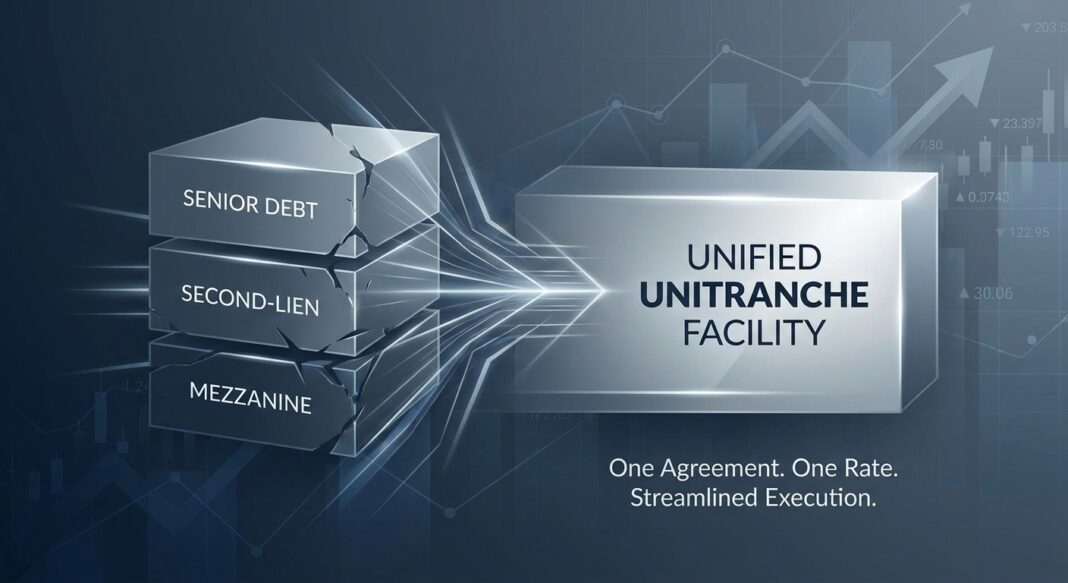
Picture the traditional leveraged buyout financing stack of the 2000s: a senior secured bank loan negotiated over weeks, a second-lien term loan added afterward, and a mezzanine tranche layered on top: three separate credit agreements, three sets of lenders, three competing counsel teams, and months of negotiation before a single dollar moved. For middle-market companies and private equity sponsors, this complexity was a persistent friction point. Then private credit managers invented a structural shortcut that would eventually reshape how billions of dollars flow through the market: the unitranche loan.
Today, unitranche structures dominate new issuance in direct lending. The concept is deceptively simple: collapse the traditional senior and subordinated debt layers into a single, unified facility with one credit agreement, one interest rate, and one lending relationship. The result is a structure that now accounts for the majority of middle-market private credit origination and is a cornerstone of how sponsors finance acquisitions, recapitalizations, and buy-and-build strategies at speed.
Understanding exactly how unitranche works (and when it is the right tool for a borrower or an attractive opportunity for an investor) is foundational knowledge for anyone operating in private credit markets in 2026.
The Concept: One Rate, Two Risk Layers Hidden Inside
Unitranche debt is a hybrid loan structure that combines senior secured debt and subordinated debt into a single credit facility governed by one credit agreement and one security agreement. As described in SEC filings by Carlyle’s private credit vehicles, “unitranche financing combines multiple debt tranches into a single financing” and the borrower pays a single blended interest rate to all lenders collectively.
From the borrower’s perspective, the experience is clean: one lender counterparty (or a small club), one set of covenants, one reporting package. However, behind the scenes the structure is more nuanced. When multiple lenders participate, the single loan is typically split internally between a “first-out” (FO) tranche and a “last-out” (LO) tranche: governed by an Agreement Among Lenders (AAL) that the borrower never signs and often never sees. The FO lender holds the lower-risk senior position with priority on repayment and collateral; the LO lender takes the subordinated risk and receives a proportionally higher share of the blended rate in compensation.
The blended interest rate that the borrower pays sits between what traditional senior debt would cost and what stand-alone subordinated or mezzanine debt would cost. As SEC filings confirm, the unitranche rate is “often higher than, or about the same as, the interest rate of traditional senior debt, but lower than the interest rate for traditional second lien or subordinated debt.” The borrower effectively gets one simplified loan; the lenders divide the risk and return among themselves through the internal AAL mechanism.
How It Works: A Concrete Deal Example
Consider a private equity sponsor acquiring a B2B software company at a $50 million enterprise value, putting in $20 million of equity (40%) and financing $30 million of debt. In a traditional structure, they might negotiate:
- Senior bank term loan: $20 million at SOFR + 300 bps (all-in ~6.8%)
- Second-lien or mezzanine: $10 million at 12–14% cash/PIK
- Timeline: 60–90 days, two credit agreements, two lender groups
Under a unitranche structure with a single private credit manager, the same deal looks like this:
- Unitranche facility: $30 million at SOFR + 500 bps (all-in ~9.0–9.5%)
- Original issue discount (OID): 1.0–1.5 points (borrower receives ~$29.1M, owes $30M)
- Timeline: 20–30 days, one credit agreement, one lender relationship
The borrower pays a modestly higher all-in rate on the blended facility versus the senior-only tranche, but eliminates the expensive mezzanine layer entirely and dramatically compresses execution risk. The sponsor avoids a broken syndication, a failed mezzanine raise, or a delayed close that could blow up the purchase agreement. As one analysis noted, if unitranche financing can close 30 to 45 days faster than a syndicated alternative, “sponsors often justify 50 to 100 basis points of extra spread by avoiding financing gaps, broken syndications, or delayed closings that jeopardize purchase agreements.”
Current Market Relevance: Unitranche in 2026
The unitranche structure has moved from innovation to institution. The data tells the story of a market that has fully embraced this approach, even as pricing has shifted through rate cycles.
| Metric | Current Reading (2026) | Source |
|---|---|---|
| U.S. unitranche all-in yield range | ~9.00% – 9.75% | VRC Q2 2026 Private Markets Update |
| Unitranche coupon spreads (new issuance) | SOFR + 4.75% to 5.50% | VRC Q2 2026 Private Markets Update |
| 3-month Term SOFR (June 2026) | 3.69% | VRC Q2 2026 Private Markets Update |
| Private credit global AUM | ~$2.1 trillion (2025) | Private Equity Bro, 2025 |
| Preqin private credit AUM forecast (2030) | $4.5 trillion | Preqin Global Reports 2026, via Private Markets Insights |
Per Valuation Research Corporation’s Q2 2026 Private Markets Update, unitranche structures continue to dominate new direct lending issuance, with all-in yields ranging between approximately 9.00% and 9.75%, a meaningful decline of roughly 250 basis points from late 2023 peak levels near 11.5%–12.5%, yet still well above pre-2022 historical ranges of 7%–8%.
Bank lending context matters here too. According to the Federal Reserve’s July 2026 SLOOS, C&I lending standards at banks were broadly unchanged in Q2 2026 and easier than the midpoint of their historic ranges, yet structural access gaps persist for sponsor-backed middle-market borrowers who need execution speed and bespoke structuring that banks cannot reliably provide.
According to Lord Abbett’s 2026 Midyear Investment Outlook, new loans are increasingly coming with better credit structures, and PitchBook data indicates spreads have widened by roughly 50 to 100 basis points since late 2025, a shift that meaningfully improves lender economics going into the second half of the year.
The competitive landscape is dominated by large platforms. According to Octus’s FY 2025 U.S. Direct Lending Rankings, Blackstone Credit maintained its position as the most active lender, closing 225 deals with a 5.4% market share, followed by Antares Capital and Churchill Asset Management.
Decision Framework: Investors and Operators
For Investors Evaluating Unitranche Opportunities
Investors considering unitranche exposure through direct lending funds or BDCs typically evaluate the following:
- Position in the AAL: Are you holding the first-out (lower risk, lower yield) or last-out (higher yield, subordinated exposure) tranche? The blended rate obscures meaningful risk differentiation.
- Covenant quality: Stronger vintage deals in 2026 are coming with improved maintenance covenants and documentation. Investors assess whether financial covenants provide early-warning triggers, not just incurrence covenants that only test at time of a new action.
- EBITDA add-back discipline: Unitranche underwriting depends heavily on adjusted EBITDA definitions. Aggressive add-backs can inflate the denominator and mask true leverage multiples.
- Prepayment and call protection: Standard 2026 prepayment schedules are typically structured as 102/101/par in years one through three. This protects investors from rapid refinancing arbitrage if spreads compress.
- Manager relationships and deal flow sourcing: In a concentrated market, larger platforms with proprietary sponsor relationships access better paper. Manager selection drives outcomes.
For Operators and Sponsors Evaluating Unitranche Financing
Business owners and sponsors considering unitranche financing should weigh the following:
- Price the certainty premium honestly: Compare the all-in unitranche yield not against the cheapest theoretical bank rate, but against a fully flexed, syndicated facility with all associated execution risk priced in.
- Evaluate equity cure rights carefully: Standard 2026 terms allow approximately four cures over the loan life, with no more than two in any consecutive four quarters. This is meaningful downside protection if EBITDA misses a covenant threshold.
- Understand MFN clauses: Most-favored-nation provisions can automatically reset your existing spread upward if you issue incremental debt at higher pricing. Negotiate the cushion threshold and sunset period before signing.
- Delayed draw term loans: For buy-and-build strategies, negotiate for pre-committed delayed draw capacity in the unitranche facility at inception; this secures acquisition financing without returning to market.
- Fit matters: Unitranche is well-suited for companies with stable recurring revenue, clean EBITDA, and compressed deal timelines. Companies with volatile cash flows, heavy seasonality, or near-term refinancing catalysts in public markets may find better structural alternatives.
Key Takeaways
- Unitranche collapses complexity: By combining senior and subordinated debt into a single credit facility with one credit agreement and one rate, unitranche loans eliminate the multi-party negotiation overhead of traditional leveraged finance structures.
- The blended rate conceals layered risk: Internally, lenders divide the unitranche into first-out and last-out tranches via an Agreement Among Lenders. Investors must understand which risk position their capital actually occupies.
- Speed is a real economic input: Execution certainty in 20–30 days versus 60–90 days for traditional structures can justify a 50–100 bps spread premium, particularly when a delayed close risks losing the acquisition target.
- Current yields sit in an attractive window: At approximately 9.00%–9.75% all-in for mid-market unitranche (as of Q2 2026), yields remain well above pre-2022 ranges while spreads are beginning to widen modestly, creating a favorable entry point for new capital deployment.
- Structural quality is improving: As private credit matures, the 2026 vintage is benefiting from tighter covenants, better documentation, and more disciplined underwriting, making this an important moment to understand what differentiates strong deals from weak ones.


