
Why the Capital Stack Just Got a Lot Simpler
If you have ever tried to close an acquisition or refinance a middle-market company, you know the traditional playbook: negotiate with a senior bank lender, layer in a mezzanine fund, wrangle over intercreditor terms, and manage two sets of covenants, sometimes for months. Unitranche financing rewrites that playbook entirely.
In 2026, unitranche structures dominate middle-market deal financing, and understanding how they work is foundational knowledge for both investors evaluating private credit funds and business operators weighing capital structure decisions. The structure is elegant in its simplicity on the borrower’s side, and quietly sophisticated on the lender’s side: a distinction that carries real implications for pricing, risk, and control.
This article teaches the mechanics of unitranche financing, walks through a concrete deal example with real numbers, and connects the structure to where the market stands today.
What Is a Unitranche Loan?
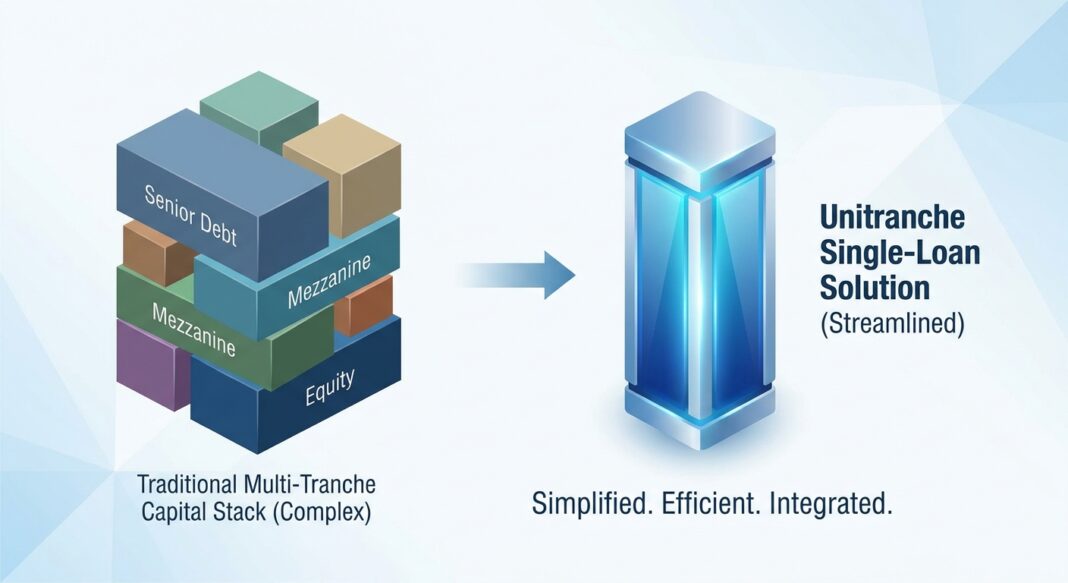
Unitranche debt is a single secured credit facility that combines what would otherwise be separate first-lien senior debt and subordinated (junior or second-lien) debt into one loan instrument, governed by one credit agreement, at one blended interest rate. According to Mayer Brown, the facility carries “a blended senior and junior interest rate and is documented in a single loan agreement with a single set of collateral documents.”
From the borrower’s perspective, there is one lender relationship, one closing process, one set of covenants, and one monthly payment. The simplicity is real.
Behind the scenes, however, the lenders (often two or more private credit funds) divide the loan into a “first out” tranche and a “last out” tranche through a confidential Agreement Among Lenders (AAL). According to Lucosky Brookman LLP, the AAL “synthetically separates the lenders into a ‘first out’ tranche and a ‘last out’ tranche, effectively mimicking the senior/junior lien structure while maintaining a single credit agreement.” The borrower is typically not a party to the AAL; it operates entirely between lenders. This structure emerged in the U.S. during the early 2000s and gained momentum in private markets after 2008, when banks pulled back from complex leveraged lending.
How It Works: A Concrete Example
Consider a hypothetical lower middle-market acquisition: a regional HVAC services company with $8 million in EBITDA, purchased at a 7x multiple for a $56 million enterprise value. The buyer, a private equity sponsor, contributes 40% equity ($22.4 million) and needs to finance the remaining $33.6 million in debt.
Traditional structure (two-tranche):
- Senior secured term loan: $22 million at SOFR + 400 bps (approximately 7.7% all-in)
- Mezzanine debt: $11.6 million at 12% cash pay + 2% PIK
- Two credit agreements, two sets of covenants, one intercreditor agreement
- Blended cost of debt: approximately 9.4%
- Time to close: 90–120 days
Unitranche structure (one lender):
- Single unitranche term loan: $33.6 million at SOFR + 575 bps (approximately 9.4% all-in in today’s market)
- One credit agreement, one covenant package, one lender relationship
- Behind the scenes: first-out lender holds $22 million; last-out lender holds $11.6 million, each compensated differently via the AAL
- Time to close: 45–60 days
The borrower pays a similar blended rate but gains speed, simplicity, and a single point of contact. According to Mayer Brown, unitranche structures offer borrowers “simplicity, speed of execution, lower transaction costs… and greater ease of compliance monitoring.” The equity sponsor avoids weeks of intercreditor negotiations that could derail deal timing, a meaningful advantage in competitive auctions.
Current Market Relevance
Unitranche is not a niche product; it is the financing standard for a wide swath of middle-market M&A. According to Valuation Research Corporation, Q2 2026, “unitranche structures continue to dominate new issuance,” with coupon spreads ranging from 4.75% to 5.50% over SOFR and all-in yields broadly between 9.00% and 9.75%, down roughly 250 basis points from late-2023 peak levels but still above the pre-2022 range of approximately 7% to 8%.
The broader private credit market provides the engine powering this growth. According to PIMCO, June 2026, global private credit AUM stands at roughly $3.2 trillion, with direct lending, of which unitranche is the dominant instrument, comprising the largest share. Preqin projects that figure could exceed $4.5 trillion by 2030.
The bank lending environment reinforces private credit’s role. The Federal Reserve’s July 2026 SLOOS confirms that while C&I lending standards were broadly unchanged in Q2, banks reported tighter conditions for loans to non-depository financial institution (NDFI) categories, including higher risk premiums, stricter covenants, and lower maximum credit line sizes, conditions that push mid-market borrowers toward private lenders offering greater flexibility.
Meanwhile, according to Lord Abbett’s 2026 Midyear Outlook, the market has “reset in a more lender-friendly direction”: with spreads widening modestly, covenants and documentation improving, and managers with dry powder becoming more selective. This benefits disciplined unitranche lenders who can now negotiate stronger terms.
| Metric | Data Point | Source |
|---|---|---|
| Unitranche all-in yield range | 9.00% – 9.75% | VRC, Q2 2026 |
| Coupon spread over SOFR | 4.75% – 5.50% | VRC, Q2 2026 |
| 3-month Term SOFR (June 2026) | 3.69% | VRC, Q2 2026 |
| Global private credit AUM | ~$3.2 trillion | PIMCO, June 2026 |
| Direct lending share of private debt fundraising (2024) | ~60% | PitchBook, 2024 |
Decision Framework
For Investors Evaluating Private Credit Funds
When assessing a fund that deploys capital via unitranche loans, investors consider several structural questions:
- First-out vs. last-out position: A fund holding last-out exposure earns a higher spread but absorbs losses before first-out lenders. Investors evaluate whether the additional yield compensates for subordinated risk in a restructuring scenario.
- Leverage and EBITDA quality: Unitranche loans typically range from 4x to 6x leverage. Investors assess whether the underlying company’s cash flows are durable enough to service debt through a cycle, especially at all-in rates near 9%–10%.
- Covenant package: According to Lord Abbett (2026), covenants and documentation are improving in the current environment. Investors look for maintenance covenants, particularly financial covenant tests that trigger lender intervention before a borrower is truly distressed.
- Manager size and selectivity: According to PitchBook, mega-funds (over $5 billion) accounted for 42.5% of all capital raised by closed-end private debt vehicles in the first half of 2025, and this concentration is expected to continue, underlining the importance of manager selection.
For Business Operators and Sponsors
When evaluating whether unitranche financing fits a specific transaction, operators and sponsors consider:
- Deal size sweet spot: Unitranche is most efficient for enterprise values between roughly $25 million and $200 million. Smaller deals may benefit from SBA or seller financing; larger deals above $300 million can often access cheaper broadly-syndicated loans.
- Speed of execution: If deal timing is critical, as in competitive auction processes, unitranche’s single-lender, single-document approach can cut weeks off the closing timeline versus a senior-plus-mezz structure.
- Cost comparison: At current pricing, according to CT Acquisitions (May 2026), a typical unitranche all-in cost of 9.5%–11% compares closely to a blended senior-plus-sub structure at roughly 9%–10.5%, often only marginally cheaper but with materially more execution complexity.
- Covenant negotiation: A single lender means a single covenant negotiation. Operators evaluate trade-offs: fewer parties to manage, but potentially less room to play lenders against each other in a waiver scenario.
Key Takeaways
- Unitranche = one loan, one rate, hidden complexity: The borrower sees simplicity; behind the scenes, a confidential Agreement Among Lenders (AAL) divides the facility into first-out and last-out tranches with distinct risk and return profiles.
- Dominant in the middle market: Unitranche structures dominate new issuance in private credit, with all-in yields ranging from 9.00% to 9.75% as of Q2 2026, according to Valuation Research Corporation.
- Speed and certainty have real value: For time-sensitive acquisitions, the ability to close in 45–60 days versus 90–120 days for a bifurcated structure can determine whether a deal gets done at all.
- Bank pullback reinforces private credit demand: The Federal Reserve’s July 2026 SLOOS confirms tightening standards for non-depository lenders and elevated risk premiums, conditions that continue to drive middle-market borrowers toward unitranche providers.
- Investors should distinguish position, not just structure: Last-out unitranche exposure is economically similar to mezzanine debt. Evaluating where in the AAL waterfall a fund sits is as important as understanding that the loan is called a “unitranche.”


