
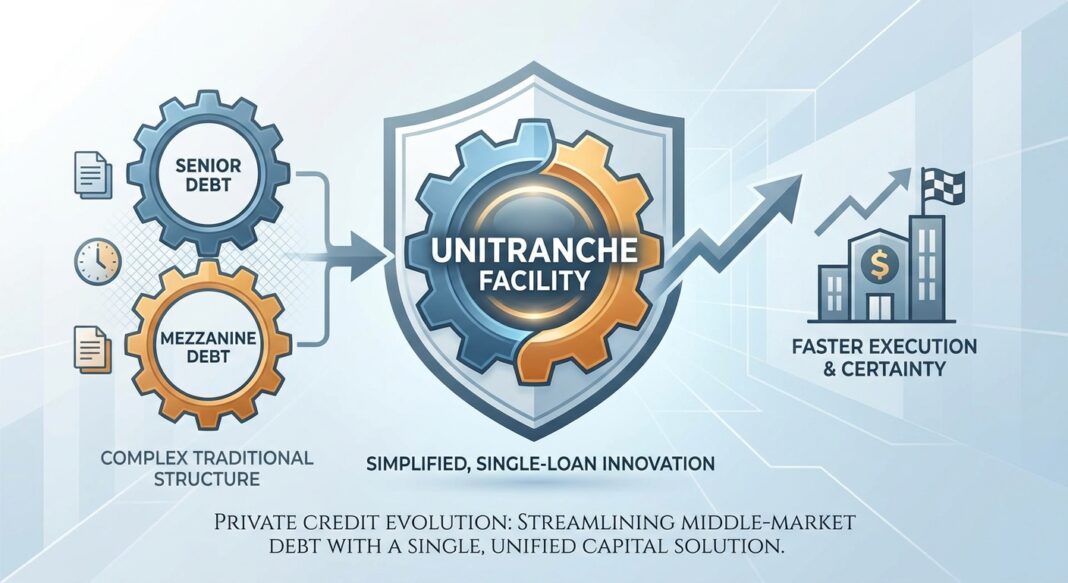
Why the Old Way of Borrowing No Longer Works for the Middle Market
Imagine closing an acquisition that requires both senior and mezzanine debt. In the traditional structure, you negotiate separately with a senior bank and a junior lender, reconcile two sets of covenants, coordinate two legal teams, and then manage an intercreditor agreement that dictates which lender controls the deal if things go sideways. The clock is ticking, your seller is impatient, and your total transaction cost is climbing. This is precisely the problem that the unitranche loan was designed to solve, and it has become the dominant financing structure for acquisitions in the $25 million to $200 million enterprise value range.
Unitranche is no longer a niche product. It represents the structural backbone of modern private credit. Understanding how it works (and where its trade-offs lie) is essential for both investors evaluating direct lending funds and business owners seeking growth or acquisition capital in 2026.
What Is a Unitranche Loan?
Unitranche financing combines what would traditionally be separate senior and subordinated debt into a single credit facility, governed by one credit agreement, carrying one blended interest rate, and secured by a single shared lien on the borrower’s assets. Rather than negotiating with two lender groups under two separate legal documents, the borrower deals with one counterparty (typically a direct lender or a small club of direct lenders) and signs one covenant package.
The innovation that makes this possible is called the Agreement Among Lenders (AAL). When multiple lenders participate in a unitranche facility, the AAL is a confidential, borrower-invisible contract that sits beneath the surface and allocates economic rights and control. It divides participants into first-out lenders (who receive priority of payment, accept lower yields, and bear less risk) and last-out lenders (who accept higher risk and demand higher yields in return). The borrower sees only one loan at one blended rate; lenders internally negotiate who gets paid first in a waterfall scenario.
As the American Bar Association (2025) explains, within this single facility all lenders share one lien, yet the AAL, not lien priority, dictates the economic and control rights of each lender group, including payment allocation, voting, and remedies. The AAL is highly customizable; no two transactions are identical.
How It Works: A Concrete Example
Consider a private equity sponsor acquiring a regional HVAC services business with $8 million in EBITDA at a 7x multiple, implying a $56 million enterprise value. The sponsor contributes 40% equity ($22.4 million) and needs $33.6 million in debt, roughly 4.2x leverage.
Under a traditional two-tranche structure, the borrower might source $22 million in senior bank debt (priced at SOFR + 275 bps) and $11.6 million in mezzanine (priced at 13–15%). That involves two term sheets, two closing processes, and an intercreditor agreement that could take 90–150 days to finalize.
Under a unitranche structure, one direct lender (say, a platform like Ares or Blue Owl) provides the full $33.6 million in a single facility priced at SOFR + 575 basis points. With 3-month Term SOFR at approximately 3.69% in June 2026 (per Valuation Research Corp., Q2 2026), the all-in rate is approximately 9.25%. The closing timeline compresses to 45–90 days. The borrower pays slightly more on a blended basis than pure senior bank debt but far less than a senior/mezz stack, and gains speed, simplicity, and certainty of execution.
Internally, the lender may sell the first-out portion to a bank partner at SOFR + 275 bps while retaining the last-out at a higher yield, a structure the borrower never directly manages.
Current Market Relevance
Unitranche has evolved from a niche middle-market tool into an institutional-grade product at the center of the private credit ecosystem. Here is what the current data tells us:
| Metric | Data Point | Source |
|---|---|---|
| LMM Unitranche Spread (2026) | SOFR + 500–700 bps | CT Acquisitions, Q2 2026 |
| Unitranche Market Issuance Growth | ~$20B (2015) → $200B+ (2025) | CT Acquisitions, Q2 2026 |
| Private Credit Global AUM | $2+ trillion; projected $4.5T by 2030 | Preqin, 2026 / S&P Global MI, Nov 2025 |
| Spread Widening Since Late 2025 | +50–100 bps; improving credit structures | Lord Abbett / PitchBook, June 2026 |
| Bank C&I Lending Standards Q1 2026 | Tighter for all firm sizes | Federal Reserve SLOOS, April 2026 |
| Cov-Lite Share of Direct Lending (2025) | 21% of deals (up from 4% in 2023) | McKinsey / Proskauer via PitchBook, 2026 |
The macroeconomic backdrop is accelerating unitranche adoption on two fronts. First, bank lending constraints persist: the Federal Reserve’s April 2026 SLOOS reported tighter standards across all C&I loan categories in Q1 2026, with banks citing higher premiums on riskier loans, stricter covenants, and lower maximum credit line sizes. This effectively pushes middle-market borrowers, especially those below investment grade, toward non-bank alternatives.
Second, private credit lenders have gained pricing power after years of aggressive competition. According to Lord Abbett’s 2026 Midyear Outlook (citing PitchBook data), spreads have widened roughly 50–100 basis points since late 2025, and new loans are increasingly coming with “better credit structures: less leverage, more covenants, fewer PIK requests, and tighter documentation.” This is a meaningful structural improvement from the borrower-friendly environment of 2022–2024.
The scale of leading platforms reinforces how institutionalized the market has become. CT Acquisitions (Q1 2026) reports that Apollo Global Management leads with approximately $600 billion in credit AUM, followed by Ares Management at $464 billion and Blackstone Credit & Insurance at $354 billion, figures that reflect the migration of institutional capital into private credit structures where unitranche is the primary origination vehicle.
Decision Framework
For Investors Evaluating Direct Lending Funds
- Assess first-out vs. last-out exposure: When analyzing a BDC or direct lending fund, consider whether the fund holds predominately first-out positions (lower yield, higher security) or last-out positions (higher yield, subordinated in stress scenarios). This distinction is not always visible in headline yield figures.
- Examine covenant quality: The post-2025 lender-friendly reset means newer vintages carry meaningfully stronger covenant packages than 2022–2024 deals. Investors may consider evaluating the covenant composition of a fund’s portfolio by vintage year.
- Leverage the AAL as a credit signal: In well-structured deals, the AAL creates a clear waterfall that mimics senior/mezzanine protection without dual documentation complexity. Understanding how a manager negotiates AAL terms (particularly standstill provisions and buyout rights) is a meaningful indicator of credit discipline.
- Watch liquidity risks: Valuation Research Corp. (Q2 2026) noted that investors withdrew approximately $1.8 billion from the ten largest direct lending funds in Q1 2026 amid credit quality concerns, with many funds operating near their redemption limits. Semi-liquid structures carry real liquidity constraints.
For Business Owners & Operators Seeking Capital
- Evaluate unitranche when speed and certainty matter most: For acquisition financing in the $25–200 million enterprise value range, unitranche typically closes in 45–90 days versus 90–150 days for broadly syndicated alternatives, according to CT Acquisitions (2026).
- Model the true all-in cost: Headline pricing of SOFR + spread understates total cost. Operators may consider factoring in original issue discount (OID), upfront fees, amendment fees, and prepayment penalties when comparing unitranche against bank alternatives.
- Bank tightening creates a structural window: As traditional bank C&I lending standards remain elevated, businesses that were historically eligible for bank financing may find private credit, including unitranche, to be a practical and increasingly competitive alternative, particularly for leveraged acquisitions or situations with non-standard collateral.
- Know when unitranche does not fit: For deals below $15–25 million in debt quantum, SBA 7(a) or traditional senior bank debt often prices more favorably. For transactions above $300 million, broadly syndicated loans typically offer cheaper execution. Unitranche occupies a defined middle-market niche.
Key Takeaways
- Unitranche combines senior and subordinated debt into one facility with a single credit agreement, blended interest rate, and shared lien, simplifying what was previously a two-lender, two-document process.
- The Agreement Among Lenders (AAL) is the structural engine that allocates first-out and last-out economics privately between lenders, while the borrower sees only a single unified loan.
- Pricing in 2026 sits at SOFR + 500–700 bps for lower middle-market deals, translating to all-in rates of approximately 8–11% depending on leverage, business quality, and sponsor relationships.
- Bank tightening and private credit scale are converging tailwinds: The Fed’s April 2026 SLOOS confirms ongoing C&I tightening, while leading platforms such as Apollo, Ares, and Blackstone now collectively manage trillions in credit AUM, providing the capital depth to execute at scale.
- The market is shifting toward lenders: After a borrower-friendly 2022–2024 period, spreads have widened and credit structures have tightened since late 2025, a dynamic that may improve risk-adjusted returns for investors in newer-vintage direct lending funds.


