
The Evolution of Efficiency in Private Debt
For decades, middle-market companies seeking significant capital faced a fragmented process. To fund an acquisition or buyout, a borrower typically needed two distinct groups of lenders: a commercial bank to provide the low-cost senior debt (covering perhaps 50% of the value) and a mezzanine fund to provide the higher-risk, higher-cost junior capital (covering the next 20-30%).
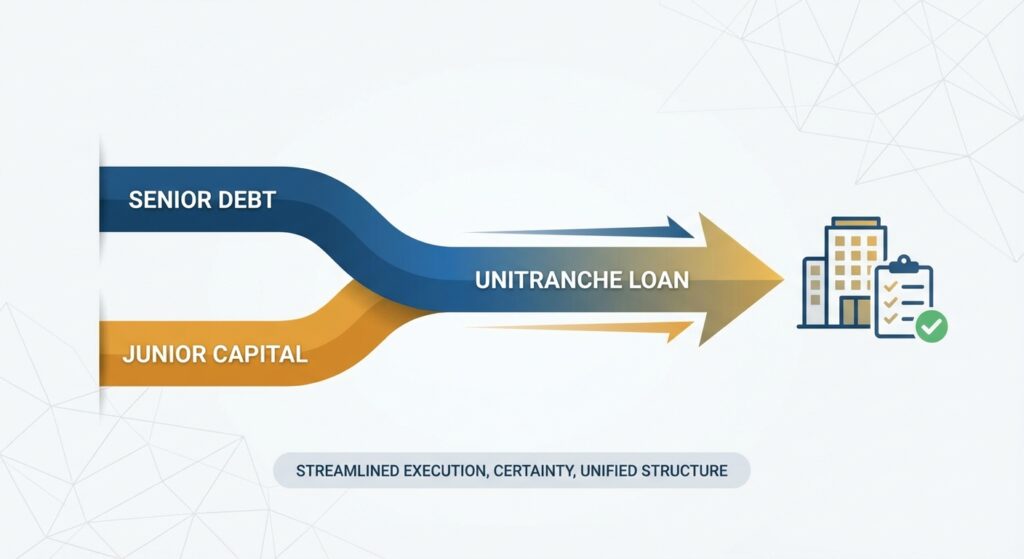
This “layering” process required negotiating two sets of legal documents, managing two different interest rates, and navigating potential conflicts between lenders via complex intercreditor agreements. Today, that friction has been largely replaced by a streamlined innovation: Unitranche Financing.
As private credit touches an estimated market size of $1.7 trillion, the unitranche facility has become the workhorse of the direct lending industry. It offers a critical lesson in how modern capital markets trade slight increases in cost for significant gains in speed, certainty, and structural simplicity.
The Concept: What is Unitranche Debt?
Unitranche debt is a hybrid loan structure that combines senior and subordinated debt into a single instrument. Instead of two loans with different terms and priority, the borrower receives one loan, with one interest rate, one set of covenants, and one amortization schedule.
From the borrower’s perspective, they deal with a single lender or a small “club” of lenders, removing the administrative burden of managing multiple creditor classes. The unitranche lender holds a first-lien position on the company’s assets, securing the entire loan amount. This differs from traditional mezzanine debt, which is typically unsecured or second-lien.
Behind the scenes, the unitranche lender may effectively keep all the debt on their own balance sheet, or they might synthetically split the risk with a partner through an “Agreement Among Lenders” (AAL), creating a “First Out” (lower risk) and “Last Out” (higher risk) tranche. Crucially, this internal slicing is invisible to the borrower.
How It Works: The “Blended Rate” Math
To understand the value proposition, we must look at the math of the Weighted Average Cost of Capital (WACC) within the debt stack.
Imagine a company needing $100 million in financing. Here is how the two structures compare:
Scenario A: The Traditional Siloed Approach
- Senior Loan (Bank): $70 million @ 8.0% interest.
- Mezzanine Loan (Fund): $30 million @ 14.0% interest.
- Result: The borrower manages two relationships. The blended interest cost is roughly 9.8%.
Scenario B: The Unitranche Solution
- Unitranche Facility: $100 million @ 10.5% interest.
- Result: The borrower pays a slightly higher rate (10.5% vs 9.8%) but gains significant operational advantages: faster closing, no inter-lender disputes during stress, and a single legal bill.
For the lender, the unitranche structure allows them to deploy more capital ($100M vs $30M) and secure the entire amount with a first lien on assets. While the risk is higher because the leverage attachment point is deeper (lending up to 100% of the debt capacity rather than just the top 30%), the lender is compensated with a premium yield on the entire balance, not just the risky portion.
Current Market Relevance
The shift toward unitranche financing correlates directly with the retreat of traditional banks from middle-market lending. According to Lord Abbett, private credit has grown largely because investors seek higher income and less market “noise” (volatility) than public markets offer. The unitranche product delivers exactly this steady income profile.
Data supports the dominance of this structure in the current cycle:
- Market Scale: The NAIC estimates the U.S. private credit market at approximately $1.3 to $1.7 trillion, with direct lending (unitranche) comprising the largest segment (approx. 40%).
- Yield Premiums: Private credit investments, including unitranche, provide yield premiums over public counterparts to compensate for illiquidity and complexity.
- Bank Retrenchment: Regulatory changes have forced banks to become more conservative, opening a void for non-bank lenders to offer these flexible senior debt solutions.
Decision Framework
When should investors and operators utilize this structure? It requires evaluating the trade-off between cost and control.
For Operators (Borrowers)
Choose Unitranche When:
- Speed is critical: You need to close an acquisition in 30-45 days, which is often too fast for a syndicated bank process.
- Complexity is high: The business has irregular cash flows or a complex story that a rigid bank credit committee might reject.
- Certainty of closing: You are willing to pay 50-100 basis points more in interest to guarantee the funds will be there at closing without a “market flex” clause.
For Investors
Evaluate Unitranche Based On:
- LTV Attachment Point: Does the loan represent 40% of the company’s value or 80%? A unitranche loan creates a “first dollar” risk exposure but also extends to the “last dollar” of debt.
- Covenant Strength: Because there is no junior lender to act as a buffer, the unitranche lender must have robust financial maintenance covenants to intervene early if performance dips.
- Yield vs. Risk: Ensure the blended yield adequately compensates for the risk of the whole facility, not just the senior portion.
Key Takeaways
- Simplification: Unitranche replaces the two-tiered Bank/Mezzanine structure with a single loan, rate, and document.
- Trade-off: Borrowers often pay a slight premium (higher blended rate) for increased speed, certainty, and ease of execution.
- Security: Lenders benefit from a first-lien position on all assets, unlike traditional mezzanine lenders who are subordinated.
- Market Dominance: As banks retreat due to regulation, unitranche has become the standard financing tool for middle-market private equity buyouts.
- Risk Management: For allocators, assessing the Loan-to-Value (LTV) attachment point is critical to understanding downside protection in these structures.


