
The Financing Challenge: Certainty vs. Cost
In the high-stakes environment of middle-market M&A, the primary friction point for sponsors often boils down to a single trade-off: speed versus cost. Traditional syndicated loan structures offers lower interest rates but introduce execution risk, rating agency delays, and “market flex” terms that can change pricing at the eleventh hour.
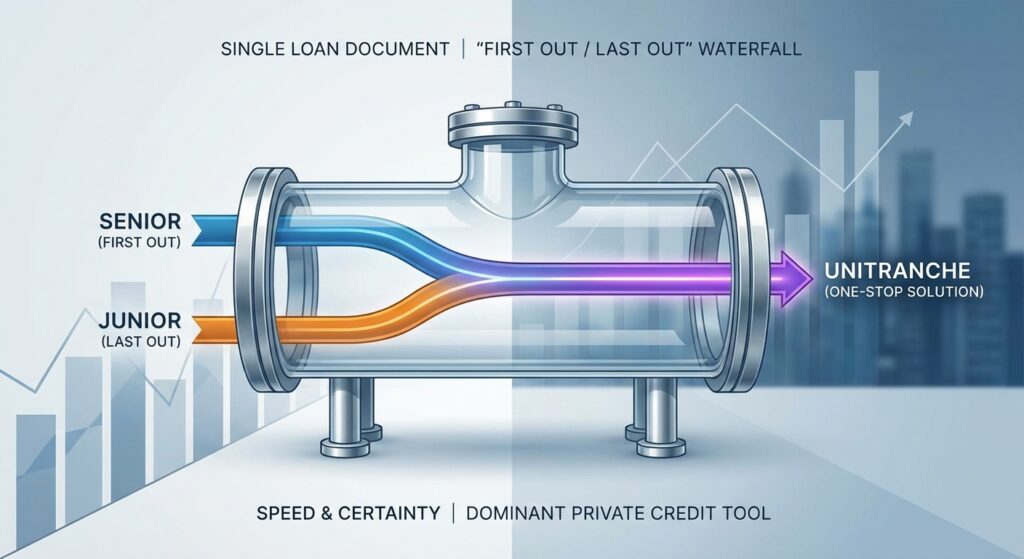
The unitranche facility answers this challenge by collapsing the capital stack. It offers a single loan document, a single interest rate, and a single counterparty, eliminating the intercreditor complexities of holding separate senior and junior debt. While borrowing costs are typically higher, often reflected in a “speed premium”, the structure has become the dominant financing tool for private equity sponsors valuing deal certainty.
Structure Breakdown: Mechanics of the “One-Stop” Shop
A unitranche loan blends senior and subordinated debt risk into one instrument. To the borrower, it appears as a singular term loan with a blended interest rate. However, behind the scenes, the structure is often bifurcated through an Agreement Among Lenders (AAL).
The “First Out / Last Out” Waterfall
While the borrower pays one rate (e.g., SOFR + 650 bps), the lenders split the risk and return internally:
- First Out (Senior) Tranche: Often held by a bank or low-cost capital provider. This tranche has priority in repayment and liquidation. It might earn SOFR + 450 bps.
- Last Out (Junior) Tranche: Held by a private credit fund or BDC. This tranche absorbs the first loss (after equity) and carries higher risk, earning a premium return (e.g., SOFR + 900 bps).
Detailed Example: Financing a $100M Acquisition
Consider a software company with $20M EBITDA being acquired for $200M (10x EV). The sponsor seeks 5.0x leverage ($100M debt).
| Term Sheet Element | Terms | Notes |
|---|---|---|
| Facility Size | $100M Unitranche Term Loan | Funded at close. |
| Pricing | SOFR + 6.25% (Cash) | Blended rate paid by borrower. |
| OID / Upfront Fee | 2.0% – 2.5% | Original Issue Discount reduces proceeds. |
| Amortization | 1.0% per annum | Minimal required principal payments. |
| Call Protection | 102 / 101 / Par | Hard prepay penalties for years 1 and 2. |
| Covenants | Adjusted Leverage Ratio | Usually a single maintenance covenant set with 25-30% headroom. |
In this scenario, the “First Out” lender might provide $60M of the capital, while the “Last Out” lender provides $40M. The AAL dictates that the First Out lender gets paid first in a default scenario, effectively simulating a first lien/second lien structure without the legal complexity of two credit agreements.
How It Compares: Unitranche vs. Syndicated Facilities
The unitranche structure is not always the optimal solution. It competes primarily with broadly syndicated loans (BSL) and traditional bank senior + mezzanine structures.
Speed and Execution
Unitranche deals can typically close 30 to 45 days faster than syndicated alternatives. There is no “roadshow,” no rating agency process, and no syndication risk. For a sponsor in a competitive auction, this certainty is worth paying for.
Cost Implications
Market data suggests a spread premium of approximately 50 to 100 basis points for unitranche over syndicated first lien options. The borrower pays this premium to avoid the “flex” language in syndicated deals, which allows arrangers to increase pricing if the debt doesn’t clear the market.
Contractual Simplicity
Managing a single credit agreement is operationally simpler than managing a Senior Facility and a Mezzanine Facility with an intercreditor deed. However, the AAL in a unitranche is a private contract between lenders; if the company enters bankruptcy, the enforceability of these agreements is less tested in court than standard intercreditor agreements.
Current Market Terms (2025/2026 Context)
Following the rapid growth of private credit, with assets under management reaching approximately $2.1 trillion in 2025, the market has settled into standardized terms for middle-market borrowers.
- All-in Yields: New private credit deals in the core middle market are seeing all-in yields in the 10% to 12% range, stabilizing after the rate hikes of previous years.
- Leverage Profiles: Total leverage for sponsored deals typically lands around 4.75x to 5.25x EBITDA. Lenders remain focused on interest coverage ratios and free cash flow rather than just gross leverage.
- Jumbo Unitranches: The market has seen a rise in “mega-unitranche” facilities exceeding $2 billion, allowing private lenders to displace public high-yield bond markets for larger issuers.
Structuring Guidance & Negotiation
For Operators and Borrowers:
When negotiating a unitranche, focus on incremental facilities (accordions). Since unitranche lenders usually intend to hold the debt to maturity, ensure the document allows for easy “add-ons” to finance future acquisitions without needing a full refinancing. Additionally, scrutinize the definition of EBITDA carefully; private lenders may allow more generous “add-backs” than regulated commercial banks.
For Investors and Lenders:
The “Call Protection” is critical. Because unitranche lenders are not trading the paper, they rely on yield maintenance. A standard structure is NC-1, 102, 101 (Non-callable for year 1, 2% penalty year 2, 1% penalty year 3). Lenders should also ensure the AAL clearly defines “voting rights” for waivers and amendments, specifically protecting the “Last Out” holder from being outvoted on material changes that erode their subordination protection.
Key Takeaways
- Speed Premium: Borrowers pay ~50-100 bps more for execution speed (30-45 days faster) and deal certainty.
- Hidden Bifurcation: The “Agreement Among Lenders” (AAL) creates synthetic seniority (First Out/Last Out) behind a single borrower-facing document.
- Market Depth: “Jumbo” unitranches ($1B+) are now viable alternatives to the liquid high-yield markets.
- Covenant Headroom: Generally looser than bank deals, often limited to a single leverage maintenance covenant.
- Relationship Focus: One lender (or a small club) simplifies post-close modifications and M&A add-ons.


