
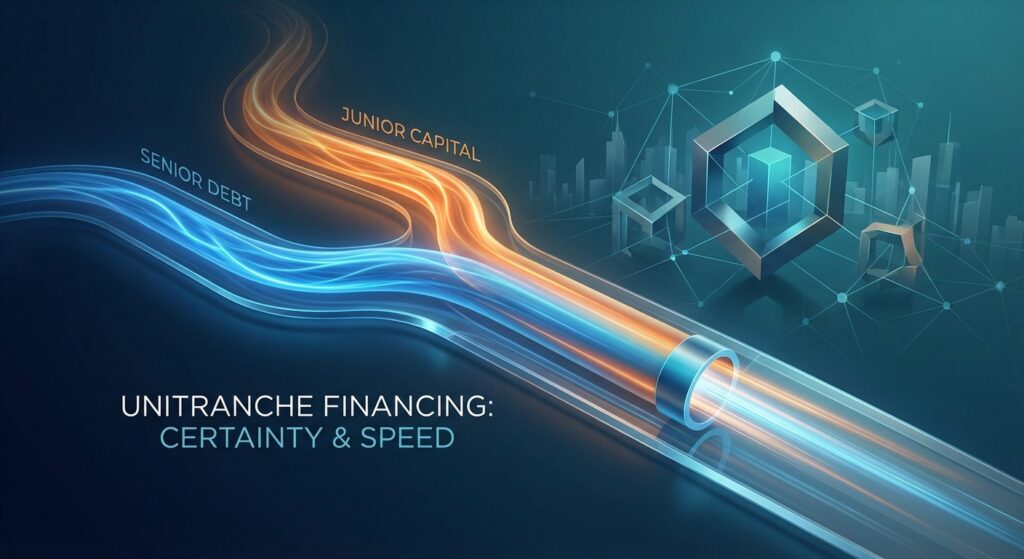
In the high-velocity environment of 2026 middle-market M&A, the financing structure often dictates the winning bid. While traditional bank syndication offers the lowest cost of capital, it rarely offers the speed or certainty required in competitive auctions. The solution dominating the landscape is the Unitranche Facility.
Unitranche financing creates a single layer of senior secured debt that blends the risk and return of traditional senior and junior capital. By 2024, unitranche issuance in the U.S. middle market reached a record $210 billion, signaling a permanent shift away from bifurcated structures for sub-$500M enterprise value deals. For operators and sponsors, understanding the mechanics “under the hood” of these facilities is essential to negotiating flexibility.
The Anatomy of a Unitranche Deal
At its core, a unitranche facility combines senior debt and subordinated debt into one loan document with a single interest rate and repayment schedule. To the borrower, it appears as a single senior term loan. However, behind the scenes, an Agreement Among Lenders (AAL) bifurcates the loan into tranches with different risk profiles.
Structuring Example: Project Alpha
Consider “Project Alpha,” a software company with $100M Enterprise Value and $10M EBITDA, seeking $55M in leverage (5.5x) for a buyout.
- Facility Size: $55 Million Term Loan
- Blended Pricing: SOFR + 550 basis points (bps)
- Amortization: 1% per annum
- LTV: 55%
While the borrower pays a flat SOFR + 5.50%, the lenders may split the risk via an AAL:
- First Out (FO) Tranche ($30M): Held by a commercial bank. Lower risk, lower return (e.g., SOFR + 350 bps).
- Last Out (LO) Tranche ($25M): Held by a private credit fund. Higher risk, higher return (e.g., SOFR + 800 bps).
The “First Out” lender gets paid first in a liquidation scenario, justifying their lower return. The “Last Out” lender takes the junior risk but captures the excess spread. The borrower benefits by avoiding the complexity of negotiating with two separate lender groups.
Unitranche vs. Senior-Mezzanine: The Trade-Offs
The primary alternative to unitranche is a traditional Senior-Mezzanine structure, where a bank provides senior debt (First Lien) and a specialized fund provides junior capital (Second Lien or Unsecured Mezzanine).
1. Speed and Certainty
Data from mid-2025 indicates a median “sign-to-fund” timeline of 45 days for unitranche deals, compared to 70 days for senior-mezzanine structures financienly-group.com. Senior-mezz requires two separate credit committees and the negotiation of a complex Intercreditor Agreement, creating execution risk.
2. Cost vs. Dilution
Senior-mezzanine structures can sometimes offer a lower weighted average cost of capital (WACC) if the bank portion is large enough. However, mezzanine debt often requires equity warrants (commonly 5-15% coverage) to juice returns. Unitranche facilities typically do not require warrants, preserving equity upside for the sponsor and management.
3. Covenant Flexibility
Unitranche lenders are generally unregulated credit funds that offer more flexibility than commercial banks. While they may still require a maintenance covenant (e.g., Total Net Leverage not to exceed 6.0x), they are less likely to react aggressively to temporary performance dips compared to a regulated bank senior lender.
Current Market Terms (2025-2026)
As of early 2026, the market has stabilized following the rate volatility of previous years. Standard terms for middle-market unitranche facilities include:
- Pricing Spreads: SOFR + 475 to 575 bps.
- Upfront Fees: 1.5% to 2.0% of the facility amount.
- Leverage (LTV): 55% to 65% Loan-to-Value.
- Call Protection: Typically “Soft Call” protection (101) for 12 months, whereas mezzanine debt often carries expensive “Hard Call” premiums for multiple years.
Notably, the volume of these deals has surged, with estimates showing a significant jump in issuance year-over-year as private credit funds deploy record levels of dry powder jdsupra.com.
Negotiation & Structuring Strategy
For Operators and Borrowers
- Negotiate the “Accordion”: Ensure the facility includes an uncommitted incremental facility (accordion) permitting you to raise additional debt for acquisitions up to a certain leverage cap (e.g., 1.0x turn of freebie basket) without restating loan documents.
- Focus on “Add-backs”: The definition of EBITDA dictates your covenant headroom. detailed negotiation of “pro forma cost savings” and “synergies” is often more valuable than fighting for a 25 bps reduction in spread.
For Investors and Lenders
- Analyze the AAL: If participating in a syndicated unitranche, understand the “voting rights.” Does the First Out lender have a veto on enforcement actions? In a bankruptcy, does the Last Out lender have “purchase rights” to buy out the senior position?
- Documentation Risk: Watch for “trap doors” that allow assets to be transferred to unrestricted subsidiaries, stripping collateral value away from the main credit facility.
Key Takeaways
- Unified Execution: Unitranche offers a single loan document and one agent, reducing closing timelines by ~35% compared to multi-layered debt.
- Blended Cost: While headline rates (SOFR+550) seem higher than senior bank debt, the blended cost is competitive when factoring in the elimination of expensive mezzanine warrants.
- No Intercreditor Wars: The borrower is insulated from lender infighting; risk allocation is handled privately via the Agreement Among Lenders (AAL).
- Scalability: Private credit funds holding unitranche debt are often better equipped to provide follow-on capital for buy-and-build strategies than traditional banks.
- Market Standard: With over $200B in annual volume, unitranche is now the default structure for sponsor-backed middle-market LBOs.


