
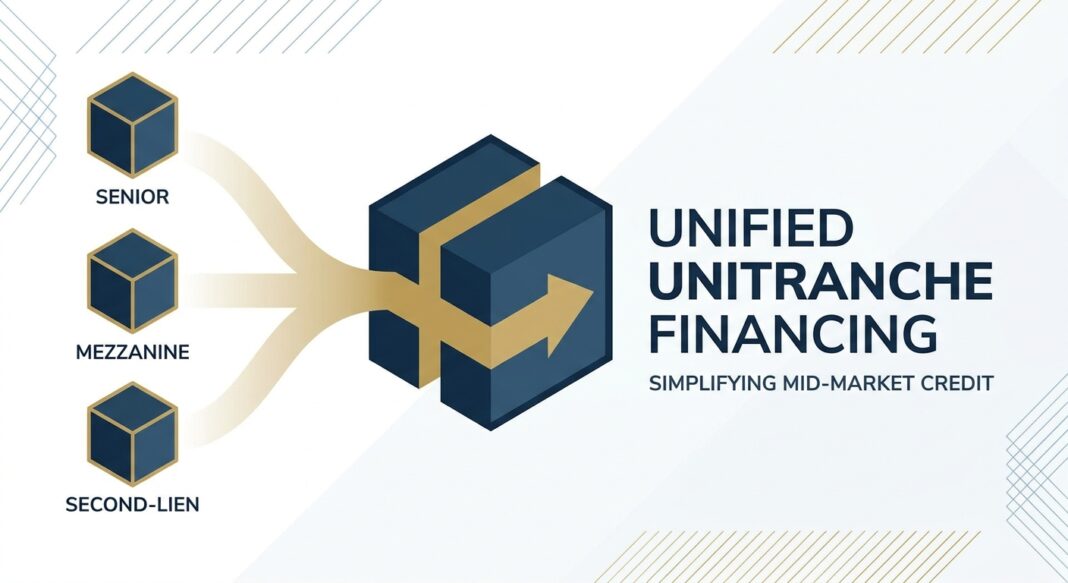
One Loan, One Relationship, One Decision
When a private equity sponsor needs to finance a middle-market buyout, the traditional playbook involves assembling multiple creditor groups (a senior bank syndicate, a mezzanine provider, sometimes a second-lien lender) each with their own term sheets, covenants, pricing grids, and legal documents. The negotiation is complex, the timeline is long, and the intercreditor agreement alone can become a contentious, months-long exercise.
The unitranche structure cuts through all of that. From the borrower’s perspective, it is a single loan, a single interest rate, and a single lender relationship. From the market’s perspective, it has become the dominant debt product for private equity-backed mid-market transactions, and understanding exactly how it works is essential for any investor evaluating private credit funds or any operator weighing their financing options.
This article explains the mechanics of unitranche financing, walks through a concrete numerical example, and connects the structure to the current private credit market conditions shaping pricing and deployment in mid-2026.
What Is a Unitranche Loan?
Unitranche debt is a single-facility structure that combines what would traditionally be separate senior and subordinated debt layers into one loan, governed by one credit agreement, carrying one blended interest rate, and maintained with one lender relationship. As PipelineRoad’s Capital Raising Glossary (March 2026) explains, the entire capital structure below equity collapses into a single instrument; there is no intercreditor agreement for the borrower to negotiate.
Behind the scenes, however, the economics are often divided. In a bifurcated unitranche, the lending group uses an Agreement Among Lenders (AAL): a private document, typically invisible to the borrower, to split the single loan into a first-out (FO) tranche and a last-out (LO) tranche. According to Global Legal Insights (January 2026), the AAL governs the relationship between first-out and last-out lenders, specifying payment waterfalls, allocation of fees and interest, voting rights, lien priorities, and enforcement rules.
The first-out lender receives priority of payment and lower risk, comparable to a traditional senior secured position. The last-out lender absorbs more risk and earns a higher spread in return, economically similar to a mezzanine position, but documented inside a single senior lien rather than as a separate subordinated instrument.
A simpler variant, the stretch senior unitranche: functions like a traditional Term Loan B but extended to higher leverage multiples, with all lenders sharing ratable payment rights rather than a first-out/last-out split.
How It Works: A Concrete Example
Consider a hypothetical mid-market software business, call it TechCo, generating $20 million in EBITDA. A private equity sponsor wants to acquire TechCo at a 10x EBITDA multiple, or $200 million enterprise value. The deal structure might look like this:
- Purchase price: $200 million
- Unitranche loan (5.0x leverage): $100 million at SOFR + 550 bps
- Equity contributed by sponsor: $100 million (50% of deal value)
In a traditional layered structure, this $100 million might be split into a $70 million senior term loan at SOFR + 300 bps and a $30 million mezzanine tranche at a fixed 13–14%. The borrower must manage two separate lender groups, two sets of covenants, and an intercreditor agreement that governs who controls enforcement in a default scenario.
Under the unitranche model, TechCo sees only one loan at a blended rate, say SOFR + 550 bps, implying roughly 10–11% all-in at current base rates. Behind the AAL, the arranging lender may allocate the first $70 million to first-out lenders at SOFR + 425 bps, and the remaining $30 million to last-out lenders at SOFR + 775 bps. The blended economics balance out; the borrower is insulated from this internal negotiation entirely.
The practical benefits are immediate. Private Capital Global (September 2025) notes that private credit can close within four weeks while bank-syndicated deals may require six to eight weeks, a speed advantage that sponsors routinely price at 50 to 100 basis points of extra spread to protect purchase agreement timelines.
Current Market Relevance
Unitranche has moved from a niche innovation to the backbone of mid-market buyout finance, and the current environment is testing both its pricing dynamics and its structural resilience.
Spread Environment: After a prolonged period of spread compression, pricing is beginning to re-widen. According to McKinsey’s Global Private Markets Report (June 2026), global new-issue direct loan median spreads fell from a peak of 716 basis points in March 2023 to 544 basis points at year-end 2025. However, PitchBook (March 2026) reports that conditions are now becoming more lender-friendly, pointing to a $4.815 billion unitranche financing for WWEX Group that priced at SOFR + 575, meaningfully wider than late-2024 deals.
Bank Tightening as a Structural Tailwind: The bank lending environment continues to funnel borrowers toward private credit. The Federal Reserve’s April 2026 SLOOS reported tighter standards for commercial and industrial loans across firms of all sizes during Q1 2026, with banks citing higher premiums on riskier loans, stricter covenants, and shorter maximum maturities. This sustained tightening reinforces the structural case for unitranche lenders as an alternative to the bank channel.
Market Scale: The private credit industry underpinning these deals has reached significant scale. S&P Global Market Intelligence (November 2025) reports that private credit AUM is expected to grow from approximately $2.28 trillion in 2025 to $4.5 trillion by 2030, according to Preqin projections. Major platforms are scaling rapidly: Ares Management reported private credit AUM of $391.5 billion as of Q3 2025, up 22% year-over-year in 2024.
Covenant Evolution: Documentation has shifted. McKinsey (June 2026) notes that covenant-lite transactions rose to 21% of direct lending deals in 2025, up from just 4% in 2023, a sign of how competitive deal dynamics have pressured lender protections, particularly at the upper end of the market where private credit competes directly with broadly syndicated loans.
Default Outlook: Northleaf Capital (May 2026) projects the annualized private credit default rate to rise modestly from 1.5% in 2025 to 2.0% by year-end 2026, with credit risk remaining largely idiosyncratic and concentrated in select sectors and certain 2021 vintage deals.
| Metric | Value | Source |
|---|---|---|
| Global direct lending median spread (YE 2025) | 544 bps | McKinsey, Jun 2026 |
| WWEX Group unitranche pricing (Q1 2026) | SOFR + 575 bps | PitchBook, Mar 2026 |
| Private credit AUM estimate (2025) | ~$2.28 trillion | S&P Global / Preqin, Nov 2025 |
| Covenant-lite share of direct lending deals (2025) | 21% (vs. 4% in 2023) | McKinsey / Proskauer, Jun 2026 |
| Projected private credit default rate (YE 2026) | ~2.0% | Northleaf / KBRA, May 2026 |
Decision Framework
For Investors Evaluating Private Credit Funds
Investors considering exposure to unitranche strategies typically evaluate several dimensions. First, where in the AAL does the fund sit? A fund holding predominantly first-out positions has meaningfully different risk-return characteristics than one concentrated in last-out paper, even though both hold the same senior lien on paper. First-out investors consider their de facto position similar to senior secured lending; last-out investors are absorbing leveraged credit risk closer to mezzanine. Transparency around this split matters when evaluating a fund’s stated loss history.
Second, investors consider vintage and spread entry point. Unitranche loans originated in 2021 at sub-SOFR+500 spreads face very different coverage dynamics than 2026 deals pricing at SOFR+550–575. Evaluating a manager’s average portfolio spread and interest coverage ratio across vintages is central to assessing downside scenarios.
Third, manager scale and market access increasingly determine deal quality. As McKinsey’s 2026 data indicates, the top 25 managers captured approximately 72% of private credit fundraising in 2025: larger platforms can hold bigger single-name positions, access deal flow earlier, and negotiate stronger documentation.
For Operators and Business Owners
For a business owner or CFO evaluating financing, the unitranche’s primary value proposition is simplicity and speed. Operators evaluating a unitranche consider: the all-in cost relative to a multi-lender bank structure; the value of a single point of contact for amendments and waivers; and whether the flexibility of private credit documentation, including potentially fewer financial maintenance covenants, outweighs the pricing premium over investment-grade bank facilities.
Operators in growth or acquisition mode also weigh the incremental leverage a unitranche can provide. A bank senior facility might be available up to 3.5–4.0x EBITDA; a unitranche from a direct lender may extend to 5.0–6.0x, unlocking additional acquisition capacity without issuing equity and diluting existing shareholders.
Key Takeaways
- Unitranche simplifies borrower experience: One loan, one rate, one relationship, no intercreditor negotiation and no multiple creditor groups for operators to manage.
- The AAL is the hidden architecture: Behind most unitranche deals, a private Agreement Among Lenders divides the economics into first-out (lower risk, lower return) and last-out (higher risk, higher return) positions, critical context for any investor evaluating a private credit fund’s actual risk profile.
- Spreads are re-widening after years of compression: After declining from 716 bps in 2023 to 544 bps at year-end 2025, pricing momentum has shifted, recent large deals are printing above SOFR+550, improving the entry-point for new direct lending capital.
- Bank tightening remains a structural tailwind: The Federal Reserve’s April 2026 SLOOS confirms continued tightening of C&I lending standards, reinforcing the market gap that unitranche lenders are structurally positioned to fill.
- Covenant evolution demands manager due diligence: With covenant-lite deals rising to 21% of direct lending volume in 2025, investors should scrutinize documentation quality, not all unitranche loans carry equivalent lender protections, even within the same fund.


