
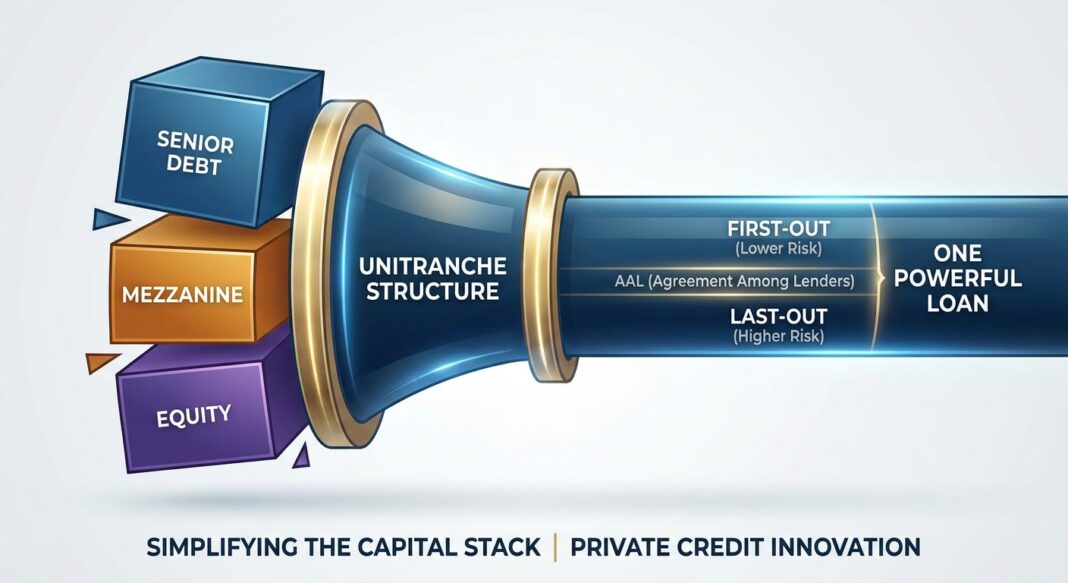
One Loan, One Rate, One Closing Table, But the Complexity Doesn’t Disappear
Somewhere between a senior bank loan and a subordinated mezzanine note lives one of the most important innovations in modern private credit: the unitranche. For business owners seeking growth capital and institutional investors deploying into direct lending, understanding how unitranche structures work (and what risks they actually carry) is no longer optional. It is table stakes.
The unitranche has become the defining instrument of the private credit era. As of mid-2026, coupon spreads on new unitranche issuance generally range from 4.75% to 5.50% over the floating benchmark, roughly 25 basis points wider than year-end 2025 levels. Meanwhile, the asset class itself has crossed $2 trillion in U.S. AUM per Preqin, with unitranche structures dominating new deal flow. To evaluate or use this instrument intelligently, you first need to understand what it actually is, and what it is not.
What a Unitranche Loan Actually Is
A unitranche is a single secured credit facility in which two or more groups of lenders share the same security interest on a borrower’s collateral, but agree among themselves, privately, on payment priority and risk allocation. The borrower sees one loan, one agent, one interest rate, and one set of documents. The complexity lives backstage.
That backstage document is called an Agreement Among Lenders (AAL). According to Mayer Brown (July 2026), the AAL divides lenders into two groups: first-out lenders, who receive priority in repayment and accept a lower yield, and last-out lenders, who absorb losses first in a default scenario and in exchange earn a higher return. The borrower may owe a single blended rate to the entire lender group, even though the economics each lender receives differ substantially based on their position in the AAL waterfall.
It is critical to understand one distinction: a unitranche is not the same as a traditional first lien/second lien arrangement. In a classic two-lien deal, two separate liens exist on collateral, governed by a public intercreditor agreement between two distinct secured parties. In a unitranche, there is only one lien, the internal priority split is a private contractual arrangement invisible to the borrower and most third parties.
What makes unitranche attractive to direct lenders is yield capture. As noted by Brinley Partners (February 2026), the structure lets direct lenders capture yield that historically flowed to separate mezzanine funds, while retaining first-lien security and control of the single credit agreement.
How the Numbers Work: A Concrete Example
Consider a private equity sponsor acquiring a regional manufacturing business for $100 million. The sponsor contributes $40 million in equity (40% of enterprise value) and finances the remaining $60 million with a unitranche facility.
The unitranche facility is structured with two internal tranches via the AAL:
- First-Out Tranche ($20 million): Priced at SOFR + 350 bps. These lenders (often a bank or a conservative direct lender) get paid first from any cash flow or liquidation proceeds. Lower risk, lower return.
- Last-Out Tranche ($40 million): Priced at SOFR + 650 bps. These lenders, typically private credit funds, absorb losses before the first-out group. Higher risk, higher return.
- Blended Borrower Rate: The business makes one payment at approximately SOFR + 550 bps. With three-month Term SOFR at roughly 3.69% as of June 2026 (per Valuation Research Corp., July 2026), the all-in coupon is approximately 9.2%.
If the business is later sold in distress for $70 million, enough to cover the $60 million debt but not a full recovery, all lenders are made whole because the equity cushion absorbed the first $30 million of value erosion. The unitranche structure only begins to show its internal complexity if the business is sold for less than $60 million, at which point the last-out tranche suffers losses before the first-out tranche takes any hit.
This example illustrates why the equity cushion beneath the unitranche, in this case 40% of enterprise value, matters enormously to every lender in the structure, regardless of their first-out or last-out designation.
Current Market Relevance
Unitranche is no longer a niche innovation; it is the dominant structure in private credit deal-making, and the current data tells a compelling story.
| Metric | Data Point | Source |
|---|---|---|
| Unitranche spread range (Q2 2026) | 475–550 bps over SOFR | Valuation Research Corp., July 2026 |
| Spread widening since late 2025 | ~50–100 bps wider | Lord Abbett / PitchBook, June 2026 |
| Average private unitranche coupon (end-2025) | ~9.00% | KBRA / Brinley Partners, Feb 2026 |
| CDLI 2025 total return (direct lending benchmark) | 9.3% (20-yr avg: 9.5%) | Cliffwater CDLI, March 2026 |
| U.S. private credit AUM (2025) | Crossed $2 trillion | Preqin / CT Acquisitions, July 2026 |
A key macro driver of unitranche volume is the sustained tightening of traditional bank lending. The Federal Reserve’s April 2026 SLOOS reported that banks continued to tighten standards across commercial and industrial loans in Q1 2026, with significant net shares of institutions also reporting stricter covenants, higher premiums on riskier loans, and shorter maximum maturities for non-bank financial institution (NDFI) loans. When banks retreat, private credit advances, and the unitranche is the vehicle that captures the largest share of that displaced demand.
The scale of recent transactions illustrates the maturation of the product. According to PitchBook (March 2026), a single Thoma Bravo-backed transaction secured a $4.815 billion unitranche facility with Ares Capital as administrative agent and a 33-lender club including Blackstone, Blue Owl, Apollo, and Oaktree. Deals at this scale were once the exclusive domain of syndicated bank markets. That boundary no longer holds.
Covenant discipline is also shifting. McKinsey’s 2026 Global Private Markets Report found that covenant-lite transactions rose to 21% of direct lending deals in 2025, up sharply from just 4% in 2023, a sign that competition for deal flow is gradually eroding some structural protections, particularly at the upper end of the market.
Decision Framework
For Investors Evaluating Unitranche Exposure
- Understand your position in the AAL. Investors in a direct lending fund may hold last-out exposure without clear disclosure in headline documents. Review fund-level transparency on AAL position before allocating.
- Assess the equity cushion first. The blended rate is only as reliable as the equity buffer below the debt. A unitranche at 55% loan-to-value (LTV) carries fundamentally different risk than one at 75% LTV, regardless of how the first-out/last-out split is drawn.
- Compare blended yield to standalone mezzanine alternatives. A last-out tranche earning SOFR + 650 bps inside a unitranche should be compared to standalone mezzanine funds on both yield and covenant quality before concluding the unitranche offers superior risk-adjusted return.
- Monitor the covenant-lite trend. As covenant-lite deals rise as a share of the market, the early-warning system for borrower deterioration weakens. Investors evaluate whether managers have built operational monitoring capacity to compensate.
For Business Owners and Operators Considering Unitranche Financing
- Speed and certainty have a price. Unitranche pricing sits above a plain senior bank loan precisely because it packages junior risk inside one wrapper. Operators weigh the premium against the value of a faster, simpler close, particularly in competitive acquisition timelines.
- One relationship, one negotiation. Unlike a bifurcated first lien/second lien structure requiring separate lender negotiations and intercreditor agreements, unitranche means one agent and one set of covenants. This simplifies ongoing management, amendment requests, and refinancing discussions.
- Understand the amendment process under the AAL. Even though the borrower faces one document, the lenders’ internal AAL may create veto dynamics between first-out and last-out parties in a workout scenario. Operators who understand this dynamic are better positioned in restructuring conversations.
Key Takeaways
- One loan, layered risk: Unitranche presents the borrower with a single blended rate and one lender relationship, but internally divides risk and return between first-out and last-out lenders via a private Agreement Among Lenders, complexity the borrower never sees directly.
- Pricing reflects junior risk: With Q2 2026 unitranche spreads ranging from approximately 475 to 550 bps over SOFR, unitranche consistently prices above senior-only bank loans because it incorporates subordinated risk inside a first-lien security wrapper.
- Bank withdrawal fuels unitranche volume: Continued tightening of bank C&I lending standards through 2025 and into 2026, as documented in successive Federal Reserve SLOOS surveys, has structurally expanded the addressable market for unitranche direct lenders.
- Scale has arrived: Multi-billion-dollar unitranche transactions, once unthinkable outside syndicated markets, are now routine among large private credit platforms. The top three managers (Apollo, Ares, Blackstone) collectively oversee more than $1.4 trillion in credit AUM, enabling participation in the largest single-lender financings.
- Covenant-lite is a watch item: As covenant-lite provisions reach 21% of direct lending deals in 2025, investors and operators alike consider what protections remain, and what monitoring infrastructure managers have built to identify borrower stress before formal default triggers.


