
When the Capital Stack Gets Too Complicated
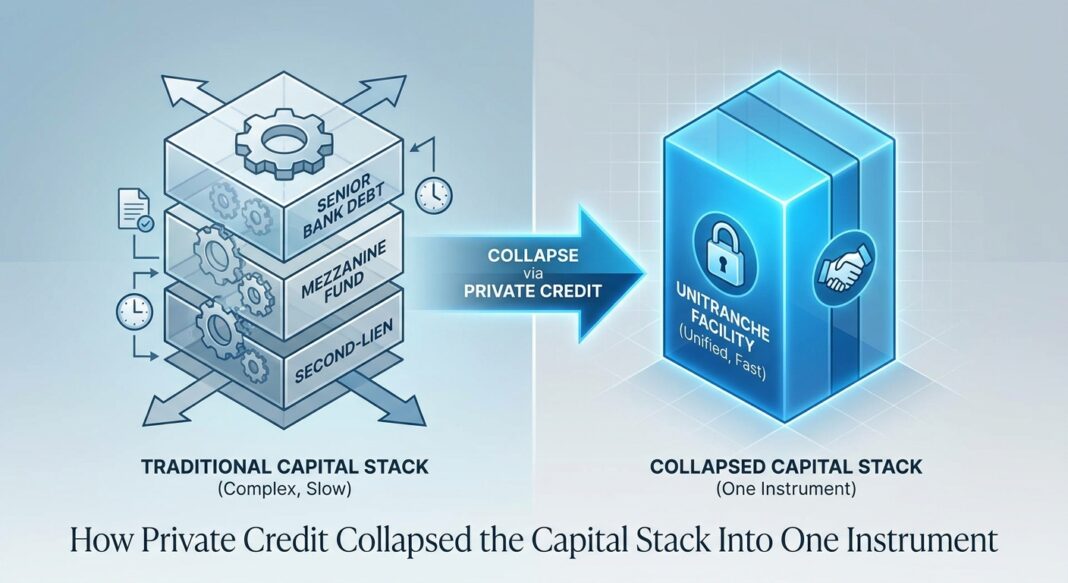
Imagine you are a private equity sponsor trying to close a $100 million leveraged buyout in 45 days. The traditional path requires negotiating separate credit agreements with a senior bank lender, a mezzanine fund, and occasionally a second-lien lender: three sets of lawyers, three sets of covenants, and an intercreditor agreement governing who gets paid first if things go wrong. Each relationship introduces friction, delay, and risk of a broken deal.
Now imagine instead that a single private credit fund offers you the entire debt package under one loan agreement, one interest rate, and one set of terms. That is the core innovation of unitranche financing, and it has become the dominant instrument reshaping how mid-market companies access capital in 2026.
This article explains exactly how unitranche structures work, what they cost today, why banks have largely ceded this market to private credit funds, and how both investors evaluating private credit and operators seeking growth capital should think about this instrument.
What Is a Unitranche Loan?
Unitranche debt is a hybrid loan structure that consolidates what would otherwise be separate senior and subordinated debt tranches into a single credit facility, governed by a single credit agreement between the borrower and the lender (or a small club of lenders). The borrower sees one interest rate, one set of covenants, and one counterparty relationship.
According to Global Legal Insights (January 2026), unitranche loans have become the flagship product of the private credit market, particularly in the middle market and increasingly in large-cap transactions. The structure combines senior and subordinated debt into a single credit agreement, offering a blended interest rate and a unified set of loan documents.
Behind the scenes, many unitranche facilities are split into first-out (FO) and last-out (LO) components governed by an Agreement Among Lenders (AAL): a private document invisible to the borrower. The first-out lender holds priority in repayment, accepting lower yield in exchange for lower risk. The last-out lender absorbs losses first but earns a higher spread. The borrower experiences none of this complexity; it simply manages a single loan.
There are two primary unitranche variants. A stretch unitranche functions like a traditional Term Loan B but with higher permissible leverage. A bifurcated unitranche slices the loan into explicit first-out and last-out components with the AAL privately redistributing economics among lenders based on their priority position.
How It Works: A Concrete Example
Consider a hypothetical mid-market software business with $10 million in EBITDA being acquired for $80 million (8.0x EBITDA). A traditional financing structure might look like this:
- Senior bank debt: $40 million at SOFR + 300 bps (~7.3% all-in)
- Mezzanine debt: $20 million at 13–14% (cash + PIK)
- Equity: $20 million from the sponsor
The blended cost of debt is approximately 9.5–10%, but the borrower must manage two separate lender relationships, two sets of covenants, and an intercreditor agreement that can become contentious in a restructuring scenario.
A unitranche alternative collapses this into a single $60 million term loan from one private credit fund. According to CTA Acquisitions (Q2 2026), a typical lower-middle-market unitranche in 2026 prices at SOFR + 500–700 bps with Term SOFR at approximately 4.3%, producing an all-in current rate of 9.3–11.3% before original issue discount (OID) and fees. Unitranche loans typically carry 2–3% OID at funding, on a $60 million loan, the borrower receives approximately $58.2 million but owes $60 million in principal.
The all-in economics are slightly higher than the traditional structure, but the borrower gains substantial benefits: one negotiation, one closing, and critically, faster execution. As noted by Private Equity Bro (October 2025), if unitranche financing closes 30 to 45 days faster than a syndicated alternative, sponsors often justify 50 to 100 basis points of extra spread by avoiding financing gaps, broken syndications, or delayed closings that jeopardize purchase agreements.
Current Market Reality: Why Unitranche Has Never Been More Relevant
Several converging forces in 2025–2026 have made unitranche financing the default instrument for middle-market transactions.
Bank retrenchment is persistent and documented. According to the Federal Reserve’s April 2026 Senior Loan Officer Opinion Survey (SLOOS), banks reported tighter lending standards for commercial and industrial (C&I) loans to firms of all sizes during the first quarter of 2026. Notably, significant net shares of banks also reported tighter standards specifically for loans to business credit intermediaries and private equity funds, with higher risk premiums, stricter covenants, shorter maturities, and lower maximum credit line sizes all cited as tightened terms. This is not a temporary phenomenon, the January 2026 SLOOS reported the same tightening trend across Q4 2025.
The market that filled the void is enormous and growing. According to PIMCO (citing Preqin, March 2026), total AUM in North American direct lending portfolios increased roughly sevenfold over the past decade, from $93 billion in 2015 to approximately $644 billion by year-end 2025. PwC’s Global Private Credit Survey 2026 places total global private credit AUM above $2 trillion, with a base-case forecast to reach $3.4 trillion by 2030.
Unitranche dominates mid-market deal flow. According to CTA Acquisitions (2026), the unitranche market grew from roughly $20 billion in annual issuance in 2015 to over $200 billion in 2025 as direct lenders displaced traditional bank syndication for sub-$1 billion EBITDA borrowers. Key providers include Ares Capital, Blue Owl Capital, Apollo Global Management direct lending, KKR, Golub Capital, and others.
Pricing has reset to a more attractive level for lenders. According to Valuation Research Corporation’s Q2 2026 Private Markets Update, overall unitranche yields range between approximately 9.00% and 9.75%, a decline of roughly 250 basis points from late-2023 peak levels of approximately 11.5–12.5%, but still well above pre-2022 historical ranges of approximately 7–8%. According to Lord Abbett’s 2026 Midyear Investment Outlook, spreads have widened by roughly 50 to 100 basis points since late 2025, and new loans are increasingly coming with better credit structures: less leverage, more covenants, fewer payment-in-kind (PIK) requests, and tighter documentation.
Covenant inclusion is firming up. According to Private Capital Global, private credit lenders have maintained firmer positions on covenant inclusion, particularly for mid-market transactions, with maintenance covenants (quarterly tests of leverage or fixed charge coverage) returning to many private-equity-backed deals financed by non-bank lenders.
| Metric | Current Level | Source |
|---|---|---|
| LMM Unitranche Spread | SOFR + 500–700 bps | CTA Acquisitions, Q2 2026 |
| All-In Unitranche Yield Range | ~9.00%–9.75% | Valuation Research Corp., Q2 2026 |
| N. American Direct Lending AUM | ~$644 billion (YE 2025) | PIMCO / Preqin, March 2026 |
| Annual Unitranche Issuance (2025) | ~$200 billion+ | CTA Acquisitions, Q2 2026 |
| Global Private Credit AUM | $2 trillion+ (2024) | PwC Global Private Credit Survey, 2026 |
Decision Framework: Investors and Operators
For investors evaluating private credit funds with unitranche exposure:
- Understand the first-out vs. last-out split. Not all unitranche positions carry the same risk. A fund holding last-out paper on a 6x levered borrower carries meaningfully more first-loss exposure than a fund holding first-out paper on the same deal. Investors should ask managers to disclose their FO/LO mix and how it affects expected recovery in a default scenario.
- Assess covenant quality, not just yield. With covenant-lite transactions rising even in private credit, McKinsey (June 2026) notes that covenant-lite transactions rose to 21% of direct lending deals in 2025, up from just 4% in 2023, investors should actively evaluate how many portfolio loans include maintenance covenants and what headroom those covenants provide.
- Monitor PIK usage as a stress indicator. According to With Intelligence (2026), public BDCs now receive an average of 8% of investment income via payment-in-kind (PIK), a metric that signals borrower cash flow stress when it rises.
- Recognize the illiquidity premium. Direct lending funds have generated a net IRR of 8.6% over the past 10 years, outperforming leveraged loans by three percentage points as of June 2025, according to Callan (2025). That premium reflects the illiquidity and complexity that unitranche structures represent.
For business operators and CFOs evaluating unitranche financing:
- Unitranche makes most sense when speed matters. For competitive M&A processes, add-on acquisitions, or management buyouts with tight timelines, the ability to close in 4–6 weeks with a single lender relationship is a genuine strategic advantage, often worth the 50–100 bps pricing premium over a syndicated alternative.
- Model interest coverage carefully. With all-in rates of 9–11% on middle-market unitranche loans, operators need forward EBITDA projections that support interest coverage of at least 2.0–2.5x. According to Private Capital Global, interest coverage expectations typically exceed 2.0x on forward projections for well-structured deals.
- Understand your covenant package before signing. Unlike broadly syndicated loans, where approximately 90% of new issuance in 2024 remained covenant-lite, private credit unitranche loans increasingly include at least one maintenance covenant, typically a maximum total leverage ratio that steps down over the loan’s life. Operators should stress-test their financial models against these thresholds before signing.
- Consider prepayment economics in your exit plan. Standard 2026 unitranche prepayment schedules typically run 102/101/par over the first three years. Operators planning a near-term refinancing or sale should factor this cost into their total capital planning.
Key Takeaways
- Unitranche is the dominant middle-market financing instrument of 2026. Backed by over $200 billion in annual issuance, it has structurally displaced traditional senior-plus-mezzanine bank stacks for sub-$1 billion EBITDA transactions.
- Bank tightening is a structural tailwind, not a cycle. The Federal Reserve’s SLOOS has shown persistent C&I tightening across every quarter from Q2 2025 through Q1 2026, the gap that private credit unitranche lenders are filling is real and growing.
- All-in yields of 9–10% are well above pre-2022 norms. While spreads have come in from 2023 peaks, unitranche still prices well above its historical 7–8% range, providing meaningful income to disciplined lenders.
- The first-out/last-out architecture matters for risk. Investors and operators alike should understand whether unitranche exposure is senior or subordinated within the AAL, the headline structure masks different risk profiles within the same instrument.
- Documentation is improving for lenders. Wider spreads, returning covenants, and better credit structures entering 2026 mark a shift from the borrower-friendly conditions of 2023–2024, making the current vintage potentially more attractive for disciplined private credit managers.


