
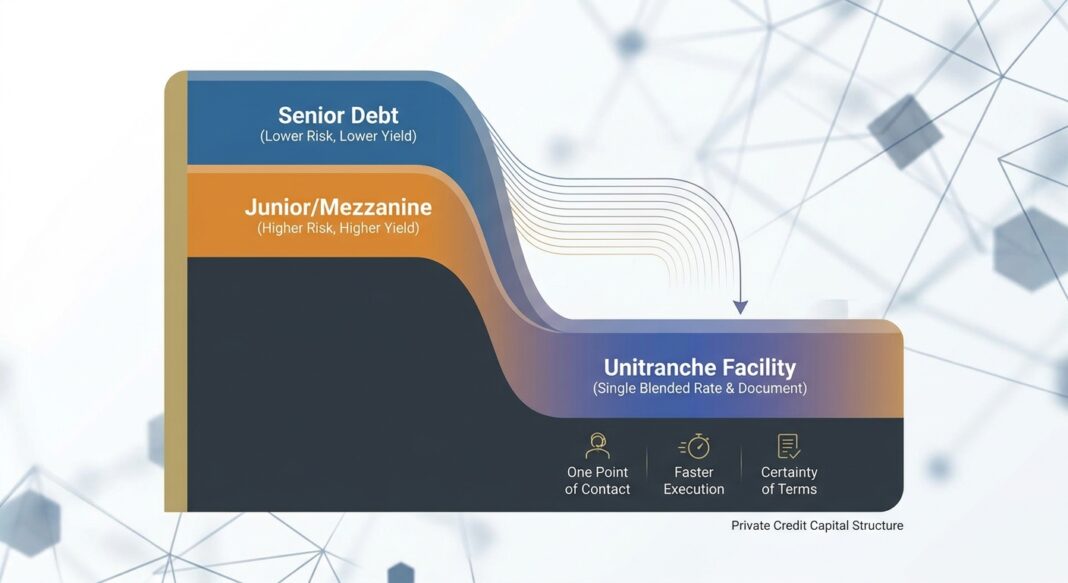
One Loan to Rule the Stack
Walk into most middle-market leveraged buyouts today, and you will not find a neat ladder of bank debt, mezzanine, and subordinated notes. Instead, you will find a single document, a single lender group, and a single blended rate. That instrument is the unitranche facility, and it has fundamentally restructured how private companies access capital.
For business owners evaluating growth financing, the pitch is compelling: one closing, one set of covenants, and a lender who will move faster than a bank syndicate. For investors allocating to private credit funds, the picture is more nuanced. Unitranche structures deliver attractive yields, but understanding why they yield what they yield (and where the risk actually sits) is a prerequisite for any rigorous evaluation.
This article teaches the mechanics of unitranche financing from first principles: what it is, how the internal risk split works, what it costs in today’s market, and how both operators and institutional allocators should think about it.
What Is a Unitranche Facility?
A unitranche facility is a single credit agreement that blends what would traditionally be two or more separate debt instruments (most commonly a senior secured bank loan and a junior or mezzanine tranche) into one unified facility at one blended interest rate. The borrower signs one document, negotiates with one lead arranger, and makes one payment. That simplicity is the product’s core selling point.
But simplicity on the borrower side conceals complexity within the lender group. When multiple lenders participate in a unitranche, they divide the facility into first-out and last-out tranches through a private contract called the Agreement Among Lenders (AAL): a document the borrower is typically not a party to. According to Alternative Fortune (July 2026), the risk split lives inside this private AAL, and the borrower sees only one clean credit agreement.
The first-out lender receives repayment priority and accepts a lower spread in exchange for that safety. The last-out lender accepts a higher spread and takes first losses in a restructuring scenario. The blended rate the borrower pays falls between what each piece would price at independently, above a pure senior loan, but below a separate senior-plus-mezzanine stack in aggregate cost and transaction friction.
Critically, unitranche loans come almost exclusively from non-bank private lenders: business development companies (BDCs), direct lending funds, and large private credit platforms. According to Stirling Capital Group (July 2026), traditional commercial banks do not offer this structure, so borrowers generally need established private credit relationships to access it.
How the Numbers Work: A Concrete Example
Consider a private equity sponsor acquiring a manufacturing business with $15 million in EBITDA. The deal requires $75 million in total debt, a 5.0x leverage multiple. In a traditional structure, the sponsor might layer a $50 million senior bank term loan at roughly SOFR + 275 bps and a $25 million mezzanine tranche at 12–14%, requiring separate documentation, two sets of covenants, and an intercreditor agreement negotiated between the bank and the mezzanine fund.
Under a unitranche structure, a single direct lender (or lender club) funds the full $75 million at a blended rate. Using current market benchmarks, the math looks like this:
- Facility size: $75 million (5.0x EBITDA)
- Spread over SOFR: approximately 500–525 bps, per current market pricing
- Base rate (3-month Term SOFR): approximately 3.69% as of June 2026
- All-in rate (approximate): 9.00%–9.75%
- Annual interest expense: approximately $6.75M–$7.3M
Internally, the AAL might allocate $50 million to the first-out tranche at SOFR + 350 bps and $25 million to the last-out tranche at SOFR + 750 bps. The borrower never sees this split; they simply pay the blended rate. According to Stirling Capital Group (July 2026), as a directional benchmark, Golub Capital’s direct lending research shows unitranche return ranges of 9%–11%, sitting between 7%–9% for senior debt and 10%–12% for junior debt.
The operator pays a modest premium over a bank senior loan in exchange for certainty of execution, a single closing timeline (often 30–45 days versus 90+ for a bank syndication), and a single counterparty relationship post-close.
Current Market Reality: What the Data Shows
Unitranche is no longer a niche structure; it is the dominant financing mechanism for middle-market leveraged transactions. According to CT Acquisitions (July 2026), roughly 80% of lower-middle-market leveraged buyouts closed in 2025 used a private credit unitranche rather than a syndicated bank loan, per S&P Global Market Intelligence data. The private credit market supporting this activity has reached approximately $1.7 trillion in global assets under management at the start of 2026, up from $970 billion in 2019, per Preqin’s 2026 Global Alternatives Report.
Pricing, however, has moved in 2026. According to Kadenwood Group citing PitchBook LCD data (September 10, 2026), new-issue US private credit spreads averaged 502 basis points in the three months to August 31, 2026, up from 475 basis points in Q1 2026. The premium a borrower pays for private credit over a syndicated loan has widened to 162 basis points, approximately 39 basis points wider than Q1. In the first quarter, 25% of sponsor-backed direct lending deals priced between 500–549 bps; by late summer, that band accounted for 52% of deals.
On an all-in yield basis, Valuation Research Corporation (July 2026) reports unitranche yields ranging between approximately 9.00% and 9.75%: down roughly 250 basis points from late-2023 peak levels of 11.5%–12.5%, but still above the pre-2022 historical range of approximately 7%–8%.
The bank lending backdrop explains much of the structural demand. The Federal Reserve’s July 2026 SLOOS confirmed that C&I lending standards remained essentially unchanged in Q2 2026, and earlier in the year, the April 2026 SLOOS flagged that banks reported tighter standards across all categories of non-depository financial institution (NDFI) loans, with higher premiums charged on riskier loans and stricter loan covenants among the most widely reported tightening terms. According to Northleaf Capital (May 2026), periods of market volatility typically see banks and liquid credit markets retrench, with private equity sponsors turning to private credit for greater execution certainty, a dynamic that continues to reinforce unitranche demand.
| Metric | Value | Source |
|---|---|---|
| Avg. new-issue private credit spread (Aug 2026) | 502 bps over SOFR | PitchBook LCD via Kadenwood, Sep 2026 |
| All-in unitranche yield range (Q2 2026) | 9.00%–9.75% | Valuation Research Corp, Jul 2026 |
| Premium of private credit over syndicated loans | 162 bps (widened ~39 bps vs. Q1) | PitchBook LCD via Kadenwood, Sep 2026 |
| LMM LBOs using unitranche (2025) | ~80% of transactions | S&P Global Market Intelligence via CT Acquisitions, Jul 2026 |
| Global private credit AUM (start of 2026) | ~$1.7 trillion | Preqin 2026 Global Alternatives Report via CT Acquisitions |
Decision Framework for Investors and Operators
For Investors Evaluating Private Credit Funds:
When evaluating a direct lending fund with significant unitranche exposure, analysts consider the following questions: What percentage of the portfolio is first-out vs. last-out? The AAL structure means reported first-lien collateral position may overstate actual loss protection in a restructuring if the fund holds primarily last-out paper. What covenants protect the lender? According to Angel Investors Network citing Proskauer’s Private Credit Insights Report (February 2026), cov-lite deals rose to 21% of private credit transactions in 2025, up from just 4% in 2023, meaning fewer early-warning triggers exist across a growing share of portfolios. Investors also evaluate whether the spread premium (currently ~162 bps over syndicated loans) adequately compensates for illiquidity, opacity, and the absence of mark-to-market price discovery that exchange-traded instruments provide.
For Operators Considering a Unitranche:
Business owners and CFOs weigh the unitranche against alternatives primarily on four dimensions: speed (one lender group vs. a bank syndicate), certainty (committed terms vs. market flex risk in a BSL), flexibility (PIK options, delayed-draw tranches, and covenant room are all more negotiable in private credit), and cost. On cost, operators should recognize that the spread premium is the price of execution certainty and simplicity, not a discount. According to Alternative Fortune (July 2026), what the borrower buys is not a lower coupon but a simpler, faster, more certain deal. Importantly, operators evaluating unitranche financing should also negotiate prepayment terms carefully, if spreads narrow or the company grows into investment-grade territory, the ability to refinance cheaply later has real economic value.
Key Takeaways
- A unitranche blends senior and junior debt into one instrument. The borrower sees one rate; the risk split between first-out and last-out lenders lives in a private Agreement Among Lenders (AAL) that the borrower typically never sees.
- The blended rate reflects blended risk. Current unitranche all-in yields of 9.00%–9.75% (Q2 2026) sit above pure senior rates precisely because the structure carries junior risk inside a first-lien wrapper, not because lenders are pricing irrationally.
- Dominance in LBOs is structural, not cyclical. Roughly 80% of lower-middle-market LBOs used unitranche in 2025. Banks cannot offer this product, and the speed and certainty advantages compound in volatile M&A environments.
- Spread premiums are widening in 2026. The gap between private credit and syndicated loan spreads expanded to 162 basis points by August 2026, a 39-basis-point widening from Q1, signaling a more cautious lender environment that operators should price into their capital cost assumptions.
- Investors must look past the first-lien label. A fund reporting 100% first-lien exposure that holds last-out unitranche paper carries materially different risk than a fund holding true senior secured bank debt. Understanding the AAL allocation is essential due diligence.


