
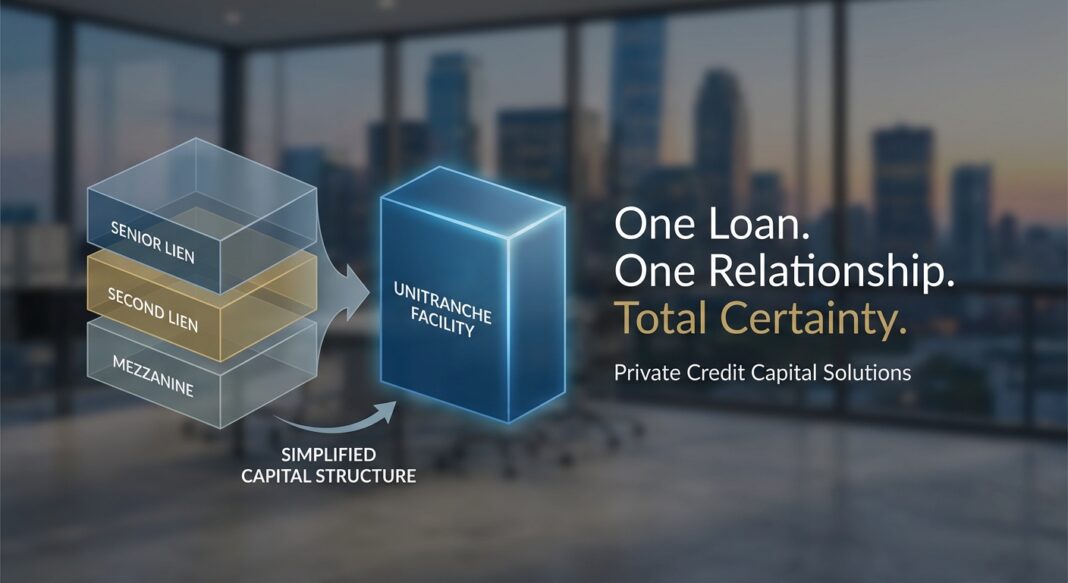
Why Borrowers and Sponsors Are Choosing One Loan Over Many
In a traditional leveraged buyout, a business owner or private equity sponsor sits across the table from multiple creditor groups: a senior bank lender, perhaps a second-lien fund, and a mezzanine provider. Each demands its own credit agreement, its own covenants, its own legal fees, and its own closing timeline. Weeks, sometimes months, can pass before capital arrives. In competitive auctions, that delay can cost you the deal entirely.
Unitranche financing was designed to solve exactly this problem. Rather than stacking separate debt instruments, a unitranche facility collapses the entire debt portion of a capital structure into a single loan, one interest rate, one set of documents, and one lender relationship. For borrowers, the experience is clean and simple. For the lenders behind it, the economics are more nuanced, and that nuance is where the real private credit education begins.
As bank lending standards tighten and competition among direct lenders reshapes pricing, understanding unitranche is no longer optional for operators seeking growth capital or investors allocating to private credit funds. It is the dominant debt structure in middle-market lending today.
The Mechanism: One Loan, Two Realities
At its core, unitranche debt is a hybrid instrument that combines what would traditionally be separate senior and subordinated debt layers into a single term loan. As defined by pipeline lending specialists, PipelineRoad (2026), “the entire capital structure below equity collapses into a single instrument.” The borrower signs one credit agreement, negotiates with one agent, and makes one interest payment.
But behind the scenes, the structure is often bifurcated. When multiple lenders participate, they typically divide the facility into a first-out tranche and a last-out tranche through a confidential document called the Agreement Among Lenders (AAL). According to Wall Street Prep, the AAL establishes the waterfall payment schedule and allocation of fees and interest among lenders, and crucially, its terms are kept confidential from the borrower.
First-out lenders receive priority on scheduled interest, principal amortization, and prepayments. They carry lower risk and accept a lower return. Last-out lenders absorb first loss after equity and receive a higher residual yield to compensate. From a legal standpoint, as noted by Wall Street Oasis, in a bankruptcy proceeding the loan still appears as a single first-lien facility; it is the AAL between lenders that governs who receives what share of the recovery.
The traditional alternative, as described by PipelineRoad, requires a borrower “to negotiate with multiple creditor groups: a senior lender (or syndicate), a mezzanine provider, and potentially a second-lien lender: each with its own documents, covenants, pricing, and enforcement rights.” Unitranche eliminates that fragmentation entirely for the borrower, while preserving differentiated risk-return profiles for institutional lenders.
How It Works: A Concrete Example
Consider a private equity sponsor acquiring a software business generating $20 million in EBITDA at a 10x multiple, implying a $200 million enterprise value. The sponsor contributes $80 million in equity (40%) and needs $120 million in debt: representing 6.0x leverage.
In a traditional structure, this might be split:
- Senior first-lien term loan: $90M at SOFR + 375 bps (4.5x leverage)
- Second-lien or mezzanine: $30M at SOFR + 800 bps (1.5x additional leverage)
- Two separate credit agreements, two lender groups, two sets of covenants, 8–12 weeks to close
In a unitranche structure, the same $120 million is packaged as one loan:
- Single unitranche facility: $120M at a blended rate of SOFR + 575 bps
- One credit agreement, one agent, one covenant package
- Closes in as few as 30–45 days faster than a syndicated alternative
Behind the AAL, the lead lender may hold the first-out $70M at SOFR + 450 bps and syndicate the last-out $50M to a partner lender at SOFR + 750 bps, with the blended rate landing at S+575 for the borrower. The borrower’s experience is seamless; the lenders’ economics are differentiated.
According to Private Equity Bro (Oct 2025), sponsors often justify paying 50 to 100 basis points of extra spread for a unitranche over a syndicated alternative specifically because it eliminates the risk of a broken syndication or a delayed closing that could jeopardize a purchase agreement.
Current Market Relevance
Unitranche has moved from a niche mid-market product to the backbone of private credit deal flow, and the current macro environment is accelerating that trend.
Bank credit continues to tighten. According to the Federal Reserve April 2026 SLOOS, banks reported tighter lending standards for commercial and industrial loans across firms of all sizes in Q1 2026, with the most widely reported changes including higher risk premiums, stricter covenants, and lower maximum credit line sizes. This structural tightening has been sustained across multiple consecutive quarters.
Private credit has stepped into the gap at scale. According to S&P Global Market Intelligence (Nov 2025), Preqin projects private credit AUM will nearly double from an estimated $2.28 trillion in 2025 to $4.5 trillion by 2030. The largest managers are already dominant: Ares Management reported private credit AUM of $391.5 billion as of Q3 2025, while Apollo’s private credit platform reached $723 billion as of September 2025, representing approximately 82% of its total AUM.
Unitranche dominates mid-market buyout financing. According to Private Equity Bro (Oct 2025), unitranche structures dominate direct lending for cash flow leveraged buyouts in the core and upper middle market, and private credit provided roughly 80% of North American buyout financing by deal count in 2023.
Spreads are widening after years of compression. According to McKinsey Global Private Markets Report (Jun 2026), global new-issue direct loan median spreads compressed from a peak of 716 basis points in March 2023 to 544 basis points at year-end 2025. However, as PitchBook (Mar 2026) reported, credit conditions are becoming more lender-friendly again, citing WWEX Group’s $4.815 billion unitranche loan led by Ares Capital that priced at S+575 in Q1 2026 as evidence of this shift.
| Metric | Data Point | Source |
|---|---|---|
| Global private credit AUM (2025E) | ~$2.28 trillion | S&P Global / Preqin, Nov 2025 |
| Median direct loan spread (YE 2025) | 544 bps over SOFR | McKinsey Global Private Markets Report, Jun 2026 |
| Large unitranche example spread (Q1 2026) | S+575 (WWEX / Ares, $4.8B) | PitchBook, Mar 2026 |
| Covenant-lite share of direct lending (2025) | 21% (up from 4% in 2023) | McKinsey / Proskauer, Jun 2026 |
| Bank C&I lending standards (Q1 2026) | Net tighter for all firm sizes | Federal Reserve SLOOS, Apr 2026 |
Decision Framework
For Investors Evaluating Unitranche Exposure
Investors considering allocation to private credit funds with unitranche exposure evaluate several structural factors. Position within the AAL is critical: first-out exposure carries senior-like risk with modest yield enhancement, while last-out exposure behaves more like second-lien debt and warrants higher expected returns. PipelineRoad notes that from a fund return perspective, unitranche strategies generally target gross returns of 9–13%, positioning them between pure senior direct lending and mezzanine funds. Investors also examine leverage at entry: total debt/EBITDA multiples, and the quality of the underlying borrower’s free cash flow generation, since a unitranche facility stretches leverage higher than a traditional first-lien-only structure. Covenant density matters too: McKinsey data shows that covenant-lite transactions rose to 21% of direct lending deals in 2025, meaning lender protections are not uniform across the market.
For Operators and Sponsors Choosing a Financing Structure
Business owners and private equity sponsors evaluate unitranche against traditional multi-tranche structures on three primary dimensions. Speed and certainty: according to Private Capital Global, private credit can close within four weeks while bank syndication may require six to eight weeks, a difference that can be decisive in competitive auction processes. Total cost of capital: the blended unitranche rate will typically sit above what a pure senior bank loan would cost, but below what a combined senior-plus-mezzanine stack might cost when fees and complexity are fully accounted for. Relationship and flexibility: a single lender relationship simplifies future amendment requests, covenant waivers, and add-on financing, which are common needs during a company’s growth phase. Operators should evaluate whether the speed premium justifies the pricing differential on a net present value basis against their specific transaction timeline and competitive context.
Key Takeaways
- One loan, two realities: Unitranche presents borrowers with a single instrument while lenders privately allocate first-out (lower risk, lower yield) and last-out (higher risk, higher yield) economics through a confidential Agreement Among Lenders (AAL).
- Speed is the premium: Unitranche can close 30–45 days faster than a syndicated alternative, and sponsors often justify paying 50–100 bps of extra spread to eliminate execution risk in competitive deals.
- Bank tightening is structural: The Federal Reserve’s April 2026 SLOOS confirms banks continued to tighten C&I lending standards in Q1 2026, reinforcing the structural tailwind for private credit unitranche solutions.
- Spreads are shifting lender-friendly: After compressing from 716 bps in 2023 to 544 bps at year-end 2025, unitranche spreads showed signs of widening in early 2026, a trend investors in direct lending funds should monitor closely.
- Scale is concentrating at the top: With the top 25 private credit managers capturing approximately 72% of 2025 fundraising (per McKinsey/Preqin data), operators seeking unitranche financing increasingly access it through scaled platforms such as Ares, Apollo, and Blackstone, where execution capacity and relationship depth are largest.


