
The Problem With Traditional Capital Stacks
Imagine you are a private equity sponsor trying to close a $400 million leveraged buyout in a competitive auction. You have four weeks. The seller wants certainty of close. Your bank offers to lend $180 million at a low rate, but only that. Your mezzanine provider wants two weeks to run its own diligence, its own lawyers, and its own term sheet. You need an intercreditor agreement negotiated between the two lenders before you can even sign. Every day you wait, the deal is at risk.
This was the structural reality of middle-market financing for decades, until the rise of the unitranche loan. Today, the unitranche structure has become the defining financing instrument of private credit’s dominance, powering a market that Preqin projects will grow from roughly $2 trillion to $4.5 trillion in AUM by 2030.
Understanding how unitranche works (and why it matters) is fundamental to understanding the modern private credit market for both investors allocating capital and business owners seeking it.
What Is a Unitranche Loan?
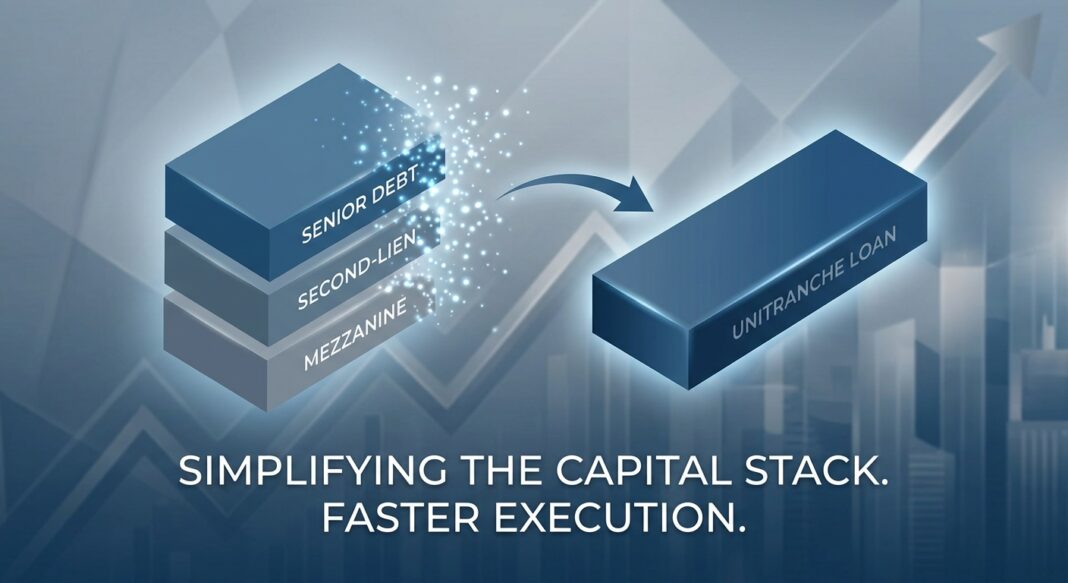
A unitranche facility is a single-facility debt structure that collapses what would traditionally be multiple layers of the capital stack (senior secured debt, second-lien debt, and sometimes mezzanine) into one loan agreement, one interest rate, and one lender relationship. As PipelineRoad’s Capital Raising Glossary explains, the borrower signs one credit agreement with no intercreditor agreement to negotiate, and the entire debt structure below equity is consolidated into a single instrument.
From the borrower’s perspective, it is a clean, simple first-lien loan. Behind the scenes, however, the reality is more nuanced. When multiple lenders participate, they often bifurcate the economics internally through a confidential document called an Agreement Among Lenders (AAL).
According to Mayer Brown, the AAL divides the facility into a first-out tranche: typically a revolving credit facility or lower-risk piece, and a last-out tranche, which is often the larger term loan held by private credit funds. The first-out lender receives lower yield but priority of payment; the last-out lender takes more subordinated risk and earns a higher spread. Critically, the borrower is generally not even a party to the AAL and may not know the split exists at all.
The AAL governs payment waterfalls, enforcement rights, amendment voting, and the allocation of recoveries in a default scenario, all without creating the public complexity of a formal first-lien/second-lien structure.
How It Works: A Concrete Example
Consider a sponsor acquiring a manufacturing company for $700 million, a 10x multiple on $70 million of EBITDA. The deal is financed with $350 million of equity (50%) and $350 million of debt (5x leverage).
Under a traditional structure, the sponsor might stack the debt as follows:
- Senior bank term loan: $200 million at ~SOFR + 250 bps (all-in ~6.2%)
- Second-lien or mezzanine: $150 million at ~SOFR + 700 bps (all-in ~10.7%)
- Blended cost of debt: ~8.1% across the full stack
- Negotiation timeline: 8–12 weeks minimum, with two sets of lawyers and an intercreditor agreement
Under a unitranche structure, a private credit fund (or a small club of two to three funds) offers:
- Single unitranche facility: $350 million at SOFR + 550 bps (all-in ~9.2%)
- One set of documents, one closing process
- Execution timeline: As fast as three to four weeks
- Internal AAL split (invisible to borrower): $100 million first-out at SOFR + 375 bps; $250 million last-out at SOFR + 625 bps
The borrower pays a modest premium on the blended rate, roughly 110 basis points more than the stacked structure in this example, in exchange for speed, certainty, and structural simplicity. According to Private Capital Global, execution speed is a genuine competitive advantage: private credit can close within four weeks while traditional bank syndication may require six to eight weeks. In competitive auctions, that gap can determine whether a sponsor wins the deal at all.
Current Market Relevance
The unitranche structure has moved from a niche innovation to the backbone of middle-market M&A financing. Several converging forces explain why it dominates today’s market.
Bank withdrawal is structural, not cyclical. The Federal Reserve’s April 2026 SLOOS reported that banks, on net, tightened lending standards for commercial and industrial loans to firms of all sizes in Q1 2026, with major net shares citing a less favorable economic outlook and reduced risk tolerance as key reasons. This has been a consistent pattern across multiple SLOOS cycles. Banks are not merely cautious; they are structurally retreating from the risk profile that middle-market unitranche lending requires.
Pricing has reset in lenders’ favor. According to Global Market Insights, unitranche all-in pricing in U.S. middle-market transactions ranged between SOFR plus 500 and 650 basis points through 2024–2025. More recently, Lord Abbett’s 2026 Midyear Outlook noted that spreads have widened by roughly 50 to 100 basis points since late 2025, according to PitchBook: reflecting a shift toward more lender-friendly conditions that includes less leverage, more covenants, and tighter documentation on new loans.
Loan documentation standards are evolving. While McKinsey’s 2025 Global Private Markets Report noted that covenant-lite transactions rose to 21% of direct lending deals in 2025 (up from 4% in 2023), a borrower-friendly trend at the upper end of the market, PipelineRoad highlights that unitranche facilities typically retain maintenance covenants, giving lenders a meaningful advantage over broadly syndicated loans where covenant-lite has become the norm.
Equity cushions are larger today than in prior cycles. Hamilton Lane’s 2026 Private Credit Focus reported that equity contributions in leveraged buyouts averaged 49% of total capitalization in 2025, compared to approximately 33% in 2007. This is structurally significant: a thicker equity cushion means unitranche lenders are absorbing less first-dollar risk even when holding a larger share of the capital stack.
The global private credit market now estimated at ~$3.2 trillion. PIMCO triangulates across Preqin, PitchBook, and company disclosures to estimate global private credit AUM at roughly $3.2 trillion, with direct lending, the strategy unitranche dominates, remaining the largest sub-strategy by assets.
| Metric | Data Point | Source |
|---|---|---|
| Unitranche all-in pricing (2024–2025) | SOFR + 500–650 bps | Global Market Insights, 2026 |
| Spread widening since late 2025 | +50–100 bps (per PitchBook) | Lord Abbett, June 2026 |
| Term SOFR (June 2026) | ~3.69% | Valuation Research Corp., Q2 2026 |
| LBO equity contribution (2025 avg.) | ~49% of total cap | Hamilton Lane, April 2026 |
| Covenant-lite share of direct lending deals (2025) | 21% (vs. 4% in 2023) | McKinsey / Proskauer, 2026 |
Decision Framework
For Investors Evaluating Unitranche Exposure
Investors accessing unitranche loans (typically through direct lending funds, Business Development Companies (BDCs), or institutional separately managed accounts) consider several structural factors before committing capital:
- First-out vs. last-out position: Investors may not always know which piece of the AAL their fund holds. Last-out positions offer higher yield but absorb first-dollar credit losses after equity. Evaluating a manager’s disclosed tranche composition matters for risk-adjusted return analysis.
- AAL enforceability risk: As Wall Street Prep notes, how bankruptcy courts treat AAL provisions remains an unsettled area of law. Investors consider the quality of legal documentation and bankruptcy counsel when evaluating manager competency.
- Covenant quality: Unitranche loans typically retain financial maintenance covenants, a meaningful lender protection. Investors evaluate whether managers are maintaining covenant discipline as deal competition increases.
- Manager concentration and club dynamics: When a club of two to three funds shares a unitranche, coordination risk in a restructuring scenario is real. Investors ask how lender relationships and voting structures are managed.
For Business Owners and Operators Seeking Capital
For middle-market companies or their private equity sponsors considering a unitranche, the trade-off framework is practical:
- When unitranche makes sense: Competitive auction timelines, single-lender certainty requirements, or situations where a borrower values simplified administration over marginal cost savings. According to PipelineRoad, unitranche is typically preferred when speed and certainty of execution are paramount, such as in competitive auction processes where a financing contingency could cost the deal.
- When a traditional stack may be preferable: Large transactions where a bank can provide a meaningful senior tranche at materially lower cost, or deals where the borrower has significant negotiating leverage and time to run a broad process.
- Understand the rate premium: The all-in cost of a unitranche is higher than a bank term loan in isolation. Operators model the spread premium against the value of speed, flexibility, and the avoidance of multi-lender coordination costs over the full life of the loan.
Key Takeaways
- Unitranche is a structural innovation, not just a product: By collapsing multiple debt layers into one instrument, it eliminates intercreditor complexity and dramatically reduces time-to-close, a decisive advantage in competitive M&A processes.
- The AAL is the hidden architecture: Behind the single loan that borrowers see, lenders often privately bifurcate risk and return into first-out and last-out positions. Investors in private credit funds consider which piece of the waterfall their manager typically holds.
- Bank retrenchment is a structural tailwind: The Federal Reserve’s SLOOS has documented persistent tightening of C&I lending standards across multiple quarters. This is not a cyclical blip; it is the structural withdrawal that unitranche lenders are systematically filling.
- The 2026 reset is lender-friendly: Rising spreads, more covenants, and better documentation on new loans, combined with thicker equity cushions averaging ~49% of capitalization in LBOs, create a more protective environment for unitranche investors than the compressed terms of 2023–2024.
- Unitranche is the dominant LBO financing instrument today: With global private credit AUM estimated near $3.2 trillion and direct lending its largest strategy, unitranche has become the default financing mechanism for sponsor-backed middle-market transactions, making it one of the most important structures in modern credit markets for both investors and operators to understand deeply.


