
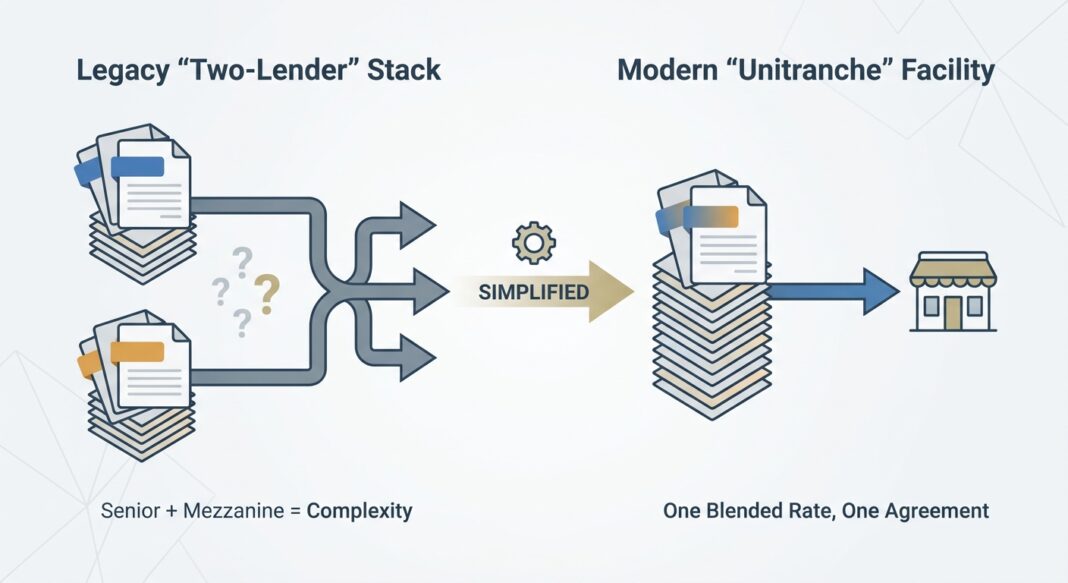
Why One Loan Beat Two
A decade ago, a mid-market company seeking $150 million to fund an acquisition had to negotiate with at least two distinct lender groups: a senior bank syndicate for the first-priority debt and a mezzanine fund or second-lien lender for the subordinated slice. Two credit agreements, two sets of covenants, two closing timelines, two sets of legal fees, and two lenders whose interests could diverge the moment the business hit a rough patch. The process was expensive, slow, and fragile.
Today, the same company is far more likely to close with a single direct lender in 45 to 90 days under one credit agreement, one covenant package, and one blended interest rate. That instrument is the unitranche loan: the defining product innovation of the private credit era, and understanding its mechanics is essential for anyone evaluating this asset class, whether as an investor allocating to private credit funds or as a business owner weighing financing options.
What a Unitranche Loan Actually Is
At its core, a unitranche loan is a hybrid debt instrument that combines what would otherwise be senior secured debt and subordinated or mezzanine debt into a single credit facility with a blended interest rate. The term itself is descriptive: uni (one) and tranche (portion of debt). From the borrower’s perspective, there is one loan document, one lender or lender-led syndicate, one set of covenants, one interest rate, and one prepayment schedule.
But that simplicity on the borrower side conceals a sophisticated internal architecture. Behind the scenes, the single loan is typically divided into at least two components between the lenders: a first-out (FO) tranche and a last-out (LO) tranche. The FO tranche functions like traditional senior debt; it has the first claim on collateral and principal repayments, carries lower risk, and earns a lower interest rate. The LO tranche sits behind the FO portion in the payment waterfall, functions like subordinated or mezzanine capital, takes on higher risk, and earns a correspondingly higher interest rate.
The legal document governing the relationship between the two lender groups is called an Agreement Among Lenders (AAL). The AAL is a private contract that the borrower is typically not a party to. It defines how interest and principal payments are allocated, which lender group controls enforcement decisions in a default, and how remedies are triggered. The borrower experiences the facility as a single loan; the lenders have privately allocated the economics and risk among themselves.
A Concrete Example: The $400 Million Buyout
Consider a private equity sponsor acquiring a company for $700 million, roughly 14x a $50 million EBITDA. The sponsor plans to contribute $300 million in equity and finance $400 million with debt. A traditional bank could offer cheaper pricing, perhaps SOFR + 375–400 basis points, but would likely cap its exposure at around $200 million, or 4x EBITDA. The remaining $200 million gap would require a separate mezzanine lender at significantly higher cost, triggering a second negotiation, second credit agreement, and additional execution risk.
Under a unitranche structure, a direct lender (or a bank partnering with a direct lender) offers the full $400 million under a single facility. A bank might take the first-out portion (say, $150 million at SOFR + 325 bps), while the direct lender holds the last-out portion ($250 million at SOFR + 675 bps). The borrower sees and pays one blended rate (in this case, roughly SOFR + 525 basis points) without engaging in separate intercreditor negotiations. The two lender groups govern their relationship privately through the AAL.
In 2026 market terms, CT Acquisitions (May 2026) puts the all-in pricing for a typical 5x leverage unitranche at 9.5–11% blended (SOFR + 500–700 bps), with a 2–3% original issue discount and prepayment fees declining over 24 months. Compare that to a traditional senior-plus-subordinated structure, where senior debt prices at SOFR + 350–450 bps and subordinated debt at 11–13% cash. On a 50/50 split, the blended cost of a traditional two-tranche structure is roughly 9–10.5% all-in, marginally cheaper than unitranche, but with materially greater execution complexity and timeline risk.
Current Market Relevance
The unitranche structure has moved from niche innovation to market standard precisely because bank lending has remained persistently tight. According to the Federal Reserve’s April 2026 Senior Loan Officer Opinion Survey (SLOOS), banks reported tighter lending standards for commercial and industrial (C&I) loans to firms of all sizes in Q1 2026, continuing a multi-quarter trend. Separately, the April 2026 SLOOS found that significant net shares of banks also tightened standards for loans to non-depository financial institutions: including higher premiums on riskier loans, stricter covenants, and lower maximum credit line sizes.
This structural bank retrenchment has been the fuel for private credit’s explosive growth. According to Cleary Gottlieb (January 2026), direct lending has grown to match the broadly syndicated loan market at $1.5–2 trillion in size and is forecast to reach $3 trillion by 2028. Unitranche financing dominates the lower middle market: CT Acquisitions (May 2026) estimates that 70–80% of deals in the $25–$200 million enterprise value range now use at least partial unitranche funding from lenders such as Ares, Blue Owl, Antares, Twin Brook, and Apollo.
The covenant landscape is also shifting. According to McKinsey’s 2026 Global Private Markets Report, covenant-lite transactions rose to 21% of direct lending deals in 2025, up from just 4% in 2023, as deal competition intensified at the upper end of the market. However, the mid-2026 environment may be correcting this trend: Lord Abbett (June 2026) notes that new loans in 2026 are increasingly coming with better credit structures (less leverage, more covenants, fewer payment-in-kind (PIK) requests, and tighter documentation) alongside spreads that have widened by roughly 50–100 basis points since late 2025, per PitchBook data.
| Metric | Data Point | Source |
|---|---|---|
| Private credit market size (2026E) | ~$1.96–$2.1 trillion AUM | Mordor Intelligence, Jan 2026 |
| Unitranche annual issuance growth (2015–2025) | ~$20B to over $200B | CT Acquisitions, May 2026 |
| Covenant-lite share of direct lending (2025) | 21% of deals (vs. 4% in 2023) | McKinsey / Proskauer, June 2026 |
| Bank C&I lending standards (Q1 2026) | Tighter for all firm sizes | Federal Reserve SLOOS, April 2026 |
| Spread widening since late 2025 | +50 to +100 basis points | Lord Abbett / PitchBook, June 2026 |
Decision Framework: Investors and Operators
For Investors Evaluating Unitranche Exposure: Investors in private credit funds, BDCs, or direct co-investments should examine where in the unitranche structure their capital sits. A fund holding predominantly first-out positions carries a risk profile closer to traditional senior lending, lower yield but higher recovery priority. A fund holding last-out positions accepts mezzanine-like risk in exchange for higher current income. Critically, investors evaluate the quality of the AAL: a well-structured AAL defines enforcement rights clearly, specifies standstill periods, and addresses how lenders vote on amendments, waivers, and bankruptcy actions. The AAL has not been tested in bankruptcy courts to the same extent as traditional intercreditor agreements, a risk factor to weigh against the structural simplicity and yield benefit.
Investors should also note concentration data at the fund level. Some BDCs carry significant unitranche exposure: for example, Ares Capital (ARCC) has reported approximately 62% of its portfolio in unitranche loans, per Accredited Insight’s 2025 analysis. Understanding the first-out vs. last-out split within that exposure is essential to correctly assess risk-adjusted return.
For Operators and Business Owners: The unitranche structure is most compelling for acquisitions in the $25–$200 million enterprise value range where speed, certainty, and simplicity outweigh the modest cost premium over a traditional two-tranche structure. Operators running acquisition-heavy strategies (roll-up platforms, add-on acquisitions) find particular value in the 45–90 day close timeline versus the 90–150 days typically required for syndicated senior-plus-mezz structures. For founder-led or family-owned businesses, unitranche is increasingly available outside of private equity-sponsored transactions. Borrowers should review whether an AAL exists in their transaction and request transparency on the lender group’s composition, enforcement trigger thresholds, and consent requirements for future amendments.
Key Takeaways
- One loan, two risk profiles: A unitranche combines senior and mezzanine debt into a single facility, but internally divides that risk into first-out (lower yield, higher priority) and last-out (higher yield, subordinated) positions governed by a private AAL.
- Speed and simplicity are priced in: The unitranche carries a modest cost premium over a traditional two-tranche structure, but eliminates the timeline and execution risk of negotiating with two separate lender groups, a meaningful advantage in competitive acquisitions.
- Bank tightening is structural, not cyclical: The Federal Reserve’s SLOOS has confirmed tighter C&I lending standards across multiple consecutive quarters through mid-2026. This environment reinforces private credit’s structural role in middle-market financing.
- Investors must look inside the structure: A fund reporting high unitranche allocations may be carrying very different risk depending on whether positions are first-out or last-out. That distinction does not always appear clearly in fund-level reporting and warrants direct inquiry during due diligence.
- The 2026 environment favors disciplined lenders: As spreads widen and documentation tightens following late-cycle stress, lenders with dry powder and selective underwriting standards are positioned to negotiate better terms than were available at the market’s competitive peak.


