
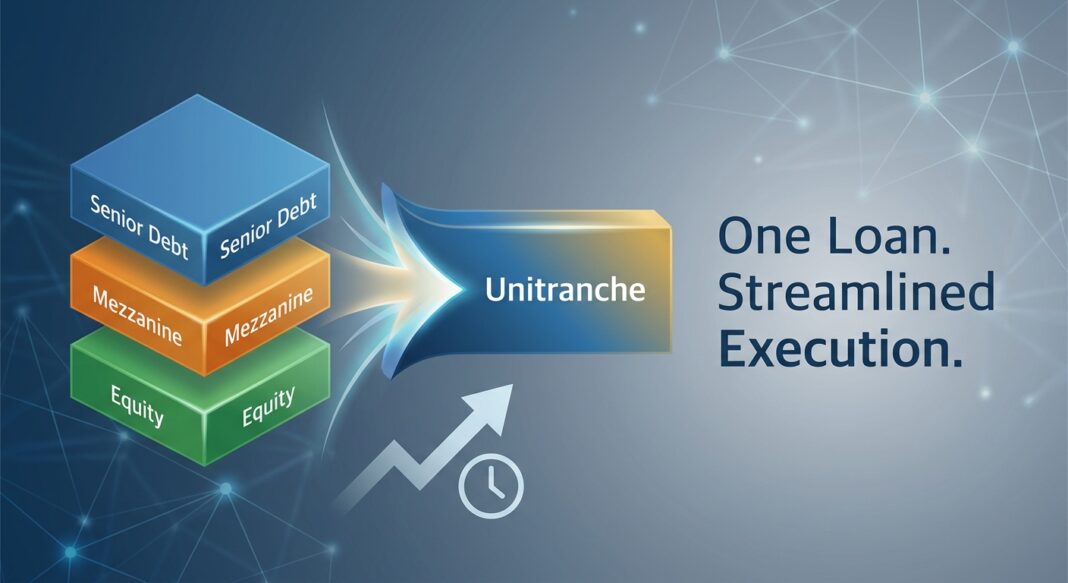
When One Loan Does the Work of Three
Most business owners who pursue acquisition financing or a leveraged recapitalization encounter the same friction: too many lenders, too many lawyers, and too little time. A private equity sponsor racing to close a $75 million platform acquisition cannot afford a 130-day financing process involving a senior bank, a mezzanine fund, and three separate legal teams negotiating intercreditor terms. That friction, not the interest rate, is often the deal killer.
The unitranche loan was engineered to solve exactly this problem. It is the dominant debt instrument in middle-market private credit today, and understanding how it works illuminates a set of fundamental principles that matter to both investors evaluating private credit funds and operators deciding how to structure a transaction. This article explains what a unitranche is, how the economics are allocated behind the scenes, what current market data reveals about pricing and adoption, and how both audiences should think about it as a decision tool.
What Is a Unitranche Loan?
Unitranche debt is a single-facility loan structure that combines what would traditionally be separate senior secured debt and subordinated debt layers into one instrument: one credit agreement, one set of collateral documents, one interest rate, and one lender relationship. PipelineRoad Capital Glossary describes it precisely: the entire capital structure below equity collapses into a single instrument that the borrower signs with one counterparty.
The borrower’s experience is deliberately simple. There is no intercreditor agreement to negotiate, no second-lien lender competing for control rights, no mezzanine fund requesting board observer seats. From the borrower’s vantage point, unitranche behaves like any senior secured loan.
But the lender side is more nuanced. As defined in Goldman Sachs’s own SEC filings for its private middle-market credit vehicles, unitranche loans are first lien loans that extend deeper into a borrower’s capital structure than traditional first lien debt and may provide for a waterfall of cash flow priority between different lenders within the same facility. That waterfall is governed by a private document called the Agreement Among Lenders (AAL).
The AAL is the engine of the unitranche structure. PipelineRoad’s analysis explains that within the AAL, the unitranche is bifurcated into a first-out tranche and a last-out tranche. The first-out lender receives priority of payment and lower risk, economically similar to a traditional senior secured lender. The last-out lender absorbs subordinated risk and earns a higher spread, functioning more like a mezzanine lender. Crucially, the borrower never sees this split: it makes one payment, and the economics are allocated according to the AAL waterfall behind the scenes.
How It Works: A Concrete Example
Consider a private equity sponsor acquiring a business services company with $10 million in EBITDA at a 7x purchase multiple, a $70 million total enterprise value. The sponsor contributes $30 million in equity (43% of TEV) and needs $40 million in debt financing.
Traditional Structure (Senior + Mezzanine):
- Senior secured term loan: $28 million at SOFR + 400 bps (~7.6% all-in)
- Mezzanine loan: $12 million at a fixed 14%
- Blended cost of debt: approximately 9.6–10.5%
- Two credit agreements, one intercreditor agreement, two legal teams
- Typical close timeline: 100–130 days
Unitranche Structure:
- Single unitranche facility: $40 million at SOFR + 575 bps (~9.25% all-in at current SOFR)
- One credit agreement, one lender relationship
- Typical close timeline: 60–90 days
- Behind the scenes: $25M allocated to first-out lender at SOFR + 400 bps; $15M to last-out lender at SOFR + 800 bps
As CTA Acquisitions (June 2026) notes, unitranche blended pricing in 2026 runs approximately SOFR + 500–700 bps for lower middle-market deals, with an all-in cost of roughly 9.5–11%. The sponsor pays 50–100 basis points more in headline rate compared to a perfectly optimized senior/mezz stack, but gains deal certainty, speed, and a single counterparty. As Private Equity Bro observes, if unitranche can close 30–45 days faster than a syndicated alternative, sponsors often justify that spread premium by eliminating the risk of a broken syndication or a delayed close that jeopardizes a signed purchase agreement.
Current Market Relevance
Unitranche structures are not a niche product; they now represent the dominant financing form for middle-market private equity buyouts in the U.S., and the macro environment of 2026 reinforces their structural advantage.
First, consider bank lending conditions. According to the Federal Reserve’s April 2026 SLOOS, banks reported tighter lending standards for commercial and industrial loans to businesses of all sizes in Q1 2026. Earlier survey data from Q4 2024 showed that 12.5% of banks had tightened C&I lending standards, banks cited economic uncertainty and a reduced tolerance for risk. When bank credit tightens, the middle market turns to private credit lenders, and unitranche is the instrument that fills that gap.
Second, direct lending performance provides context for why investors are drawn to these structures. According to Cliffwater’s March 2026 press release, the Cliffwater Direct Lending Index (CDLI) returned 9.3% for full-year 2025, with interest income of 10.4% serving as the primary return driver. The CDLI has now delivered a 20-year average annual return of approximately 9.5–9.6%, with only one negative calendar year (2008). These are the assets (primarily unitranche and first-lien direct loans) that institutional investors are funding.
Third, market scale confirms the structural shift. PIMCO (June 2026) estimates global private credit AUM at approximately $3.2 trillion, comprising $2.4 trillion in drawdown funds and roughly $800 billion in semi-liquid vehicles. IQ-EQ citing Preqin projects that figure to more than double to $4.5 trillion by 2030. Much of that capital is deployed through unitranche and first-lien direct lending facilities. At the manager level, CTA Acquisitions reports that Apollo leads with approximately $600 billion in credit AUM at Q1 2026, followed by Ares at $464 billion and Blackstone Credit & Insurance at $354 billion, all firms with direct lending unitranche programs at their core.
Fourth, product evolution is expanding the unitranche’s reach. Private Equity Bro notes that private lenders increasingly arranged mega-unitranche solutions above $2 billion in 2023 and 2024, facilitated by clubs of direct lenders and BDCs, a dramatic expansion from the structure’s origins in smaller middle-market deals.
| Metric | Data Point | Source |
|---|---|---|
| CDLI Full-Year 2025 Return | 9.3% | Cliffwater, Mar 2026 |
| CDLI 20-Year Average Annual Return | ~9.5–9.6% | Cliffwater, Mar 2026 |
| Global Private Credit AUM (est.) | ~$3.2 trillion | PIMCO, Jun 2026 |
| Unitranche Blended Pricing (LMM, 2026) | SOFR + 500–700 bps (~9.5–11% all-in) | CTA Acquisitions, Jun 2026 |
| Private Credit AUM Projection (2030) | $4.5 trillion | IQ-EQ / Preqin, Feb 2026 |
Decision Framework
For Investors Evaluating Private Credit Funds
Investors considering allocations to direct lending funds should understand that the unitranche instrument is the primary vehicle through which most middle-market direct lending AUM is deployed. When evaluating a manager, consider the following:
- First-out vs. last-out exposure: Not all unitranche positions carry the same risk. A fund concentrated in last-out positions is effectively mezzanine risk with first-lien documentation. Investors should ask managers to disclose what percentage of their unitranche portfolio represents first-out versus last-out economics.
- Covenant quality: As PipelineRoad notes, unitranche facilities typically include maintenance covenants, a meaningful structural advantage versus broadly syndicated loans. Investors should verify that the funds they evaluate maintain this discipline rather than competing on covenant-lite terms.
- AAL enforceability: Courts generally treat AALs as enforceable contracts among lenders. Investors should confirm that a fund’s legal documentation has been stress-tested and that loss-sharing provisions in the AAL are clearly defined before capital is deployed.
- Pricing compression risk: PwC’s Global Private Credit Survey 2026 found that following years of intense competition, margins have come under pressure as portfolio managers compete on both pricing and terms. Investors should assess whether a manager has maintained spread discipline or chased deal volume.
For Operators & Business Owners
Business owners and CFOs evaluating unitranche financing for an acquisition, recapitalization, or growth capital raise should weigh three practical factors:
- When speed matters: If a competitive M&A process has a hard close date, unitranche’s 60–90 day execution timeline versus the 100–130 days for a traditional senior/mezz stack may be decisive. The speed premium is real and quantifiable against a deal risk-adjusted basis.
- When simplicity has value: A unitranche from a single lender means one ongoing relationship for amendments, waivers, and future incremental facilities. For operators who want to focus on running the business rather than managing a lender consortium, that simplicity compounds in value over a 5–7 year hold.
- When the cost premium is justified: Operators should model the 50–100 bps unitranche premium explicitly. On a $40 million facility, 75 bps costs approximately $300,000 per year in additional interest expense: a figure that needs to be weighed against the certainty value, execution risk reduction, and operational simplicity that unitranche provides.
Key Takeaways
- One loan, two layers: Unitranche collapses senior and subordinated debt into a single credit agreement, but lenders privately allocate first-out (lower risk) and last-out (higher risk) economics through an Agreement Among Lenders, invisible to the borrower.
- Speed is the primary value proposition: Closing 30–45 days faster than a traditional senior/mezz structure eliminates broken-deal risk and justifies the typical 50–100 bps spread premium for time-sensitive acquisitions.
- Pricing in 2026: Lower middle-market unitranche deals price at approximately SOFR + 500–700 bps, producing all-in rates of roughly 9.5–11%, context that operators should use as a benchmark when negotiating term sheets.
- Investors should look inside the AAL: First-out and last-out positions within unitranche facilities carry materially different risk profiles. A fund’s disclosed position in the payment waterfall determines its true credit risk, regardless of what the marketing materials call it.
- Market scale validates the structure: With global private credit AUM estimated at $3.2 trillion in 2026 and projected to reach $4.5 trillion by 2030, unitranche is no longer an alternative structure; it is the dominant infrastructure of middle-market debt finance.


