
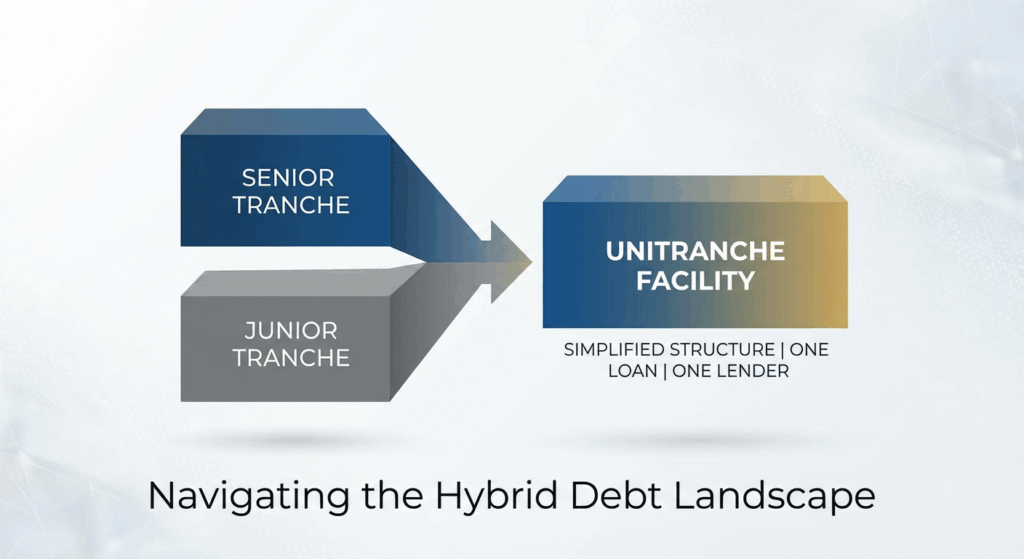
One Loan, One Lender, One Rate, But It’s More Complicated Than It Looks
In traditional corporate finance, a company borrowing $50 million might negotiate separately with a senior secured lender, a mezzanine provider, and an equity sponsor: each with different rates, covenants, and repayment priorities. The process is slow, expensive, and laden with inter-creditor friction. Unitranche financing collapsed all of that into a single loan facility at a single blended interest rate, and in doing so, it became one of the defining innovations of the modern private credit market.
Understanding how unitranche debt works (and when it makes sense) is essential for both investors evaluating private credit fund exposure and business operators weighing their capital structure options.
What Is Unitranche Debt?
A unitranche loan is a hybrid debt instrument that combines what would otherwise be a senior secured tranche and a subordinated (junior) tranche into a single, unified credit facility. A single lender (or a small club of lenders) provides the entire debt package under one agreement, charging a blended interest rate that sits between where pure senior debt and pure mezzanine debt would price independently.
The mechanics are governed by an Agreement Among Lenders (AAL), a private document that divides the economics between a “first-out” portion (which behaves like senior debt and is repaid first in any enforcement scenario) and a “last-out” portion (which absorbs losses first, analogous to subordinated debt). Crucially, the borrower sees only one loan agreement, one administrative agent, and one interest rate. The internal risk-splitting is invisible to them.
For private credit funds, the AAL creates a mechanism to syndicate risk across multiple lenders while preserving the simplicity that borrowers prize. According to the Clockwork.app analysis of private credit mechanics, private credit lenders distinguish themselves through “negotiated terms tailored to the borrower” and “stronger lender protections and covenants”, both of which the unitranche structure directly enables.
How the Numbers Work: A Concrete Example
Consider a hypothetical mid-market manufacturing company with $10 million in EBITDA seeking acquisition financing. A traditional two-tranche structure might look like this:
- Senior secured loan: $35M at SOFR + 350bps (approximately 7.8% all-in at current benchmark rates)
- Mezzanine tranche: $15M at a fixed 13.5%
- Total debt: $50M at a blended cost of approximately 9.5%
- Total leverage: 5.0x EBITDA
A unitranche alternative consolidates both tranches:
- Unitranche facility: $50M at SOFR + 550bps (approximately 9.8% all-in)
- Single lender or club deal with one set of covenants
- Closing timeline: Typically 4–6 weeks versus 10–14 weeks for a bifurcated structure
The borrower pays roughly 30 basis points more on an all-in basis but eliminates legal costs from negotiating two sets of documents, removes inter-creditor risk, and closes the deal weeks faster. For a private equity sponsor trying to win a competitive auction, that speed premium is often worth far more than the marginal rate difference. The private credit lender, meanwhile, earns a blended yield that compensates for taking on the full credit risk in a single facility.
Current Market Relevance
The unitranche structure has moved from niche innovation to mainstream middle-market financing vehicle over the past decade, and the current rate environment has both tested and validated it.
With SOFR holding near 4.3% as of early 2026, senior direct lending yields on unitranche facilities are running in the 10–12%+ range for middle-market borrowers, according to data cited by Capital Founders IO (March 2026). That yield premium over public leveraged loans compensates lenders for illiquidity and the concentration risk inherent in holding a large single-tranche position.
Default performance has held up: Cambridge Associates data cited by Capital Founders IO shows private credit default rates running at approximately 1.45% versus 3.37% for broadly syndicated loans: a meaningful gap that reflects, in part, the tighter covenant packages and lender oversight that unitranche structures typically carry.
The Meketa Investment Group Private Credit Primer (April 2024) notes that private credit “offers higher alpha potential than public credit, while potentially offering better downside protection”, attributes directly tied to the structural protections embedded in unitranche agreements, including maintenance covenants that allow lenders to intervene earlier than in broadly syndicated loan packages.
Family office allocations to private credit doubled from 2% to 4% in a single year per the UBS Global Family Office Report 2025, reflecting growing appetite for the risk-adjusted yield profile that unitranche lending delivers. However, Capital Founders IO (March 2026) also highlights that liquidity stress (including redemption gates at major vehicles like Blackstone’s BCRED and Blue Owl’s OBDC II) underscores why matching investment structure to liquidity timeline remains critical for allocators.
Decision Framework
For Investors Evaluating Private Credit Funds
- Examine the AAL terms: Understand whether the fund holds first-out or last-out exposure, as this determines the actual risk profile behind the blended yield.
- Assess covenant quality: Unitranche loans should carry maintenance covenants (tested quarterly) rather than incurrence-only covenants. Weaker covenant packages narrow the yield advantage over liquid alternatives.
- Evaluate concentration risk: A single large unitranche position in a fund creates more idiosyncratic risk than a diversified senior loan book. Analysts consider position-level sizing limits when stress-testing fund portfolios.
- Match liquidity to structure: Unitranche loans are illiquid by design. Investors typically consider fund vehicles with 5–7 year lockups or interval fund structures, not daily-liquidity wrappers, as appropriate vehicles for this exposure.
For Business Operators Considering Unitranche Financing
- Unitranche suits time-sensitive transactions: Acquisition financing, management buyouts, and recapitalizations where closing speed matters most are natural fits.
- Evaluate the all-in cost honestly: Compare the blended unitranche rate against the true all-in cost of a bifurcated structure, including legal fees, syndication risk, and timeline carrying costs.
- Understand covenant obligations: Unitranche lenders typically require tighter financial maintenance covenants than broadly syndicated loans. Operators should model downside scenarios before accepting covenant packages.
- Relationship matters: Because unitranche lenders hold the entire position, they have strong incentives (and leverage) to engage directly during stress. Operators benefit from selecting lenders with demonstrated track records in constructive workouts.
Key Takeaways
- Unitranche combines senior and subordinated debt into one facility, offering borrowers simplicity and speed at a blended rate between where the two tranches would price separately.
- The Agreement Among Lenders (AAL) is the hidden architecture: it determines how risk and recovery are split between first-out and last-out lenders, and investors should understand which position their fund occupies.
- In the current rate environment, unitranche yields of 10–12%+ reflect both credit risk and illiquidity premium: not just raw credit quality, making structure analysis as important as borrower underwriting.
- Tighter covenant packages are a defining feature, not a footnote. They give private credit lenders earlier intervention rights compared to broadly syndicated alternatives, which contributes to the lower observed default loss rates in direct lending.
- Both audiences face a liquidity matching problem: operators must model covenant compliance through cycles, and investors must align fund structure to their actual capital timeline, a lesson reinforced by the redemption gate events of early 2026.


