
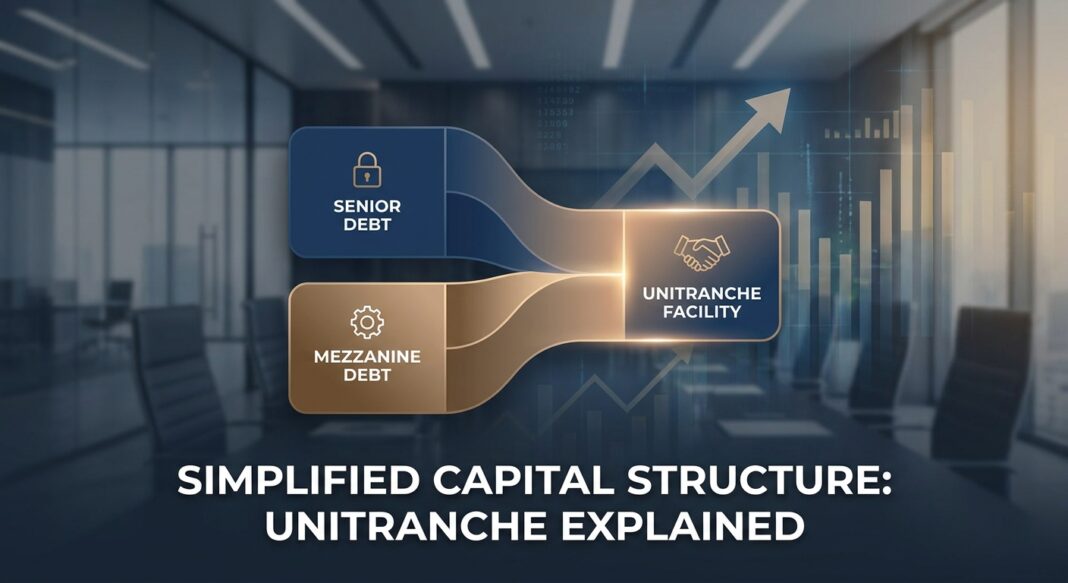
Why the Capital Stack Got a Makeover
For decades, a middle-market company seeking acquisition financing had to manage two separate lender relationships simultaneously: a bank providing a senior secured loan at one price, and a mezzanine fund layering subordinated debt on top at a significantly higher price. Each lender brought its own credit agreement, its own covenant package, and, critically, its own legal team. If the business hit a rough patch, the two creditor classes often disagreed on how to respond, creating costly intercreditor disputes at exactly the wrong moment.
The unitranche loan was designed to solve that problem. It is now the dominant financing structure in the U.S. private credit market, accounting for the majority of new middle-market direct lending issuance. Understanding how unitranche debt works (what it costs, how lenders internally allocate risk, and when it makes sense versus a traditional bifurcated stack) is foundational knowledge for any investor evaluating private credit funds or any business owner weighing financing options.
What a Unitranche Loan Actually Is
A unitranche loan is a single debt facility that merges what would traditionally be two separate instruments (a first-lien senior secured loan and a subordinated mezzanine loan) into one unified credit instrument with a single blended interest rate. As Invest In Me (2026) explains, the borrower sees one loan, one interest rate, one set of covenants, and one lender relationship.
The blended rate sits between what pure senior debt would cost and what pure mezzanine would demand. Angel Investors Network (2026) notes that unitranche debt collapses the traditional two-tranche structure into one loan, one credit agreement, and one administrative agent, meaning the borrower never has to referee a dispute between two creditor classes.
Behind the borrower-facing simplicity, however, lenders often split the facility internally. Glacier Lake Partners (2026) explains that lenders may divide the loan into a first-out tranche: repaid first from collateral proceeds, carrying lower risk and lower return, and a last-out tranche: absorbing losses first, compensated with a higher return. This internal arrangement, governed by an Agreement Among Lenders (AAL), is a document the borrower typically never sees. From the borrower’s perspective, the structure remains elegantly simple.
Key structural features:
- Single credit agreement: One document governing all terms, covenants, and remedies
- Blended interest rate: A composite of what senior and subordinated debt would each cost separately
- One lender relationship: No intercreditor negotiation required from the borrower’s side
- AB structure (optional): Internal first-out/last-out split among the lending group, invisible to the borrower
- Leverage range: Typically 4x–6x EBITDA for sponsored middle-market transactions
How the Numbers Work: A Concrete Example
Consider a manufacturing company with $10 million in annual EBITDA pursuing a $100 million acquisition. The acquirer wants to finance $50 million with debt and contribute $50 million in equity. Here is how the two structures compare side by side:
Traditional Senior + Mezzanine Stack:
- Senior term loan: $35 million at SOFR + 325 bps (~7.0% all-in), first lien
- Mezzanine loan: $15 million at a fixed 13%–14% cash coupon, often with an equity warrant
- Two credit agreements, two legal negotiations, two intercreditor discussions
- Blended cost of debt across both tranches: approximately 8.5%–9.5%
- Legal and documentation costs: often $400,000–$600,000+
- Time to close: 90–120+ days
Unitranche Alternative:
- Single unitranche facility: $50 million at SOFR + 550 bps (~9.2% all-in in today’s market), per CT Acquisitions (2026)
- One credit agreement, one lender group, one closing process
- Original issue discount (OID): 1.0%–2.0 points at funding
- Total leverage: 5.0x EBITDA
- Legal costs: $200,000–$300,000
- Time to close: 60–90 days
The unitranche all-in cost may be 50–100 basis points higher than the blended cost of a perfectly optimized senior-plus-mezz stack. But the total economic picture, lower transaction costs, faster execution, no intercreditor friction, and a single point of contact for amendments, frequently makes unitranche the preferred choice for middle-market sponsors and borrowers who value certainty and speed over marginal interest rate savings.
Current Market Reality: Where Unitranche Pricing Stands Today
Unitranche has become the workhorse of the private credit market at a moment when that market has reached significant scale. According to Preqin data via CT Acquisitions (2026), global private credit assets under management reached approximately $1.7 trillion at the start of 2026, up from $970 billion in 2019: with direct lending, where unitranche dominates, accounting for roughly 45% of that total.
| Metric | Current Reading | Source |
|---|---|---|
| Unitranche spread (upper middle market, July 2026) | S + 522 bps | Houlihan Lokey / KBRA DLD, Summer 2026 |
| Traditional middle-market unitranche spread range (Q3 2026) | S + 500–575 bps | Valuation Research Corp., Q3 2026 |
| Spot unitranche all-in yield range (Q3 2026) | 9.33%–10.08% | Valuation Research Corp., Q3 2026 |
| Average new issuance leverage (July 2026) | 4.5x EBITDA | Houlihan Lokey / KBRA DLD, Summer 2026 |
| Private credit vs. BSL spread premium (July 2026) | 178 bps | Houlihan Lokey / KBRA DLD, Summer 2026 |
| Cliffwater Direct Lending Index return (full year 2025) | 9.3% | Angel Investors Network / Cliffwater (2026) |
| Fed SLOOS: C&I lending standards (Q2 2026) | Basically unchanged; easier than historical midpoints | Federal Reserve, July 2026 SLOOS |
Two structural dynamics are reshaping the pricing landscape. First, according to Houlihan Lokey’s Summer 2026 Private Credit Market Newsletter, total leverage on new unitranche issuance declined to 4.5x EBITDA: the lowest reading in the trailing 12 months, as lenders tightened underwriting in a more uncertain macro environment. Second, the spread premium that private credit commands over broadly syndicated loans narrowed to 178 basis points in July 2026, above the 2025 average of 166 basis points but below the peaks of the post-rate-hike period, reflecting intensifying competition as capital flows into the asset class.
The Federal Reserve’s July 2026 SLOOS adds important context: the Fed reported that bank lending standards for C&I loans are currently easier than the midpoints of their historical ranges, meaning bank credit is more accessible than it has been at various points since 2005. That context matters for borrowers evaluating whether unitranche private credit or a traditional bank loan better suits their situation.
Decision Framework: Investors and Operators
For Investors Evaluating Private Credit Funds
When reviewing a direct lending fund’s portfolio, investors consider the following unitranche-specific factors:
- First-out vs. last-out exposure: Funds holding first-out positions in AB unitranche facilities carry meaningfully different risk profiles than those holding last-out. Investors evaluate which portion of the unitranche book a fund typically retains.
- Leverage discipline: With average new issuance leverage declining to 4.5x in mid-2026, investors assess whether a manager is tightening leverage multiples in response to macro uncertainty or chasing yield by accepting higher leverage.
- Spread versus covenants trade-off: As competition compresses unitranche spreads, some lenders have loosened covenant packages to win deals. Investors examine whether a fund’s documentation quality has deteriorated alongside its pricing.
- The BSL competition risk: When the private-versus-public spread premium narrows, private equity sponsors increasingly test the broadly syndicated loan market to refinance existing private credit. Investors consider prepayment and extension risk in the current 178-bps premium environment.
For Business Owners and CFOs Evaluating Unitranche
Operators and their advisors consider unitranche most favorably when:
- Speed and certainty are paramount: Acquisitions with tight timelines benefit from unitranche’s 60–90 day close versus 90–120+ days for bifurcated structures.
- Total transaction cost matters: Lower legal, agency, and intercreditor costs can offset a modestly higher interest rate, particularly on deals under $75 million where mezzanine legal friction is disproportionately expensive.
- Covenant flexibility is needed: Unitranche lenders, as relationship-oriented direct lenders, are often more willing to negotiate bespoke covenant packages and waiver processes than bank syndicates.
- Bank access is limited: The Fed’s SLOOS confirms that while C&I standards are near historical midpoints for large firms, smaller companies may still find bank access restricted, making private credit unitranche a practical alternative, not merely a premium option.
Key Takeaways
- Unitranche = simplicity with a blended price: It merges senior and mezzanine debt into one instrument, eliminating intercreditor disputes and reducing transaction friction, at a cost that sits between the two component rates.
- The borrower sees one loan; lenders may see two: The AB unitranche structure (first-out/last-out) allows lenders to internally allocate risk without changing the borrower’s single-document experience.
- Current market pricing: S+500–575 bps for traditional middle-market deals: Spot yields are running 9.33%–10.08% as of Q3 2026, well below the 11.5%–12.5% peak of late 2023 but above pre-2022 norms of 7%–8%.
- Leverage discipline is tightening: Average new issuance leverage fell to 4.5x EBITDA in mid-2026, a signal that lenders are prioritizing credit quality over deal volume as macro uncertainty persists.
- The bank vs. private credit choice is context-dependent: With the Fed SLOOS showing C&I bank standards easier than historical midpoints, the unitranche decision for operators is not automatically superior to bank financing; it depends on deal size, speed, flexibility needs, and borrower profile.


