
When One Loan Does the Work of Two
For decades, a company seeking acquisition financing had to navigate a two-act play: negotiate with a senior lender for a first-lien term loan, then return to the table with a mezzanine or second-lien lender to fill the remaining gap. Two credit agreements. Two sets of covenants. Two closing timelines. Two lenders to manage for the life of the deal.
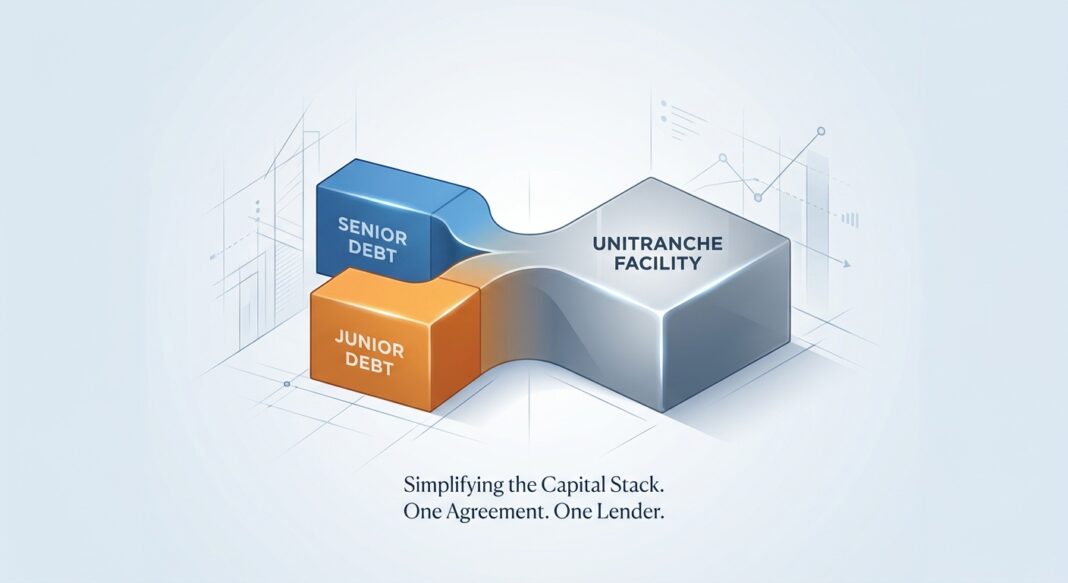
The unitranche loan tore up that script. First developed in the U.S. middle market around 2012, the unitranche is a single-lender (or single-syndicate) facility that merges senior and junior debt into one instrument, one credit agreement, and one all-in interest rate. For borrowers, the experience is elegantly simple. What happens beneath the surface, inside a confidential document called the Agreement Among Lenders (AAL): is where private credit’s structural sophistication truly lives.
Understanding how that internal architecture works is essential for any investor evaluating private credit funds today, and for any business owner or private equity sponsor weighing financing options for a transaction. The unitranche has become the dominant structure in middle-market lending, and it is not simply a convenience product. It is a precisely engineered risk-allocation machine.
The Concept: One Lien, Two Tiers of Risk
A unitranche facility is, at its core, a first-out / last-out structure concealed within a single credit agreement. The borrower sees one lender group, signs one loan document, and pays one blended interest rate. What the borrower typically does not see is the AAL: a separate, highly bespoke inter-lender agreement that governs how cash flows, control rights, and recovery proceeds are divided between the lenders participating in the facility.
According to legal analysis published by Mayer Brown (July 2026), the unitranche structure achieves a form of internal subordination within a single credit facility, rather than creating two distinct tranches with separate agreements and intercreditor arrangements.
Inside that single facility, two distinct lender positions exist:
- First-Out Lenders: Typically a bank providing a revolving credit facility. They receive priority of payment in any waterfall event: defaults, covenant breaches, or insolvency. Their risk is lower, so their yield is lower.
- Last-Out Lenders: Usually the direct lending fund providing the large term loan. They are paid after first-out lenders are made whole. Their risk is higher, so the AAL allocates them a higher effective yield, even though the borrower only sees and pays one blended rate.
As the American Bar Association (2025) explains: upon a waterfall trigger event such as default or insolvency, payments are redirected, typically cutting off last-out distributions until first-out lenders are fully repaid. In normal operating conditions, both classes receive their scheduled payments simultaneously.
How It Works: A Concrete Example
Consider a private equity sponsor acquiring a lower-middle-market software company with $10 million in EBITDA at a 7x multiple, a $70 million enterprise value. The sponsor contributes $28 million in equity (40% of EV) and needs $42 million in debt financing (4.2x leverage).
Traditional two-document structure:
- Senior first-lien term loan: $28 million at SOFR + 325 bps (~7.7% all-in)
- Second-lien / mezzanine: $14 million at SOFR + 800 bps (~12.5% all-in)
- Two credit agreements, two sets of covenants, six to eight weeks to close
- Blended cost of debt: approximately 9.3%
Unitranche alternative:
- Single unitranche facility: $42 million at SOFR + 575 bps (~10.0% all-in in mid-2026 market)
- One credit agreement, one covenant package, closes in three to four weeks
- Internally, the AAL allocates: $8 million first-out to the revolver bank at a lower yield; $34 million last-out to the direct lender at a higher effective yield, but the borrower sees only the blended 10.0% rate
The borrower pays a modest premium versus the blended two-tranche cost, but gains certainty, speed, and dramatically reduced execution complexity. As CT Acquisitions (June 2026) notes, private credit can close within four weeks while bank syndication may require six to eight weeks. For time-sensitive sponsor deals, that delta is often the deciding factor.
Current Market Relevance
The unitranche is no longer a niche instrument; it is the defining product of the private credit era. Here is where the market stands in mid-2026:
| Metric | Data Point | Source |
|---|---|---|
| Private credit global AUM | $2.1 trillion (crossed threshold in 2024) | Preqin Global Private Debt Report 2025 |
| Typical LMM unitranche spread (mid-2026) | SOFR + 500–700 bps; all-in 8%–11% | CT Acquisitions, June 2026 |
| Unitranche yield stability (Q2 2026) | Broadly stable quarter-over-quarter; credit spreads largely unchanged | Valuation Research Corp., July 2026 |
| Cliffwater CDLI 2025 annual return | 9.3% total return; 10.4% interest income; 20-year average of 9.5% | Cliffwater, March 31, 2026 |
| Bank C&I lending standards (Q2 2026) | Basically unchanged; NDFI standards tighter over prior year | Federal Reserve SLOOS, July 2026 |
The bank lending backdrop remains a structural tailwind for unitranche providers. According to the Federal Reserve’s April 2026 SLOOS, banks reported tighter standards across all categories of non-depository financial institution (NDFI) loans over the prior year: with higher premiums on riskier loans, stricter covenants, and shorter maximum maturities among the most widely reported changes. This environment continues to push mid-market borrowers toward direct lenders who can offer unitranche facilities with greater structural flexibility.
Meanwhile, the repricing cycle has compressed unitranche spreads from their 2022–2023 peaks. According to PitchBook LCD analysis, more than 50 companies repriced unitranche debt in the first nine months of 2024 alone, cutting the average spread by approximately 96 basis points to SOFR + 514. The market has since broadly stabilized, with upper-middle-market credits commanding tighter spreads than lower-middle-market peers, a critical distinction for investors evaluating fund positioning.
Decision Framework: Investors and Operators
For investors evaluating private credit funds with unitranche exposure:
- Ask about first-out vs. last-out composition. A fund holding predominantly last-out positions carries materially different risk than one holding first-out or full unitranche positions. As Alternative Fortune (March 2026) notes, the critical questions are: how much of the book is last-out exposure, and at what spread are new loans being written now?
- Evaluate AAL negotiation quality. The AAL is highly customizable, no two are identical. Skilled managers negotiate AALs that give last-out holders meaningful control over amendments and enforcement remedies, which is especially important in a stress scenario.
- Assess covenant structure amid the cov-lite trend. According to McKinsey’s 2025 Private Markets Report (June 2026), covenant-lite direct lending transactions rose to 21% of deals in 2025, up from just 4% in 2023, a meaningful erosion of lender protection that investors should weigh carefully.
For operators and PE sponsors evaluating unitranche financing:
- Prioritize certainty over headline cost. The speed premium embedded in unitranche pricing, typically 50 to 100 bps above equivalent two-document structures, is often rational when transaction certainty, confidentiality, and post-close flexibility are valued.
- Understand what you are signing. Mayer Brown notes that some unitranche borrowers are unaware that a two-tranche AAL structure sits behind their credit agreement. Knowing how voting rights and enforcement remedies are allocated between first-out and last-out lenders matters, particularly if the business ever faces a covenant waiver or amendment request.
- Leverage the repricing option. As the market has demonstrated, borrowers with strong credit profiles and sponsor backing have successfully repriced unitranche facilities, extracting significant savings without refinancing risk. Building repricing optionality into initial documentation is worth negotiating for.
Key Takeaways
- One instrument, two risk tiers: A unitranche combines senior and junior debt into a single credit agreement. The AAL governs how yield, cash flows, and control rights are divided between first-out and last-out lenders, entirely out of the borrower’s direct view.
- Speed and simplicity come at a price: Unitranche borrowers pay a spread premium relative to equivalent two-tranche structures, but gain execution certainty, single-lender management, and four-week close timelines vs. six to eight weeks for bank syndication.
- Bank retrenchment is a structural driver: With the Federal Reserve’s July 2026 SLOOS confirming tighter NDFI lending standards across bank balance sheets, private direct lenders continue to fill the vacuum, with the unitranche as their primary delivery vehicle.
- The cov-lite trend is real and material: Covenant-lite unitranche deals now represent 21% of direct lending transactions per McKinsey’s 2025 data, up from 4% in 2023. Investors considering private credit funds should scrutinize the covenant quality of underlying portfolios, not just headline yield.
- The CDLI’s 20-year track record provides context, not guarantees: The Cliffwater Direct Lending Index has averaged 9.5% annually over 20 years, posting 9.3% in 2025. But as the PwC Private Credit Survey 2026 observes, private credit is now entering its first meaningful credit cycle as a high-profile asset class, meaning historical return patterns should be evaluated alongside current underwriting standards, not in isolation.


