
Why One Loan Changed Everything
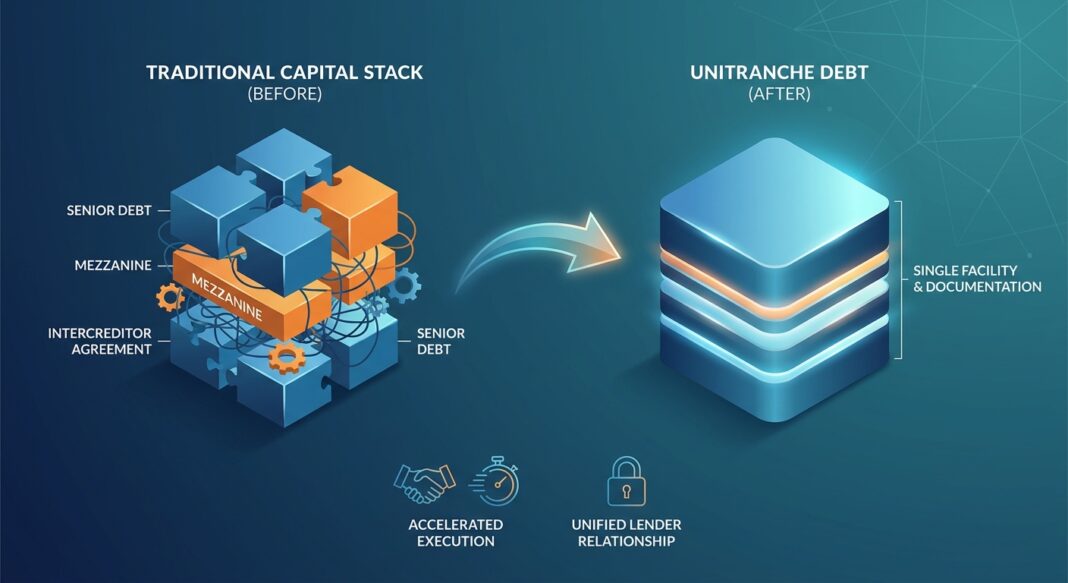
For decades, financing a leveraged buyout meant assembling a layered capital stack: negotiate senior debt with a bank syndicate, layer in second-lien or mezzanine debt from a different lender group, referee an intercreditor agreement between those parties, and hope everyone closed on schedule. The process was slow, complex, and fragile. A single holdout lender could delay or kill a time-sensitive acquisition.
Private credit rewrote that playbook with a single structural innovation: the unitranche loan. By collapsing the entire debt stack into one instrument, one set of documents, and one lender relationship, unitranche financing transformed how mid-market companies access capital, and how private credit funds generate returns. Understanding how unitranche works, what it costs, and when it makes sense is foundational knowledge for anyone operating in, investing in, or competing with private credit today.
As of mid-2026, unitranche structures remain the dominant financing instrument in private equity-sponsored middle-market transactions. The mechanics, pricing, and covenant dynamics of this structure deserve a thorough examination.
What Unitranche Debt Actually Is
Unitranche debt is a single-facility loan that blends what would traditionally be two or more separate debt layers (typically senior secured debt and subordinated or second-lien debt) into one credit facility, governed by one credit agreement, with one interest rate and one lender relationship. From the borrower’s perspective, the structure is elegantly simple: sign one document, wire one interest payment, manage one creditor.
As Wall Street Prep defines it, unitranche debt is “a distinct financing arrangement in which senior and junior tiers of debt tranches are blended into a single offering,” governed by a single credit agreement.
The traditional capital structure required a borrower to negotiate with multiple creditor groups simultaneously. PipelineRoad’s Capital Raising Glossary explains the contrast clearly: each traditional layer carries its own documents, covenants, pricing, and enforcement rights, and the intercreditor agreement between lenders is often the most complex and contentious document in any financing.
Unitranche eliminates that intercreditor negotiation entirely for the borrower. Behind the scenes, however, lenders often bifurcate the economics among themselves using a confidential Agreement Among Lenders (AAL). The AAL privately divides the loan into a first-out tranche (senior-priority, lower yield) and a last-out tranche (subordinated risk, higher yield). The borrower sees one facility and one blended rate; the lenders privately allocate different risk levels and returns between themselves.
This structure lets multiple lenders with different risk appetites participate in the same deal (a bank taking the safer first-out piece at tighter pricing, and a private credit fund absorbing the last-out piece at a higher spread) without creating any additional complexity for the borrower.
How the Numbers Work: A Concrete Example
Suppose a private equity firm is acquiring a software company with $20 million of EBITDA at a 10x purchase multiple, a $200 million enterprise value. The sponsor contributes $80 million in equity (40% of the capital structure) and finances the remaining $120 million with a single unitranche facility.
At current market pricing, that unitranche might be structured as follows:
- Principal: $120 million (6.0x leverage on $20M EBITDA)
- Rate: SOFR + 550 basis points, with a 1% SOFR floor
- OID (Original Issue Discount): 1.5%
- Upfront fee: 0.5%
- Maturity: 6 years, with minimal amortization (1% per year)
- Call protection: 102 / 101 / par in years 1-3
With 3-month SOFR near 3.25% (as projected by Capstone Partners, Q4 2025), the cash coupon is approximately 8.75%. The OID and upfront fee add roughly 40 basis points to the all-in lender yield when amortized over a 5-year expected life, producing an all-in yield to the lender near 9.15%.
Compare this to the alternative: a traditional structure might use a $80 million first-lien term loan at SOFR + 375 bps and a $40 million second-lien at SOFR + 800 bps: requiring two credit agreements, two sets of covenants, and a lengthy intercreditor negotiation. The blended cost might be modestly cheaper in pricing, but the execution risk, timing delay, and structural complexity could be material in a competitive auction where speed determines whether the deal closes at all.
For the lender, unitranche also typically includes maintenance covenants: most commonly a maximum total leverage ratio and a minimum fixed charge coverage ratio; that provide early warning signals and an active seat at the table if the borrower’s performance deteriorates. This is a meaningful protection advantage over the broadly syndicated loan market, where covenant-lite structures have become standard.
What Current Market Data Tells Us
Unitranche lending sits at the intersection of several powerful market forces shaping private credit in 2026. Here is what the data shows:
| Metric | Data Point | Source |
|---|---|---|
| CDLI 2025 Total Return (gross, unlevered) | 9.3% | Cliffwater, March 2026 |
| CDLI 20-Year Average Annual Return | 9.5% | Cliffwater, March 2026 |
| Median direct lending spread (Q4 2025) | SOFR + 475 bps | The Credit Crunch, January 2026 |
| Direct lending Q2 2025 margin dip | ~499 bps, near lowest since 2019 | ION Analytics / Debtwire, September 2025 |
| US direct lending dry powder (end-2025) | $146 billion (record) | Capstone Partners / PitchBook LCD, Q4 2025 |
| Direct lending LBOs with spread below 550 bps (2025) | 81% | Capstone Partners / PitchBook LCD, Q4 2025 |
| North American direct lending AUM (year-end 2025) | ~$644 billion | Preqin / PIMCO, March 2026 |
Several critical trends define the current environment for unitranche lenders and borrowers:
Spread compression has been significant. According to CreditSights (February 2026), direct lending yields fell below 10% for the first time in over three years during 2025, driven by Federal Reserve rate cuts and intensifying competition for deals. After spreads peaked near 700 basis points in 2022, the share of direct lending LBOs pricing below SOFR + 550 bps reached 81% in 2025.
Bank lending standards remain tight for smaller borrowers. The Federal Reserve’s April 2026 SLOOS reported tighter lending standards and basically unchanged demand for C&I loans across all firm sizes in Q1 2026, a persistent headwind that continues to push mid-market borrowers toward private credit. Notably, the April 2026 survey included new questions on Non-Depository Financial Institution (NDFI) loans, finding that significant net shares of banks also tightened standards for loans to business credit intermediaries, a signal that regulatory scrutiny is now flowing upstream to the private credit ecosystem itself.
The largest unitranche deals are scaling rapidly. According to Debtwire’s 1H 2025 Direct Lender Rankings, Clearlake’s acquisition of Dun & Bradstreet, valued at approximately $5.5 billion, was financed mostly by an Ares-led unitranche loan, pricing at SOFR + 550 bps. These mega-deals signal that unitranche has migrated well beyond its middle-market roots.
First-lien yields are projected to stabilize at 8–8.5% in 2026. Morgan Stanley Investment Management (December 2025) projects asset yields on directly originated first-lien loans will trough in the 8.0%–8.5% range in 2026, still elevated by historical standards and in the upper half of their 12-year range.
Decision Framework for Investors and Operators
For Investors Evaluating Unitranche Strategies
Investors considering allocation to unitranche-focused private credit funds may evaluate the following dimensions:
- First-out vs. last-out positioning: Understand whether the fund participates as first-out (lower yield, senior priority) or last-out (higher yield, subordinated risk). The AAL terms drive recovery outcomes in stress scenarios, and those documents are not available to borrowers or public investors.
- Covenant quality: Unitranche facilities historically include maintenance covenants that give lenders early-warning triggers. Investors may examine whether a fund’s portfolio has maintained covenant protection or has migrated toward looser, BSL-style documentation as competition intensifies.
- Spread vs. all-in yield: With SOFR compressing and spreads tightening, compare all-in yield (including OID and fees) rather than stated spread. Morgan Stanley estimates first-lien yields troughing near 8–8.5% in 2026, compare this to the 20-year CDLI average return of 9.5% to calibrate relative value.
- Manager scale and origination edge: Record dry powder of $146 billion creates deal competition. Managers with proprietary origination channels, existing sponsor relationships, and the scale to lead large single-lender facilities have a structural advantage in a crowded market.
- Credit quality trends: Per the Cliffwater CDLI 2025 annual results, non-accruals and realized losses held steady or improved in 2025 and remain well below historical averages, a positive signal, though investors may monitor PIK income trends as an early stress indicator.
For Operators and Business Owners Evaluating Unitranche Financing
Business owners and CFOs considering unitranche financing may weigh the following factors:
- Speed and certainty of execution: Unitranche facilities can close 30–45 days faster than a comparable syndicated alternative. For auction processes or time-sensitive acquisitions, that speed premium can outweigh the higher all-in cost.
- True cost comparison: Operators may compare the unitranche all-in yield (inclusive of OID, upfront fees, and any call protection) against a fully flexed syndicated alternative: accounting for underwriting risk, distribution timing, and MAC closing conditions that can create gap risk.
- Covenant modeling: Unitranche maintenance covenants require quarterly compliance testing. Operators should stress-test leverage and interest coverage ratios under downside scenarios before accepting a tight covenant package.
- Lender relationship quality: In a restructuring, unitranche borrowers deal with one lender group rather than navigating multi-creditor intercreditor battles. The quality of that single relationship (the lender’s restructuring posture, decision speed, and willingness to amend) has significant practical value.
Key Takeaways
- Unitranche simplifies the capital stack by merging senior and subordinated debt into a single instrument, eliminating intercreditor negotiations and accelerating execution, a structural advantage that commands a pricing premium over traditional multi-tranche debt.
- The Agreement Among Lenders (AAL) is the hidden architecture of bifurcated unitranche: it privately allocates first-out and last-out risk between lenders, enabling institutions with different risk appetites to co-participate without adding borrower complexity.
- Spread compression is real but manageable: Median direct lending spreads held at SOFR + 475 bps in Q4 2025, with 81% of LBO deals pricing below SOFR + 550 bps, but all-in yields remain in the 8–9% range, still historically attractive for senior-secured risk.
- Persistent bank tightening continues to support private credit demand: The Federal Reserve’s April 2026 SLOOS confirmed tighter C&I lending standards for Q1 2026, sustaining the structural gap that unitranche lenders were built to fill.
- Covenant protection remains a key differentiator for unitranche vs. broadly syndicated loans. Maintenance covenants give lenders early intervention rights, a feature investors in private credit funds may treat as a meaningful structural protection, particularly as late-cycle credit stress begins to surface across the broader leveraged loan universe.


