
Why Borrowers and Lenders Are Choosing Simplicity
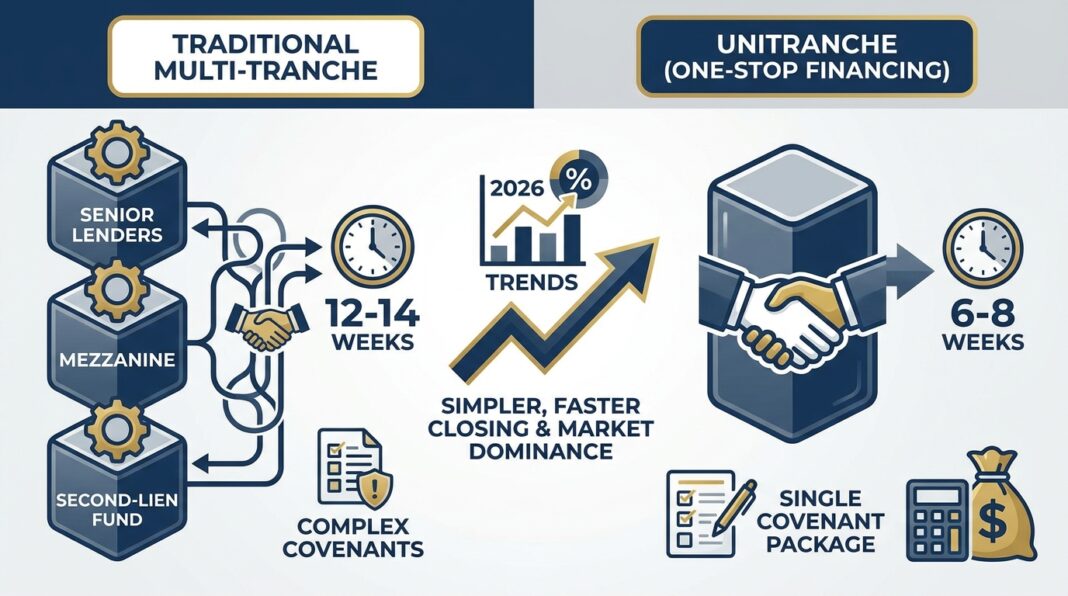
When a private equity sponsor needs to finance a $150 million acquisition, the traditional path required assembling two or three distinct lender groups: a senior secured bank syndicate, perhaps a second-lien fund, and maybe a mezzanine provider. Each demanded its own credit agreement, its own covenants, its own intercreditor negotiation. Closings stretched to 12–14 weeks. Deal certainty was never guaranteed.
Enter the unitranche loan: arguably the most consequential structural innovation in private credit over the past decade. In a unitranche, a single direct lender (or a coordinated club of lenders) provides the entire debt financing in one instrument, at one blended rate, under one covenant package. What once took multiple parties and months now closes in as few as six to eight weeks.
This is not simply a convenience play. Unitranche has reshaped the economics of middle-market lending, altered how investors underwrite private credit risk, and contributed to the rise of direct lenders as the dominant force in sub-$1 billion enterprise value transactions. Understanding how it works (mechanically, economically, and strategically) is fundamental literacy for anyone operating in or investing in private credit today.
What Is a Unitranche Loan?
Unitranche debt is a single-tranche term loan that combines what would otherwise be a senior secured loan and a subordinated or mezzanine loan into one instrument with one lender and one credit agreement. The borrower sees a single all-in interest rate, a single repayment schedule, and one set of financial covenants. Behind the scenes, however, the economics can be far more nuanced.
In many larger transactions, multiple private credit funds participate via an Agreement Among Lenders (AAL): a document invisible to the borrower that internally divides the unitranche into a “first-out” tranche (lower risk, lower yield) and a “last-out” tranche (higher risk, higher yield). The borrower makes one payment; the AAL governs how that payment is split. This structure allows lenders with different risk appetites to co-invest in the same deal while preserving the borrower’s experience of dealing with a single counterparty.
From a capital structure standpoint, the unitranche lender holds a first-lien position on all collateral, but at leverage levels that would historically have required subordinated financing. This is the defining tension (and the defining value proposition) of the instrument.
How It Works: A Concrete Example
Consider a manufacturing business with $20 million in EBITDA being acquired for $120 million (6.0x EBITDA enterprise value). The sponsor contributes $50 million in equity (roughly 42% of purchase price), and the remaining $70 million is financed with debt, representing 3.5x EBITDA in total leverage.
Under a traditional two-tranche structure, that $70 million might be split as follows:
- Senior Secured Term Loan: $50 million at SOFR + 300 bps (all-in ~7.2%)
- Mezzanine Loan: $20 million at a fixed 13–14%
- Two credit agreements, two covenant packages, one intercreditor agreement
- Closing timeline: 12–14 weeks
Under a unitranche structure, the same $70 million is provided by a single direct lender at a blended rate:
- Unitranche Term Loan: $70 million at SOFR + 525 bps (all-in ~9.0–9.2%)
- One credit agreement, one maintenance covenant package, one lender relationship
- Closing timeline: 6–8 weeks
The borrower pays a modestly higher blended rate relative to the senior tranche alone, but avoids the complexity, legal cost, and execution risk of the two-tranche process. The all-in cost is often comparable to or lower than a full senior-plus-mezzanine stack when legal fees, arrangement fees, and delayed-close risk are factored in. For the lender, the first-lien position provides collateral priority while the higher spread compensates for holding sub-equivalent leverage.
This is the core trade-off unitranche makes explicit: certainty and simplicity at a blended price.
Current Market Relevance
Unitranche is not an emerging concept; it is the established infrastructure of the modern middle-market lending ecosystem. Understanding where pricing and terms stand today is essential for both investors evaluating private credit strategies and operators considering their financing options.
| Metric | Current Level (Q2 2026) | Source |
|---|---|---|
| Unitranche all-in yield range | 9.00%–9.75% | Valuation Research Corp., Q2 2026 |
| Unitranche coupon spread range | SOFR + 475–550 bps | Valuation Research Corp., Q2 2026 |
| Avg. middle-market direct lending all-in yield (Q1 2026) | 9.13% | NEPC, Q1 2026 Private Markets Report |
| Direct lending yield premium vs. broadly syndicated loans | +228 bps | NEPC, Q1 2026 Private Markets Report |
| Typical leverage in sponsored unitranche deals | 5.0x–6.0x EBITDA | Valuation Research Corp., Q2 2026 |
| Covenant-lite share of direct lending deals (2025) | 21% (up from 4% in 2023) | McKinsey Global Private Markets Report, 2025 (citing Proskauer/PitchBook, Feb. 2026) |
| Fed SLOOS: Bank C&I lending standards (Q1 2026) | Tighter across all firm sizes | Federal Reserve SLOOS, April 2026 |
The macro context matters enormously here. According to the Federal Reserve’s April 2026 SLOOS, banks reported tighter lending standards for commercial and industrial loans across all firm sizes during the first quarter of 2026, continuing a multi-quarter trend of bank retrenchment. This is precisely the environment in which unitranche direct lending tends to gain structural advantage: when banks pull back, private lenders fill the void, often at improved pricing and terms.
Per Valuation Research Corp.’s Q2 2026 Private Markets Update, unitranche coupon spreads are running at roughly 475–550 basis points over SOFR, approximately 25 basis points above year-end 2025 levels, with all-in yields in the 9.00%–9.75% range as of June 2026. That represents a decline of roughly 250 basis points from the 2023 peak, but still well above pre-2022 historical ranges of approximately 7%–8%.
Lord Abbett’s 2026 Midyear Private Credit Outlook notes that new loans are increasingly structured with less leverage, more covenants, fewer payment-in-kind (PIK) requests, and tighter documentation, a lender-friendly reset that makes current vintage unitranche lending more defensively structured than deals written in 2021–2023. According to the same report citing PitchBook data, spreads have widened by roughly 50–100 basis points since late 2025 on new direct lending issues.
One important structural nuance: despite a rise in covenant-lite documentation at the top of the market, ABF Journal’s analysis of Secured Research data found that the vast majority of middle-market unitranche facilities still retain at least one financial maintenance covenant, a meaningful structural distinction from the broadly syndicated loan market, where over 90% of senior loans carry no meaningful maintenance covenants. That embedded covenant protection is a core reason institutional investors consider unitranche direct lending a structurally differentiated asset class relative to public leveraged loans.
Decision Framework: Investors and Operators
For Investors Evaluating Unitranche Strategies
When assessing a private credit manager’s unitranche portfolio, practitioners typically examine several dimensions:
- Leverage attachment point: At what EBITDA multiple does the unitranche attach? A facility at 4.0x leverage in a first-lien position carries a materially different risk profile than one attaching at 6.0x. Investors often evaluate average portfolio leverage relative to trailing EBITDA, not pro forma or adjusted figures.
- Covenant headroom: What is the cushion between the borrower’s current financial metrics and the covenant trigger? Tighter headroom signals higher near-term restructuring risk; wider headroom provides an early-warning mechanism before a loan goes non-performing.
- Spread-to-risk alignment: Is the manager being adequately compensated for the leverage level and sector exposure it is underwriting? As Northleaf Capital’s Q1 2026 market update notes, direct lending continues to generate a meaningful yield premium over broadly syndicated markets, but that premium must be evaluated against underlying credit quality.
- PIK prevalence: Payment-in-kind income, where interest is added to principal rather than paid in cash, can inflate reported income without reflecting true cash generation. Elevated PIK usage in a portfolio is a signal investors consider carefully when assessing true credit health.
- Sector concentration: As of mid-2026, software and technology sectors carry elevated spread premiums and higher LTV ratios following AI-disruption-related valuation compression. Investors often evaluate how much of a unitranche portfolio is exposed to these sectors and whether underwriting assumptions remain valid.
For Operators Considering Unitranche Financing
Business owners and CFOs evaluating a unitranche facility should weigh several practical factors:
- Execution certainty vs. cost: Unitranche commands a spread premium over senior-only bank debt, but the all-in cost (including legal fees, arrangement fees, and time-to-close) is often competitive with multi-tranche alternatives. Operators in time-sensitive M&A situations frequently prioritize the six-to-eight-week execution window over basis-point optimization.
- Relationship leverage: With one lender, amendments, waivers, and covenant resets require one conversation rather than a lender syndicate vote. This bilateral dynamic can be structurally advantageous in periods of operational stress or when strategic pivots require capital structure flexibility.
- Covenant architecture: Unlike bank revolvers or syndicated loans that may carry multiple maintenance tests, unitranche covenants are typically negotiated bilaterally. Operators often have more ability to shape headroom levels, EBITDA definition, and cure rights than in a syndicated structure, but should negotiate these terms carefully at origination, not after problems arise.
- Prepayment flexibility: Unitranche loans commonly include call protection, typically a “no-call” period followed by a declining prepayment premium (e.g., 102/101). Operators considering near-term refinancing or an equity exit should model these economics against projected hold periods.
Key Takeaways
- Unitranche consolidates complexity: By combining senior and subordinated debt into a single instrument, unitranche eliminates intercreditor negotiations, compresses execution timelines, and reduces documentation burden, making it the structural tool of choice for sponsored middle-market transactions.
- Pricing reflects blended seniority: As of Q2 2026, unitranche all-in yields range from approximately 9.00%–9.75%, compensating lenders for holding leverage levels that include what would historically have been subordinated exposure, with spreads running roughly 475–550 basis points over SOFR.
- Covenants remain a structural differentiator: Unlike the broadly syndicated loan market, where covenant-lite has become standard, most middle-market unitranche facilities retain at least one financial maintenance covenant, giving lenders an early seat at the table if performance deteriorates.
- Bank retrenchment is a structural tailwind: With the Federal Reserve’s April 2026 SLOOS confirming continued tightening of C&I lending standards across all firm sizes, direct lenders providing unitranche financing continue to fill a structural gap in the capital markets, particularly for sub-$500 million transactions where bank appetite remains constrained.
- Discipline in underwriting is the variable that matters most: In a market where leverage can run 5.0x–6.0x EBITDA and covenant-lite structures are rising, the quality of the unitranche instrument depends heavily on the lender’s underwriting standards, sector selection, and the specificity of covenant protections negotiated at origination. For investors, manager selection, not just asset class exposure, is the primary driver of outcomes.


