
Why Capital Structures Are Getting Simpler, and More Expensive
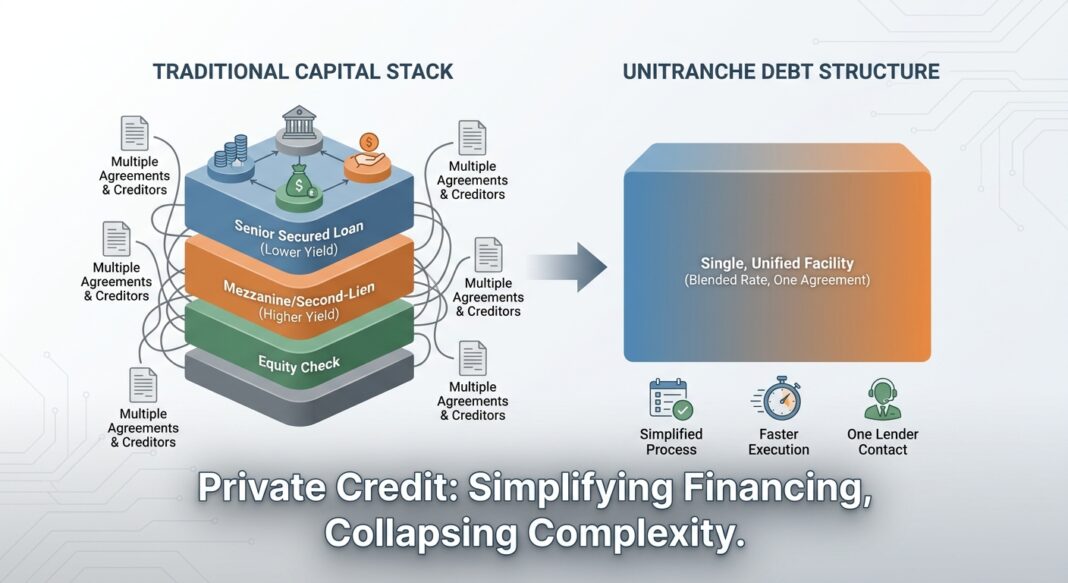
Walk into most middle-market leveraged buyouts before 2015, and you would find a layered capital structure: a senior secured term loan, a revolving credit facility, a second-lien layer, perhaps a mezzanine tranche, and finally the equity check at the bottom. Each layer had its own lender, its own credit agreement, its own pricing, and its own set of rights in a default. Stitching them together required an intercreditor agreement, one of the most contested documents in any financing.
Today, a growing majority of middle-market deals skip that complexity entirely. The instrument doing the work is the unitranche loan: a single-facility debt structure that collapses what would traditionally be separate senior and subordinated layers into one loan, one credit agreement, one lender, and one blended interest rate. According to CT Acquisitions (June 2026), the unitranche market grew from roughly $20 billion in annual issuance in 2015 to over $200 billion in 2025 as direct lenders displaced traditional bank syndication for sub-$1 billion EBITDA borrowers.
Understanding how unitranche works (its pricing logic, covenant structure, and trade-offs) is foundational knowledge for anyone evaluating private credit, whether as an investor allocating capital or a business owner considering financing options.
The Concept: What Unitranche Actually Does
In a traditional leveraged capital structure, risk is sorted by seniority. Senior secured lenders sit at the top, get paid first, and accept the lowest yield. Mezzanine lenders sit below them, accept more risk, and demand a higher return. The blended cost of that stack might combine, say, a 9% senior facility with a 14% mezzanine tranche, producing a weighted average cost of debt that reflects the different risk layers.
Unitranche consolidates all of that into one instrument at a single blended rate. As PipelineRoad (March 2026) explains: the entire capital structure below equity collapses into a single instrument. The borrower signs one credit agreement. There is no intercreditor agreement to negotiate. The lender (typically a direct lending fund or a small club of two or three direct lenders) provides the entire debt package.
Internally, the lender may still separate the facility into a “first-out” tranche (lower risk, lower yield) and a “last-out” tranche (higher risk, higher yield) governed by an agreement among lenders. But the borrower sees none of that complexity. From the operator’s seat, there is one relationship, one set of reporting covenants, and one phone call when an amendment is needed.
According to CT Acquisitions (June 2026), typical unitranche structures carry total leverage of 4–6x EBITDA, a blended interest rate of 8–11% in 2026, a single covenant package, and a single lender relationship, making it the dominant financing instrument for lower-middle-market deals with enterprise values between $25 million and $200 million.
How It Works: A Concrete Example with Numbers
Consider a hypothetical manufacturing business with $10 million of EBITDA being acquired by a private equity sponsor for a total enterprise value of $60 million (6.0x EBITDA). Here is how the two structures compare:
Traditional Two-Tranche Structure:
- Senior secured term loan: $35 million at 9.0% (3.5x EBITDA)
- Mezzanine loan: $10 million at 13.5% (1.0x EBITDA)
- Equity: $15 million sponsor check
- Total debt: $45 million (4.5x EBITDA)
- Blended cost of debt: ~9.9%
- Two lenders, two credit agreements, one intercreditor agreement
- Timeline to close: 8–12 weeks
Unitranche Structure:
- Unitranche term loan: $45 million at 10.5% (4.5x EBITDA)
- Equity: $15 million sponsor check
- Total debt: $45 million
- Single cost of debt: 10.5%
- One lender, one credit agreement, no intercreditor negotiation
- Timeline to close: 4–6 weeks
The borrower pays roughly 60 basis points more in annual interest, approximately $270,000 per year on $45 million of debt. In exchange, the deal closes faster, legal costs are lower (no intercreditor to negotiate), and ongoing lender management is dramatically simplified. As CT Acquisitions (June 2026) notes, the all-in cost difference over a five-year hold is often less than $1 million, meaningful but rarely deal-breaking, especially when weighed against the execution certainty that unitranche provides.
The covenant structure matters too. PipelineRoad (March 2026) describes how unitranche facilities typically include maintenance covenants (commonly a maximum total leverage ratio and a minimum fixed charge coverage ratio) which are tested quarterly. These give lenders an early seat at the table if financial performance deteriorates, enabling proactive credit management rather than waiting for a payment default.
Current Market Reality: Where Unitranche Stands in 2026
The macro environment has shifted the unitranche market in ways that matter for both investors and operators. The key data points as of mid-2026:
| Metric | Current Level | Source |
|---|---|---|
| LMM Unitranche All-In Yield Range | 9.00% – 9.75% | VRC Q2 2026 |
| 3-Month Term SOFR (Q2 2026) | ~3.69% | VRC Q2 2026 |
| LMM Credit Spread Over SOFR | 500 – 700 bps | CT Acquisitions June 2026 |
| Spread Widening Since Late 2025 | ~50 – 100 bps wider | Lord Abbett June 2026 |
| Global Private Credit AUM (Est.) | ~$3.2 trillion | PIMCO June 2026 |
| Direct Lending Share of Private Debt Fundraising (2024) | ~60% | Creative Planning / PitchBook |
The most important structural shift is not just in pricing. According to Lord Abbett (June 2026), new unitranche loans are increasingly coming with better credit structures: less leverage, more covenants, fewer payment-in-kind (PIK) requests, and tighter documentation, a meaningful improvement for disciplined lenders over conditions that prevailed six months ago.
The bank lending environment is amplifying demand. The Federal Reserve’s April 2026 SLOOS reported that banks tightened lending standards for commercial and industrial loans across firms of all sizes during the first quarter of 2026, and separately tightened all terms on loans to non-depository financial institutions: including stricter covenants, shorter maturities, and higher risk premiums. When banks pull back, direct lenders with unitranche capital fill the gap.
Meanwhile, ABF Journal (August 2025) notes that unlike the broadly syndicated loan market, where over 90% of senior loans carry no meaningful maintenance covenants, most middle-market unitranche facilities retain at least one financial maintenance covenant, providing lenders with earlier warning signals and greater downside protection.
Decision Framework
For Investors Evaluating Unitranche Exposure
When assessing a private credit fund or BDC with significant unitranche exposure, investors may consider the following criteria:
- Covenant quality: Does the fund demand maintenance covenants with meaningful cushions (typically 25–35% over the base-case leverage model), or has it accepted “covenant-loose” terms where breach is practically impossible?
- Leverage discipline: StepStone (February 2026) highlights that managers who kept leverage and loan-to-values contained have managed default rates below long-term averages: suggesting that disciplined underwriting, not just yield, determines outcomes.
- Spread adequacy: With 3-month Term SOFR at approximately 3.69% as of Q2 2026, investors should evaluate whether the credit spread being earned (ideally 500 bps or above for lower-middle-market credits) adequately compensates for illiquidity and credit risk across the full cycle.
- First-out vs. last-out positioning: In club unitranche deals, not all lenders hold equivalent risk. Investors in a fund positioned in the “last-out” portion of a unitranche carry higher loss-given-default risk than first-out holders.
For Operators Evaluating Whether to Use Unitranche
Business owners and CFOs evaluating unitranche financing may weigh the following:
- Speed and certainty: Private Capital Global (September 2025) notes that private credit can close within four weeks while bank syndications may require 6–8 weeks, a material advantage when deal timing is competitive.
- True all-in cost: The headline spread is not the full picture. Operators should factor in original issue discount (OID), typically 2–3%, prepayment fees (commonly 102/101/par in years 1, 2, and 3), and amendment fees over the life of the loan.
- Covenant headroom modeling: With maintenance covenants tested quarterly, operators should stress-test their financial models to ensure they maintain adequate cushion, particularly on leverage ratios, even in downside scenarios. Private Capital Global recommends modeling interest coverage ratios above 2.0x on forward projections, with stronger deals targeting 2.5–3.0x.
- When a traditional two-tranche structure may still win: For very large transactions with substantial lender competition, or where a borrower has strong enough credit to access the broadly syndicated loan market, the cost premium of unitranche may outweigh its convenience benefits.
Key Takeaways
- Unitranche is a structural simplification, not just a product: It eliminates the intercreditor agreement, reduces legal complexity, and consolidates the lender relationship, benefits that have genuine economic value for both borrowers and lenders.
- The all-in cost is higher by design: The blended rate compensates one lender for holding both the senior and subordinated risk. The premium over a two-tranche structure typically runs 50–100 basis points, which translates to a meaningful but manageable cost differential over a 5-year hold.
- Covenant retention is a key lender advantage: Unlike the broadly syndicated market where covenant-lite has become the standard, most middle-market unitranche loans retain at least one maintenance financial covenant, giving private credit lenders earlier warning and more leverage in a credit deterioration scenario.
- The current environment is shifting in lenders’ favor: According to Lord Abbett, spreads have widened 50–100 basis points since late 2025, leverage has moderated, and documentation has tightened, creating a more favorable risk-return entry point for disciplined lenders than the borrower-friendly conditions of 2023–2024.
- Bank tightening continues to expand the opportunity: Consecutive Federal Reserve SLOOS surveys through Q1 2026 show banks tightening C&I lending standards across all firm sizes. For middle-market companies that fall below the investment-grade threshold, private credit unitranche remains, in many cases, the only viable path to leveraged financing at speed.


