
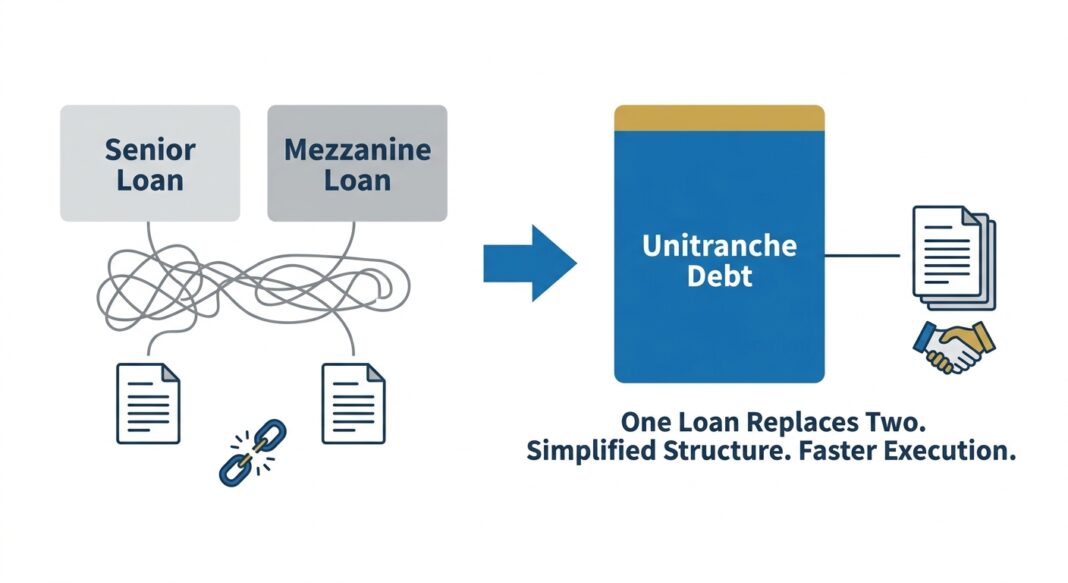
Why One Loan Is Often Better Than Two
Picture the traditional path to financing a middle-market acquisition: a company or its private equity sponsor negotiates a senior secured loan with a bank, then turns around and raises expensive mezzanine or second-lien debt from a separate lender, signs two credit agreements, manages two intercreditor relationships, and satisfies two sets of covenants, all before closing a single deal. That was the standard playbook for decades.
Unitranche debt collapsed that structure into one instrument. A single lender, typically a direct lending fund, provides a single loan that spans the entire debt portion of the capital stack, from senior through subordinated, under one credit agreement at one blended interest rate. For middle-market borrowers and their sponsors, the operational simplicity is transformative. For investors in private credit funds, unitranche has become the dominant deployment vehicle in direct lending.
Understanding how unitranche works (its mechanics, its pricing, and its tradeoffs) is foundational to understanding modern private credit. In an environment where banks continue tightening lending standards and direct lenders are expanding their market share, this structure is no longer a niche product. It now dominates the lower middle-market direct lending channel.
The Mechanism: What Unitranche Actually Does
Unitranche debt is a hybrid loan that combines what would otherwise be separate senior debt and subordinated (mezzanine or second-lien) debt into a single financing instrument. As defined in SEC filings from direct lending BDCs, unitranche loans combine both senior and subordinated debt, generally in a first lien position, with lenders agreeing separately to an order of priority among themselves.
That last phrase is the key. From the borrower’s perspective, there is one lender, one credit agreement, one interest rate, and one closing process. Behind the scenes, when multiple lenders participate in a unitranche facility, they govern their internal waterfall of payments through a private document called an Agreement Among Lenders (AAL). The AAL divides the facility into a “first out” (lower-risk, lower-yield) portion and a “last out” (higher-risk, higher-yield) portion. Borrowers never see this document; they simply make one payment to one agent.
The interest rate reflects this blended risk profile. The “last out” portion earns a higher interest rate in exchange for the greater risk of loss, while the “first out” portion commands a tighter spread reflecting its priority claim on cash flows and collateral. The borrower pays a single rate that blends both, typically higher than standalone senior debt, but lower than the weighted average cost of a traditional senior-plus-mezzanine stack.
A Concrete Example: The Numbers Behind a Unitranche Deal
Consider a private equity-sponsored acquisition of a manufacturing business with $10 million in EBITDA, being purchased at a 7x multiple for a total enterprise value of $70 million. Here is how a traditional two-tranche structure compares to a unitranche solution:
Traditional Structure (Two Tranches):
- First Lien Senior Debt: $35M at SOFR + 350 bps ≈ 7.2% all-in
- Second Lien / Mezzanine: $15M at SOFR + 800 bps ≈ 12.2% all-in
- Equity: $20M
- Two lenders, two credit agreements, two sets of covenants, two closings
- Timeline: 8–12 weeks
Unitranche Structure (One Tranche):
- Unitranche Loan: $50M at SOFR + 575 bps ≈ 9.5% all-in
- Equity: $20M
- One lender, one credit agreement, one set of covenants, one closing
- Timeline: 3–4 weeks
The borrower pays a slightly higher blended rate on the unitranche versus the senior tranche alone, but saves significantly versus the weighted-average cost of the two-tranche structure, and gains meaningful execution speed. Private credit can close a unitranche deal within four weeks, while traditional bank syndication may require 6–8 weeks. In competitive M&A auctions, that speed differential is often decisive. Total leverage in this example is 5x EBITDA, within the typical unitranche range of 4–6x EBITDA.
Current Market Relevance: Where Unitranche Stands in 2026
Unitranche has grown from a niche middle-market product into one of the defining structures of private credit. The market context in mid-2026 reinforces why:
| Metric | Data Point | Source |
|---|---|---|
| Global Private Credit AUM | ~$3.2 trillion | PIMCO / Preqin / PitchBook, June 2026 |
| LMM Unitranche Spread (2026) | SOFR + 500–700 bps | CT Acquisitions, June 2026 |
| 3-Month Term SOFR (Q2 2026) | ~3.69% | Valuation Research Corp., Q2 2026 |
| Spreads vs. Late 2025 | +50–100 bps wider | Lord Abbett / PitchBook, June 2026 |
| Bank C&I Lending Standards (Q1 2026) | Tighter for all firm sizes | Federal Reserve SLOOS, April 2026 |
| Private Credit AUM Forecast by 2030 | $4.5 trillion | Preqin via IQ-EQ, February 2026 |
The bank pullback is structural, not cyclical. The April 2026 SLOOS reported tighter standards for all categories of non-depository financial institution (NDFI) loans, with significant net shares of banks citing higher premiums on riskier loans, stricter covenants, and shorter maximum maturities. That tightening creates a persistent funding gap that unitranche lenders are structurally positioned to fill.
Conditions have also shifted in favor of lenders versus borrowers. New loans are increasingly coming with better credit structures: less leverage, more covenants, fewer PIK requests, and tighter documentation, according to Lord Abbett’s 2026 midyear outlook citing PitchBook data. The market has reset from a borrower-friendly environment (2021–2023) toward a more balanced one.
Decision Framework for Investors and Operators
For Investors Evaluating Private Credit Funds:
- Understand the tranche position: Determine whether a fund deploys primarily into “first out” (lower spread, more senior) or “last out” (higher spread, more subordinated) positions within unitranche structures. Each carries a materially different risk profile even if both are called “unitranche.”
- Evaluate covenant quality: The 2026 market shift toward tighter documentation is meaningful. Investors evaluating funds consider whether new vintages include financial maintenance covenants, tighter leverage caps, and restricted payment baskets, protections that eroded in the 2021–2022 vintage.
- Review concentration and lender relationships: Typical unitranche structures involve one to three direct lenders providing a facility. Concentrated lender positions can offer better monitoring and workout leverage but also create single-counterparty dependency.
- Consider SOFR sensitivity: Unitranche loans are floating-rate instruments. With 3-month SOFR at approximately 3.69% as of Q2 2026 and credit spreads stable, all-in yields for lower middle-market unitranche loans are in the 8–11% range, an attractive spread over investment-grade alternatives, but one that moves with rate policy.
For Business Owners and Operators Evaluating Financing Options:
- Value certainty over cheapness: In competitive acquisitions or time-sensitive recapitalizations, unitranche’s single-close, single-lender execution can be worth more than the basis points saved by assembling a bank syndicate.
- Understand the all-in cost: Headline pricing is quoted as SOFR + spread, but the all-in cost is materially higher once original issue discount (OID) and ongoing fees are factored in. Operators evaluate the full economic cost, not just the headline spread.
- Know your EBITDA floor: Unitranche lenders typically serve companies with $3M–$50M in EBITDA. Below that threshold, mezzanine or other structures may be more appropriate. Above $100M EBITDA, the broadly syndicated loan (BSL) market often provides cheaper capital.
- Negotiate the covenant package carefully: A single lender relationship means a single point of negotiation for amendments and waivers. That is both a feature and a constraint. Operators consider whether they prefer the flexibility of a relationship lender versus the anonymity of a syndicated structure.
Key Takeaways
- Unitranche = simplicity by design. One credit agreement, one lender relationship, and one blended interest rate replace the complexity of senior-plus-subordinated stacks. The structure’s core value is execution speed and certainty.
- The “first out / last out” waterfall still matters. Investors should look past the single loan label and understand where within the unitranche structure their capital sits, the risk and yield profiles are meaningfully different.
- Bank retrenchment is structural tailwind. Consecutive quarters of tighter C&I lending standards, as documented in Federal Reserve SLOOS surveys through Q1 2026, continue to expand the addressable market for unitranche direct lenders in the middle market.
- The market has shifted toward lender-friendly terms. Spreads have widened 50–100 bps since late 2025 and documentation quality has improved, a meaningful change for investors evaluating current vintage private credit funds versus 2021–2022 vintages.
- All-in cost requires careful analysis. For operators, unitranche pricing includes OID, upfront fees, and potential prepayment premiums on top of the SOFR + spread headline. Evaluating the full economic cost, not just the coupon, is essential to sound capital structure decisions.


