
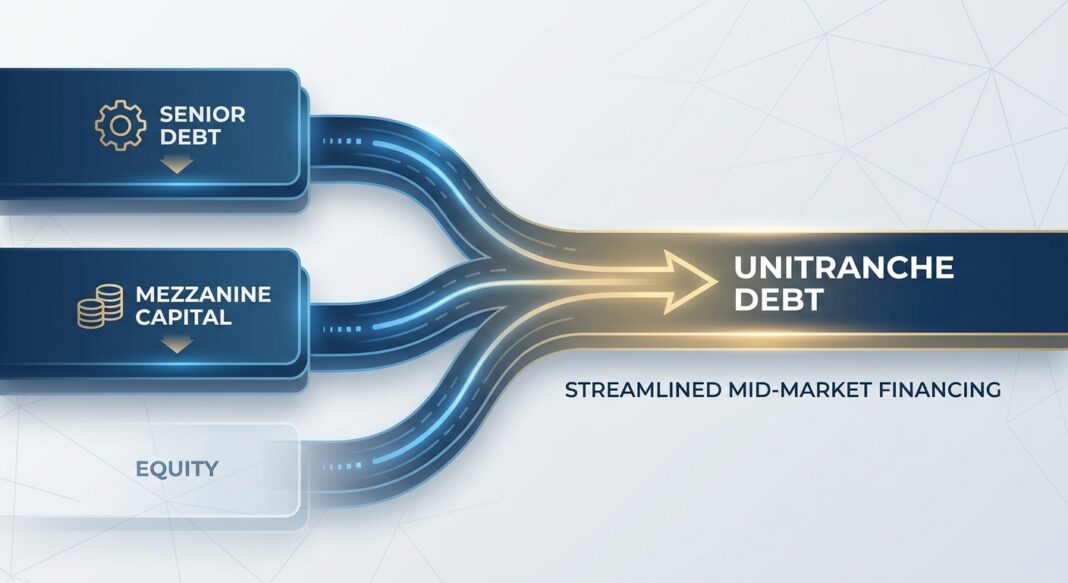
Why One Loan Now Does the Work of Three
Walk into any middle-market leveraged buyout in 2026 and you are overwhelmingly likely to find a single document, a single lender relationship, and a single interest rate governing the entire debt side of the deal. That instrument is the unitranche loan, and understanding how it works is essential for anyone evaluating private credit as an asset class or sourcing debt capital to fund an acquisition.
For decades, the standard leveraged buyout capital stack was layered: a bank provided senior secured debt at the cheapest rate, a mezzanine fund provided subordinated debt at a higher rate and sometimes took equity warrants, and sponsors contributed equity at the bottom. Each layer had its own document, its own covenants, and its own intercreditor relationship to manage. The result was complexity, slower timelines, and frequent friction between lenders when a deal hit turbulence.
The rise of direct lending as a dominant force in private credit changed the architecture of mid-market financing. Unitranche structures emerged to eliminate that friction, and today, according to data tracked by CTA Acquisitions (June 2026), the unitranche market has grown from roughly $20 billion in annual issuance in 2015 to over $200 billion in 2025, as direct lenders displaced traditional bank syndication for sub-$1 billion EBITDA borrowers.
What a Unitranche Actually Is
A unitranche loan is a single-tranche acquisition facility that combines what would otherwise be senior debt and mezzanine or subordinated debt into one instrument, governed by one credit agreement, with one lender (or a small club of lenders acting as one). The borrower sees a single blended interest rate, a single covenant package, and a single set of closing documents.
Behind the scenes, lenders may internally split risk through an Agreement Among Lenders (AAL): one party taking a “first-out” position (lower yield, lower risk) and another taking a “last-out” position (higher yield, higher loss exposure). But this internal arrangement is invisible to the borrower. As described by CTA Acquisitions (June 2026), total leverage on a typical unitranche transaction runs 4–6x EBITDA, with a blended interest rate of approximately SOFR + 500–700 basis points in 2026, producing a single covenant package and a single intercreditor relationship.
The key structural trade-off is straightforward: borrowers pay a modest premium in all-in cost versus a perfectly optimized senior/mezz stack, but gain speed, certainty, and structural simplicity. Lenders, for their part, gain full control over workout and amendment decisions without needing to negotiate with a competing creditor class.
Side-by-Side: The Numbers That Drive the Decision
Consider a hypothetical acquisition of a manufacturing business with $8 million in EBITDA at a 6.0x purchase multiple, a $48 million enterprise value. The sponsor contributes $24 million in equity (50% of EV) and needs $24 million in debt financing. Here is how the two structures compare:
Option A, Traditional Senior + Mezz Stack:
- Senior loan: $16 million at SOFR + 350 bps (~7.8% all-in). First lien. Full maintenance covenants. 6-week syndication timeline.
- Mezzanine loan: $8 million at a fixed 13.0% (cash + PIK blend). Subordinated. Warrant coverage of 3–5% equity. Intercreditor agreement required.
- Blended debt cost: Approximately 9.5% on the total $24 million debt package.
- Complexity: Two separate negotiations, two legal processes, two lender approval cycles, and an intercreditor agreement that governs how the senior and mezz lenders interact in a default scenario.
Option B, Unitranche:
- Unitranche loan: $24 million at SOFR + 600 bps (~9.5% all-in as of Q2 2026, per CTA Acquisitions). 2% OID at close. Single maintenance covenant (maximum leverage, stepping down annually). 6-year term. 102/101/par prepayment schedule.
- Blended debt cost: ~9.83% including amortized OID over the loan life.
- Simplicity: One negotiation, one closing, one lender to manage post-close. Closes in 4–6 weeks versus 6–10 weeks for a dual-tranche structure.
The all-in cost difference between the two structures, roughly 30–50 basis points in this example, is real but often modest when weighed against execution risk. As noted by CTA Acquisitions (June 2026), the legal and closing cost savings on a unitranche can offset $200–400K of the premium, making the true economic gap closer to $600–800K on a 5-year hold, meaningful, but rarely deal-breaking when certainty and speed are required.
Current Market Reality: Spreads, Standards, and the Lender-Friendly Reset
The unitranche market entered 2026 in the middle of a meaningful structural shift. After years of spread compression driven by excess capital chasing limited deal flow, lender-friendly conditions are reasserting themselves.
According to McKinsey’s Global Private Markets Report (May 2026), global new-issue direct loan median spreads peaked at 716 basis points in March 2023, then compressed steadily to 544 basis points at year-end 2025, as competition for deals intensified. However, that trajectory is now reversing. Per Lord Abbett’s 2026 Midyear Outlook (June 2026), spreads have widened by roughly 50 to 100 basis points since late 2025, while new loan documentation is increasingly coming with better credit structures: less leverage, more covenants, and fewer PIK requests.
The Federal Reserve’s own data confirms a tighter bank lending backdrop that continues to drive borrowers toward private credit. The Fed’s April 2026 SLOOS reported tighter lending standards for commercial and industrial loans across firms of all sizes in Q1 2026, with banks also tightening all terms surveyed on loans to non-depository financial intermediaries: including higher risk premiums, stricter covenants, shorter maturities, and tighter collateralization requirements.
On the performance side, the Cliffwater Direct Lending Index (CDLI) full-year 2025 report (March 2026) recorded a 9.3% total return for the calendar year, with interest income of 10.4%, consistent with the index’s 20-year average of 9.5%. Deal flow is accelerating: U.S. M&A and LBO deal volumes in Q1 2026 rose more than 30% relative to the same period the prior year, according to Northleaf Capital’s Q1 2026 Market Update (May 2026).
| Metric | Data Point | Source |
|---|---|---|
| Global Private Credit AUM | ~$2.1 trillion (2025) | Preqin via CTA Acquisitions, 2026 |
| CDLI Total Return, FY 2025 | 9.3% (20-yr avg: 9.5%) | Cliffwater CDLI, March 2026 |
| Typical LMM Unitranche Spread (Q2 2026) | SOFR + 500–700 bps | CTA Acquisitions, June 2026 |
| Global Direct Loan Median Spread, YE 2025 | 544 bps (peak: 716 bps, Mar 2023) | McKinsey Global Private Markets Report, May 2026 |
| LPs Planning to Increase Private Credit Allocations | 40% (up from 38% prior year) | McKinsey LP Survey, January 2026 |
Decision Framework: Investors and Operators
For Investors Evaluating Private Credit:
- Position in the stack matters. Unitranche lenders sit as senior secured creditors, above mezzanine and equity in a liquidation. That first-lien seniority is a meaningful downside protection in stress scenarios, particularly as tightening bank standards expand the addressable market for direct lenders.
- Evaluate the covenant package. Per Lord Abbett (June 2026), the most important shift in 2026 is not wider spreads alone; it is that new loans are increasingly structured with better credit protections: lower leverage, tighter covenants, and fewer PIK requests. Covenant quality is a key differentiator between strong and weak vintage performance.
- Assess manager concentration. According to McKinsey (May 2026), the top 25 managers accounted for approximately 72% of total private credit fundraising in 2025. Capital is concentrating in scaled platforms, investors considering the asset class should evaluate whether they are accessing differentiated origination or simply paying for brand.
- Understand the yield premium context. Per J.P. Morgan Private Bank data compiled from Cliffwater, Preqin, and Bloomberg (March 2026), over a 40-quarter period ending December 2024, direct lending delivered annualized returns of approximately 9.0% versus 5.5% for leveraged loans and 5.2% for high yield, a meaningful illiquidity premium for patient capital.
For Business Operators and Sponsors Choosing a Structure:
- Choose unitranche when speed and certainty dominate. Competitive auction processes, cross-border deals, or acquisitions with short diligence windows favor the unitranche’s faster closing timeline, typically 4 weeks versus 6–8 weeks for a dual-tranche syndicated structure, according to Private Capital Global (September 2025).
- Consider the senior/mezz stack for larger, more commoditized credits. If a business has a clean asset base, broad lender appetite, and no urgency premium, the blended cost of a well-priced senior/mezz stack may offer savings worth the added complexity.
- Model covenants, not just rates. A unitranche lender typically imposes one maintenance covenant, most commonly a maximum leverage ratio with a cushion above closing leverage. A dual-tranche structure may impose separate and potentially conflicting covenant packages. The covenant that a business cannot realistically maintain is the one that matters most.
- Stress-test PIK provisions. With PIK interest steady at 7.3% of total CDLI income as of Q4 2025 per McKinsey citing Cliffwater data, PIK toggle features are a meaningful part of the market. Operators considering loans with PIK components should model the compounding effect of deferred interest on exit valuations.
Key Takeaways
- Unitranche has become the default mid-market structure. From roughly $20 billion in issuance in 2015 to over $200 billion in 2025, the unitranche has displaced the traditional senior/mezz stack for the vast majority of sponsor-led middle-market buyouts.
- The cost premium is real but often modest. On a typical deal, the all-in unitranche premium versus a dual-tranche structure may amount to $600–800K over a 5-year hold, a manageable trade-off when weighed against execution certainty and reduced closing risk.
- The market is resetting in favor of lenders. After spread compression drove new-issue direct loan spreads to 544 basis points at year-end 2025, spreads have begun widening by 50–100 basis points since late 2025, while covenant packages and credit structures are improving, a potentially more attractive lending environment than in the prior cycle.
- Bank tightening is structural tailwind for direct lenders. The Fed’s April 2026 SLOOS confirmed continued tightening of C&I lending standards, reinforcing the structural opportunity for private credit funds to serve borrowers who cannot access bank capital on competitive terms.
- Seniority is not free, but it is valuable. Unitranche lenders hold first-lien senior secured positions. That seniority means priority in repayment and collateral recovery, a foundational protection that distinguishes direct lending returns from lower-rated credit strategies with comparable nominal yields.


