
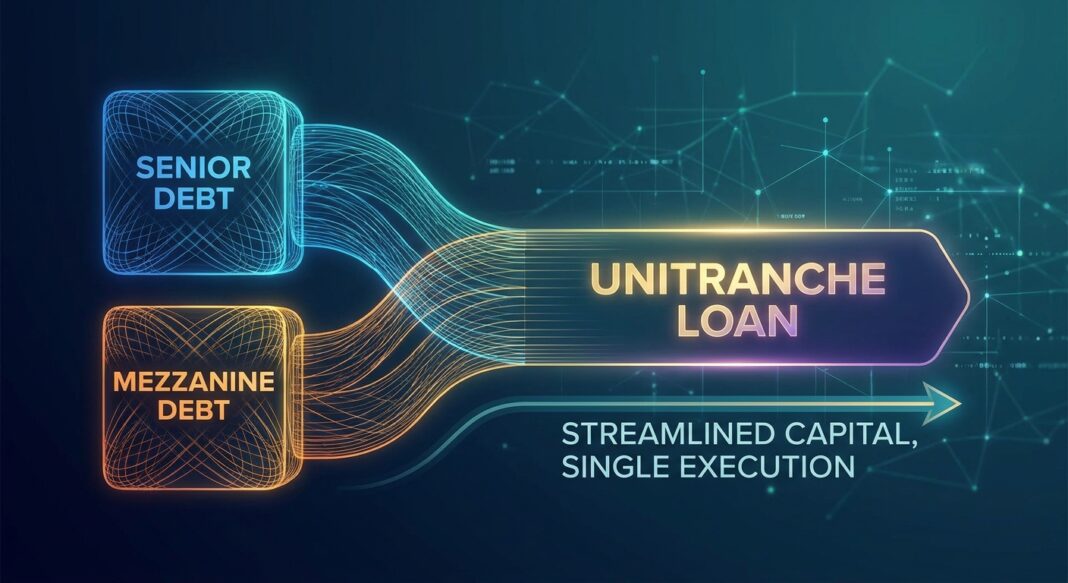
Why One Loan Is Replacing Two
Picture the traditional middle-market deal: a company needs $50 million to fund an acquisition, so it assembles a capital stack from two separate lender groups: a senior bank facility at one rate and a mezzanine layer at a much higher rate, with two sets of lawyers, two intercreditor negotiations, and two creditors to manage if anything goes wrong. That structure dominated private lending for decades. Today, a single instrument, the unitranche loan: is rapidly displacing it.
Understanding unitranche debt is not just a technical exercise. For investors evaluating private credit funds, it explains why direct lenders earn a premium over traditional bank loans without taking on subordinated risk. For business owners and sponsors seeking capital, it reveals when a single-lender structure saves time, money, and operational complexity, and when it does not.
What Is a Unitranche Loan?
Unitranche debt is a hybrid credit facility that collapses what would otherwise be separate senior secured debt and subordinated (or mezzanine) debt into a single loan instrument with one interest rate, one credit agreement, and one lender relationship. As the SEC filing for the First Trust Enhanced Private Credit Fund describes it, a unitranche loan is “characterized by a hybrid loan structure that combines senior debt and subordinated debt into one facility bearing a blended interest rate.”
The blended interest rate sits between what a pure senior lender would charge and what a subordinated lender would demand, reflecting the weighted-average risk of the combined tranches. Lenders may internally divide the facility into a “first-out” tranche (lower risk, lower return) and a “last-out” tranche (higher risk, higher return) via a private intercreditor arrangement known as an Agreement Among Lenders (AAL), but the borrower sees only one loan document and makes one payment.
According to CT Acquisitions (June 2026), unitranche structures typically carry total leverage of 4–6x EBITDA, with a single covenant package and a single intercreditor relationship, precisely the simplification that has made them the dominant structure in lower-middle-market direct lending.
How It Works: A Side-by-Side Example
Consider Apex Manufacturing, a $12 million EBITDA business being acquired for $72 million (6x EBITDA). The sponsor needs $48 million in debt (4x leverage). Here is how the two structures compare:
Traditional Two-Tranche Structure:
- Senior bank term loan: $32 million at SOFR + 350 bps (~7.6% all-in). First-priority lien on all assets.
- Mezzanine loan: $16 million at 13–15% (cash + PIK). Subordinated, unsecured, with equity warrants attached.
- Blended cost of debt: ~9.7% weighted average. Two closings, two lender groups, intercreditor agreement required.
- Timeline to close: 8–12 weeks.
Unitranche Structure:
- Single unitranche facility: $48 million at SOFR + 575 bps (~10.1% all-in in Q2 2026).
- Security: First-priority lien on substantially all assets, including equity interests of domestic subsidiaries, consistent with how the Nuveen Churchill Private Capital Income Fund describes its unitranche collateral in its 2026 SEC filing.
- One closing, one lender, one covenant package.
- Timeline to close: 3–4 weeks.
The unitranche costs roughly 40 basis points more in blended rate, but eliminates the equity warrants attached to mezzanine debt (avoiding dilution), cuts 4–8 weeks from the timeline, and removes the risk of intercreditor disputes in a workout scenario. For many sponsors and owner-operators, that trade-off is straightforward.
Current Market Reality
The unitranche market has moved from a niche innovation to the defining instrument of middle-market private credit. The macro context in mid-2026 makes understanding its pricing and dynamics more important than ever.
According to CT Acquisitions (June 2026), unitranche market issuance grew from roughly $20 billion annually in 2015 to over $200 billion in 2025, as direct lenders displaced traditional bank syndication for sub-$1 billion EBITDA borrowers. The largest players (including Ares Capital, Blue Owl Capital, Antares Capital, Apollo Global Management, KKR, and Golub Capital) dominate the $25 million to $200 million enterprise value segment.
On pricing, the Federal Reserve’s most recent data shows a nuanced bank lending environment. The Federal Reserve July 2026 SLOOS reported that bank lending standards for C&I loans to firms of all sizes were broadly unchanged in Q2 2026, with stronger demand from large and middle-market firms, but critically, standards remain at historically tighter levels relative to the pre-2022 midpoint for many loan categories. The April 2026 SLOOS also found that banks reported tighter standards across all categories of non-depository financial institution (NDFI) loans over the prior year, including higher premiums on riskier loans and stricter covenants.
This bank retrenchment creates the structural demand gap that unitranche lenders fill. As Creative Planning (March 2026) notes, traditional banks in the U.S. have their hands largely tied for middle-market companies, particularly service- and technology-related businesses that lack the hard collateral banks prefer.
| Metric | Value | Source |
|---|---|---|
| Typical LMM unitranche spread (Q2 2026) | SOFR + 500–700 bps | CT Acquisitions, June 2026 |
| 3-month Term SOFR (Q2 2026) | ~3.69% | Valuation Research Corp., July 2026 |
| Unitranche yields (Q2 2026, spot) | Broadly stable QoQ (+~1 bp) | Valuation Research Corp., July 2026 |
| Upper-MM unitranche all-in rate range | ~9–10% (top-tier credits) | Private Capital Global, Sept 2025 |
| Global private credit AUM (mid-2026 estimate) | ~$3.2 trillion | PIMCO, June 2026 |
| Preqin private credit AUM forecast (2030) | ~$4.5 trillion | IQ-EQ / Preqin, Feb 2026 |
Importantly, Goldman Sachs Research notes as of April 2026 that a notable spread differential between direct lending and the broadly syndicated leveraged loan market has persisted, existing in large part to compensate private credit lenders for holding loans to maturity and for the value of customization and execution certainty, qualities that are intrinsic to the unitranche structure.
Decision Framework
For Investors Evaluating Private Credit Funds
- Understand the lender’s position within the unitranche: Funds holding the “first-out” slice carry lower risk than those holding the “last-out” slice, even though both may describe their loans as “senior secured.” Evaluate fund disclosures carefully.
- Assess spread versus risk: The premium over syndicated loans reflects illiquidity, execution certainty, and structural complexity, not necessarily higher credit risk. Goldman Sachs Research describes this as compensation for “holding the loan until maturity” and for “the value of customization.”
- Consider the macro environment: Unitranche yields are floating-rate (SOFR-based), meaning investors benefit from elevated base rates while they persist, but should model sensitivity to further Fed rate cuts as SOFR is expected to drift lower through year-end 2026 per CT Acquisitions (June 2026).
- Manager selection matters: The top unitranche lenders (Ares, Blue Owl, Antares, Apollo, KKR, Golub) have the scale and workout infrastructure to manage stressed credits. Smaller platforms may lack that capacity. PwC’s 2026 Private Credit Survey notes that many portfolio managers are navigating sustained credit stress at scale for the first time.
For Operators and Sponsors Seeking Capital
- Unitranche is the default choice for deals in the $25M–$200M EV range in 2026. It offers execution speed (3–4 weeks vs. 6–8 weeks for bank syndication), simplified documentation, and the elimination of equity dilution from mezzanine warrants.
- Evaluate the all-in cost holistically: Headline spread is only part of the story. Original issue discount (OID), prepayment fees, and amendment fees materially raise effective cost above the quoted SOFR + spread, according to CT Acquisitions (June 2026).
- Retain mezzanine for large or complex deals: For very large transactions, or situations where maximizing cheap senior debt separately reduces overall cost, a senior-plus-mezzanine structure may still win on total price. IB Interview Questions (March 2026) notes mezzanine remains relevant where unitranche lenders cannot provide the full quantum of debt required.
- Sponsor relationships compress pricing: Repeat sponsor borrowers historically receive 25–50 bps inside pricing versus one-time borrowers, per CT Acquisitions (June 2026). Building a direct-lender relationship before a deal is in market is a tangible cost-reduction strategy.
Key Takeaways
- Unitranche collapses complexity: A single facility, single lender, single covenant package replaces the senior-mezzanine structure, eliminating intercreditor risk and cutting deal timelines by 4–8 weeks.
- Pricing reflects blended risk: The SOFR + 500–700 bps range seen in Q2 2026 sits between pure senior and pure mezzanine pricing, compensating lenders for holding illiquid, customized debt to maturity.
- Bank retrenchment is structural, not cyclical: The Federal Reserve’s 2026 SLOOS data confirms tighter bank standards for NDFI loans and C&I credits, sustaining the demand gap that makes unitranche lending a durable opportunity for direct lenders.
- Market size validates the strategy: Global private credit AUM has reached approximately $3.2 trillion and is projected to grow to $4.5 trillion by 2030 per Preqin, with direct lending, the home of unitranche, accounting for nearly 60% of private debt fundraising according to PitchBook data cited by Creative Planning.
- Operators must read beyond the headline rate: OID, prepayment penalties, and amendment fees can materially increase the effective cost of a unitranche facility above its quoted spread. A full cost-of-capital analysis across the loan’s expected life is essential before signing.


