
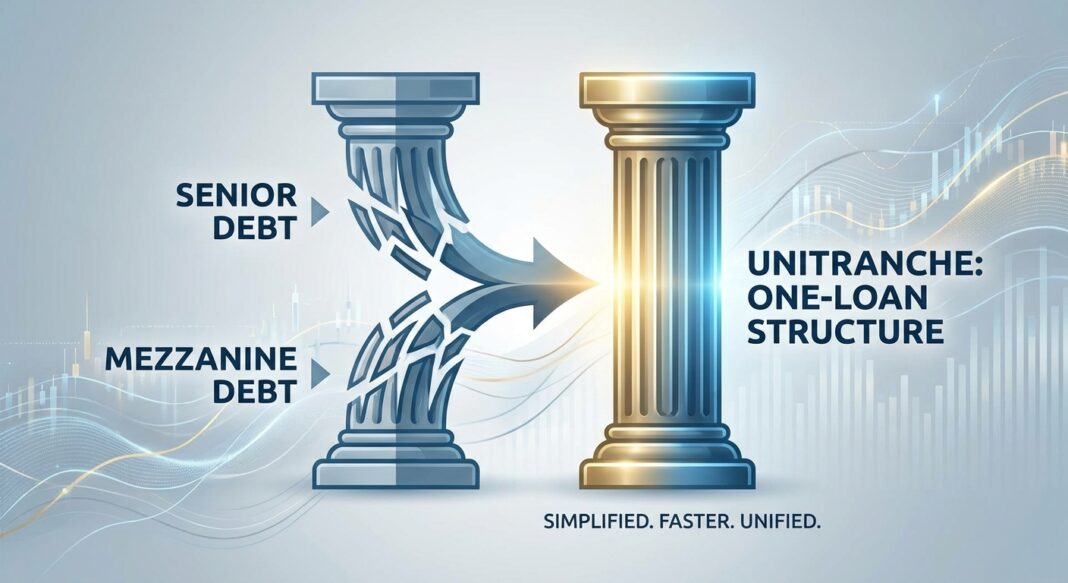
One Loan, One Lender, One Closing Table
Most middle-market companies that need acquisition financing or growth capital have historically faced a two-step ordeal: negotiate a senior secured term loan with a bank, then negotiate a separate mezzanine tranche with a different lender: each with its own legal team, its own covenants, and its own idea of who controls the deal if things go sideways. That structure worked, but it was slow, expensive to document, and riddled with intercreditor friction.
Enter the unitranche loan: a private credit innovation that collapsed the senior and subordinated debt tranches into a single facility, a single lender relationship, and a single set of loan documents. For operators, it simplified the capital raise. For direct lenders, it unlocked a larger share of the spread. For investors in private credit funds, it became the primary engine of yield generation.
Today, unitranche structures are not a niche product. They dominate new issuance in middle-market private credit, and increasingly, they are closing at multi-billion-dollar sizes that would have been unthinkable a decade ago. Understanding exactly how they work, and what the current pricing environment looks like, is foundational knowledge for anyone engaging with private credit from either side of the table.
What a Unitranche Loan Actually Is
A unitranche loan is a hybrid debt instrument that combines the characteristics of senior secured and subordinated debt into a single tranche, typically structured in a first-lien position against the borrower’s assets. Rather than issuing a $40 million senior loan at one rate and a $15 million mezzanine loan at a higher rate, the borrower takes a single $55 million unitranche facility at a blended rate that reflects the combined risk of both layers.
As SEC-registered fund disclosures describe it, unitranche debt combines both senior and subordinated debt components into a single facility, with the lender holding a security interest across the borrower’s available assets, including the equity interests of subsidiaries.
Behind the scenes, however, a single unitranche facility can conceal an internal division between a “first-out” and a “last-out” position. In a club deal, one lender takes the first-out piece (lower risk, lower yield, paid back first in a default) while another takes the last-out piece, which bears more risk but earns a higher return. Mayer Brown, a law firm that documents these transactions, describes this mechanic as a structure that provides the first-out lender “reduced risk and return” and the last-out lender “increased risk and return,” governed by an intercreditor agreement among lenders.
From the borrower’s perspective, none of that internal plumbing changes the experience: one loan document, one agent bank, one covenant package to negotiate.
How It Works: A Concrete Example
Consider a private equity sponsor acquiring a business services company at a $100 million enterprise value. The deal is structured with 50% equity and 50% debt, a $50 million unitranche loan.
Under the traditional structure, this might have been split into a $35 million first-lien term loan at SOFR + 350 bps and a $15 million mezzanine loan at 12–14% (often with equity warrants). The borrower would negotiate two separate term sheets, pay two sets of legal and arrangement fees, and manage two lender relationships with potentially conflicting amendment rights.
Under a unitranche structure, the same borrower receives a single $50 million loan. Based on current market data, a typical middle-market unitranche in 2026 prices with a credit spread of 4.75% to 5.50% over the benchmark rate (Valuation Research Corp., Q2 2026), layered on top of 3-month Term SOFR, which reached approximately 3.69% in June 2026. That produces an all-in yield range of roughly 9.00% to 9.75% for the lender, and an equivalent cost of debt for the borrower.
For a lower-middle-market deal with more leverage or credit risk, the spread widens: lower-middle-market unitranche spreads typically run 500–700 bps over SOFR in 2026 (CT Acquisitions, June 2026), producing all-in yields in the 9.7%–11.6% range. Add a standard 2% original issue discount (OID), meaning the borrower receives $49 million on a $50 million loan but owes the full $50 million at maturity, and the effective cost climbs further.
Compared to the traditional two-tranche structure, the borrower often pays a modest premium in cost, but gains significantly in speed, simplicity, and certainty of execution.
Current Market Reality
Unitranche is no longer a middle-market product. It has scaled to landmark sizes. In March 2026, a Thoma Bravo-backed merger between WWEX (Worldwide Express) and Auctane closed with a $4.815 billion unitranche loan plus a $275 million revolver, priced at 575 bps over the benchmark, with Ares Capital as administrative agent in a 33-lender club that included Blackstone, Blue Owl, Apollo, and Oaktree (PitchBook, March 2026).
The broader market context makes the appeal of private unitranche lending clear. The Federal Reserve’s July 2026 SLOOS reported that bank lending standards for C&I loans remained broadly unchanged in Q2 2026, with stronger demand coming primarily from large and middle-market firms, a signal that credit appetite is returning to the market, but selectively. Meanwhile, the April 2026 SLOOS found that banks tightened standards on loans to non-depository financial institutions (NDFIs), including higher risk premiums, stricter covenants, and lower maximum credit line sizes.
That tightening at the bank level is exactly the environment in which private credit, and unitranche in particular, fills the gap. As Northleaf Capital noted in its Q1 2026 market update, “periods of market volatility typically see banks and liquid credit markets retrench, with private equity sponsors turning to private credit for greater execution certainty.”
The scale of the private credit market that this structure has helped build is significant. PIMCO, triangulating across Preqin, PitchBook, and company disclosures, estimates global private credit AUM at roughly $3.2 trillion, comprised of approximately $2.4 trillion in drawdown funds and $800 billion in semi-liquid vehicles (PIMCO, June 2026). Preqin projects that figure could exceed $4.5 trillion by 2030, with fundraising expected to recover in 2026 following last year’s slowdown (Preqin, via IQ-EQ, 2026).
| Metric | Data Point | Source |
|---|---|---|
| Unitranche all-in yield range (mid-market) | ~9.00%–9.75% | VRC, Q2 2026 |
| Lower-middle-market unitranche spread range | SOFR + 500–700 bps | CT Acquisitions, June 2026 |
| Global private credit AUM (estimated) | ~$3.2 trillion | PIMCO, June 2026 |
| Projected private credit AUM by 2030 | >$4.5 trillion | Preqin, via IQ-EQ, 2026 |
| Bank C&I lending standards, Q2 2026 | Broadly unchanged | Federal Reserve SLOOS, July 2026 |
Decision Framework: Investors and Operators
For Investors Evaluating Private Credit Funds:
- Yield premium vs. public credit: Direct lending continues to generate high single-digit unlevered returns, representing an attractive premium relative to public credit markets, according to Northleaf Capital’s Q1 2026 analysis. Investors consider whether that spread premium adequately compensates for illiquidity and credit risk, particularly as 2021-vintage loans reach maturity in a higher-rate environment.
- First-out vs. last-out exposure: When a fund discloses significant unitranche concentration, investors evaluate whether those positions are structured as first-out (lower risk) or last-out (higher risk). The internal waterfall matters as much as the headline yield.
- Size and diversification: Mega-unitranche club deals (like the $4.8 billion WWEX transaction) distribute risk across dozens of lenders. Smaller, single-lender unitranches in the lower-middle market carry more concentrated credit exposure. Investors examine portfolio construction accordingly.
- Default cycle readiness: With many 2021 loans now maturing, the headline private credit default rate has remained below 2%, though analysts note the adjusted rate incorporating selective defaults and liability management exercises approaches 5%, according to With Intelligence (2026). Understanding how a fund manager defines and reports default metrics is essential.
For Operators Considering Unitranche Financing:
- Speed and certainty: A unitranche closes faster than a split senior/mezzanine structure because there is one term sheet, one legal process, and no intercreditor negotiation between senior and junior lenders. In competitive M&A processes, that certainty has real value.
- Prepayment economics: Standard 2026 unitranche prepayment schedules run 102/101/par over the first three years. Operators planning to refinance within 24 months should model whether a 1–2% prepayment fee offsets the savings from a tighter spread, particularly if rates decline as expected.
- Accordion capacity: Most 2026 unitranche facilities include incremental capacity, typically $20–$50 million, to fund add-on acquisitions post-close. Operators pursuing a buy-and-build strategy evaluate this feature carefully, as the MFN (most-favored-nation) clause may reset the spread on existing debt upward if new tranches price higher.
Key Takeaways
- Unitranche replaces complexity with a single tranche: By merging senior and mezzanine debt into one facility, unitranche loans eliminate intercreditor conflicts and reduce documentation burden, at the cost of a modestly higher blended rate relative to stand-alone senior debt.
- Pricing reflects risk, not just rate: Mid-market unitranche yields of roughly 9–9.75% in mid-2026 represent a meaningful decline from 2023 peaks near 12%, but remain above pre-2022 historical ranges. The spread premium compensates lenders for speed, flexibility, and illiquidity.
- Scale has arrived: Unitranche is no longer just a lower-middle-market product, billion-dollar-plus club deals involving the largest private credit managers now set pricing benchmarks for the entire market.
- Bank behavior creates opportunity: When bank lending standards tighten or remain restrictive for certain borrower profiles, private credit direct lenders, offering unitranche structures, step into the gap with execution certainty that syndicated markets cannot always match.
- Know your position in the waterfall: Whether an investor is exposed to first-out or last-out unitranche positions, or an operator is negotiating MFN and accordion terms, the structural details of the unitranche, not just the headline rate, determine the real risk and return profile of the deal.


