
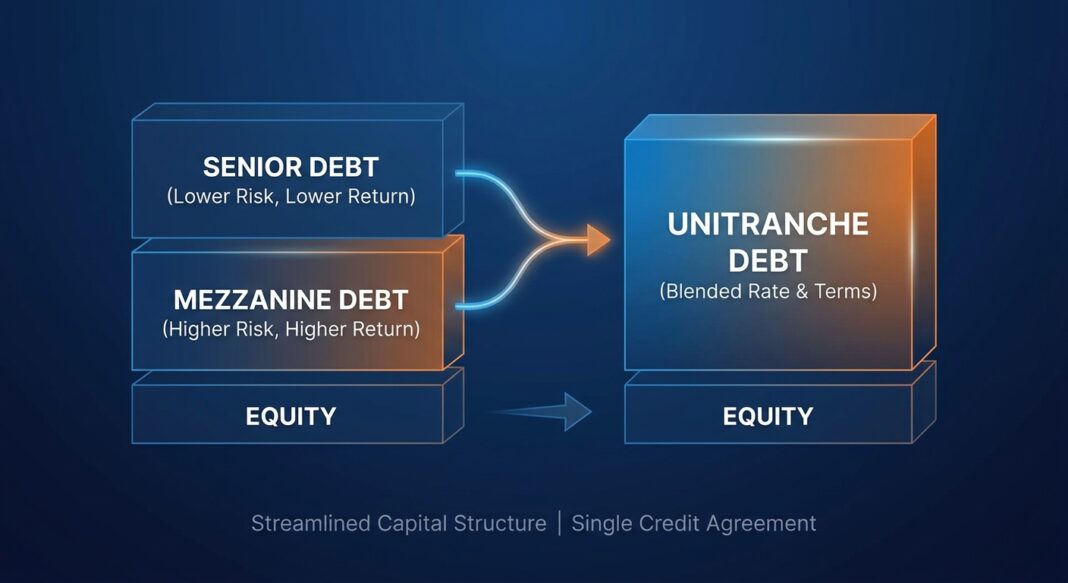
One Loan to Rule Them All
For decades, a middle-market company seeking acquisition financing had to negotiate with two sets of lenders, sign two credit agreements, satisfy two covenant packages, and hope those lenders would cooperate if trouble arose. Senior lenders sat at the top of the capital stack with first claim on assets. Mezzanine lenders sat below them, accepting higher risk in exchange for higher rates. Both wanted their own protections, their own controls, and their own lawyers.
Then the unitranche loan arrived and changed the entire equation.
Today, unitranche financing is not a niche instrument; it is the dominant deal structure in private credit’s most active segment. Understanding how it works, what it costs, and when it makes sense is essential knowledge for both investors allocating to private credit funds and business owners or operators evaluating their financing options.
What Is a Unitranche Loan?
A unitranche loan combines what were historically two separate debt instruments (a senior secured loan and a subordinated or mezzanine loan) into a single credit agreement with one set of collateral documents, one covenant package, and one blended interest rate.
To the borrower, a unitranche looks and functions like a single loan: one counterparty to negotiate with, one set of closing documents to sign, and one lender relationship to manage post-close. As Glacier Lake Partners explains, “a unitranche facility gives a borrower one loan and one payment stream while lenders divide risk and priority behind the scenes.”
That last phrase, divide risk and priority behind the scenes, is the key mechanic that most borrowers never fully examine. Behind the single loan the borrower signs is often a private contract among the lenders themselves: the Agreement Among Lenders (AAL).
The AAL splits the lender group into two internal positions: first-out lenders, who receive payment priority and accept a lower return, and last-out lenders, who absorb losses first in a default and earn a higher return in exchange. As Mayer Brown, a law firm that regularly documents these structures, described in July 2026, the structure is “intended to provide the ‘first out’ lender reduced risk and return, providing the ‘last out’ lender increased risk and return”, all within a single credit facility sharing one security interest on the borrower’s collateral.
Crucially, this internal seniority arrangement is invisible to the borrower. The complexity lives among the lenders; the borrower enjoys simplicity.
How the Numbers Actually Work: A Concrete Example
Consider a private equity firm acquiring a software company with $10 million in annual EBITDA at a 12x purchase price, a $120 million enterprise value. The deal requires roughly $72 million in debt financing (6.0x leverage). Here is how the two structures compare:
Traditional Two-Tranche Structure:
- Senior term loan: $48M at SOFR + 350 bps (~8.3% all-in at 4.8% SOFR)
- Mezzanine loan: $24M at 13-14% fixed (often with equity warrants attached)
- Two credit agreements, two lender groups, two sets of covenants, two closings
- Blended cost of debt: approximately 9.7-10.0%
- Time to close: 60-90+ days
Unitranche Structure:
- Single unitranche facility: $72M at SOFR + 550 bps (~10.3% all-in)
- One credit agreement, one lender (or small club), one covenant set
- No mezzanine lender with equity warrants, no dilution
- Time to close: 30-45 days for a single lender or pre-agreed club
The borrower pays approximately 30-60 basis points more in blended cost on the unitranche, but eliminates mezzanine equity dilution, cuts closing time by weeks, and removes the intercreditor friction risk if financial performance deteriorates. For a sponsor racing other bidders in an auction, Private Equity Bro notes that “if unitranche financing can close 30 to 45 days faster than a syndicated alternative, sponsors often justify 50 to 100 basis points of extra spread by avoiding financing gaps, broken syndications, or delayed closings.”
For the direct lender, the math works differently. The unitranche structure allows them to capture the yield that once flowed to mezzanine funds, while controlling the entire credit relationship and covenant package.
Current Market Reality: Where Unitranche Stands in 2026
Unitranche has moved from a creative middle-market tool to the backbone of private credit deal flow at scale. The data tells that story clearly.
| Metric | Data Point | Source |
|---|---|---|
| Global private credit AUM | ~$3.2 trillion (2026 est.) | PIMCO, June 2026 |
| Avg. unitranche coupon (end of 2025) | ~9.00% (~160 bps above BSL) | KBRA via Brinley Partners, Feb 2026 |
| Direct lending new-issue median spread (year-end 2025) | 544 bps (down from 716 bps peak, Mar 2023) | McKinsey / Kroll StepStone, June 2026 |
| Cliffwater Direct Lending Index return (2025) | 9.3% total return; 20-yr avg 9.5% | Cliffwater / Morningstar, March 2026 |
| Largest unitranche on record | €6.5B (Adevinta refinancing, 2025) | McKinsey, citing Private Equity Wire, June 2026 |
| Avg. LBO deal size in direct lending (2025) | ~$380M (up 29% from $295M in 2024) | McKinsey / PitchBook LCD, June 2026 |
| Bank C&I lending standards (Q2 2026) | Basically unchanged; standards easier than historic midpoint | Federal Reserve SLOOS, July 2026 |
The competitive pressure on unitranche has intensified from both directions. On one side, Lord Abbett’s midyear 2026 outlook notes that spreads have widened by roughly 50 to 100 basis points since late 2025, and new loans are increasingly structured with stronger credit protections: less leverage, more covenants, and fewer payment-in-kind (PIK) provisions. On the other side, the Federal Reserve’s July 2026 SLOOS confirms that bank C&I lending standards were essentially unchanged in Q2 2026 and that current standards sit easier than the historical midpoint, meaning banks are not aggressively restricting credit, which keeps the competitive tension between bank lending and private credit very much alive.
Despite that competition, the scale of the unitranche market speaks for itself. In March 2026, PitchBook reported that the WWEX/Auctane merger, a Thoma Bravo-backed transaction, secured a $4.815 billion unitranche facility plus a $275 million revolver at 575 basis points over the benchmark rate, with Ares Capital as administrative agent for a 33-lender club that included Blackstone, Blue Owl, Apollo, and Oaktree. The era of unitranche as a small-deal tool is firmly over.
Decision Framework: Investors and Operators
For Investors Evaluating Private Credit Funds:
- Understand what you own inside the fund. A fund described as a “direct lender” may hold last-out positions in unitranche facilities, meaning it carries subordinated economic risk even though the loan is technically first-lien. Investors should evaluate whether a fund’s reported loan seniority reflects first-out or last-out economics within the AAL.
- Track spread compression carefully. Global new-issue direct loan median spreads fell from 716 basis points in March 2023 to 544 basis points by year-end 2025, according to McKinsey’s 2026 analysis of Kroll StepStone benchmarks. Investors considering allocations to the asset class should evaluate whether current yield levels appropriately compensate for the risk being taken, particularly in the face of ongoing compression.
- The Cliffwater CDLI is your benchmark. Cliffwater’s 2025 annual results showed a 9.3% total return with 10.4% interest income and a 20-year average return of 9.5%, but those figures are gross of fees and unlevered. Net returns and vintage-year dispersion matter enormously for fund selection.
- Capital concentration is increasing. PitchBook data shows that in the first half of 2025, mega-funds raising more than $5 billion accounted for 42.5% of all capital raised by closed-end private debt vehicles, reinforcing the advantage of scale for top-tier managers.
For Business Operators Evaluating Unitranche Financing:
- Speed and certainty have a real price tag, and it is often worth paying. CT Acquisitions’ 2026 analysis puts the unitranche sweet spot at transactions in the $25M–$200M enterprise value range, where roughly 70-80% of deals now use at least partial unitranche funding. Smaller deals may be better served by SBA financing and seller notes; larger deals above $300M often access cheaper broadly syndicated loans.
- Understand the AAL before you close. Even though the borrower is not a party to the Agreement Among Lenders, that document defines who controls enforcement decisions if the company underperforms. A single lender or a tightly coordinated club is far less risky for the borrower than a fragmented group with misaligned incentives.
- Consider covenant structures carefully. The current market’s shift toward more lender-protective terms means new unitranche deals are coming with tighter documentation than deals originated in 2021-2022. Operators should compare the covenant package against business plan assumptions, particularly maintenance tests, before signing.
- No equity dilution is a genuine benefit. The unitranche replaces mezzanine debt that typically comes attached with equity warrants or conversion rights. For operators focused on preserving ownership, the higher interest cost of a unitranche often represents better long-term economics than a cheaper two-tranche structure that includes equity participation by the mezzanine provider.
Key Takeaways
- The unitranche is one loan to the borrower, but often two risk positions to lenders. The Agreement Among Lenders divides participants into first-out and last-out tranches, creating internal seniority that investors in private credit funds must understand.
- Borrowers pay a spread premium for speed and certainty, not a penalty for ignorance. The unitranche prices above a standalone senior loan because it replaces mezzanine debt, and because it eliminates the execution risk of coordinating two lender groups on a timeline-sensitive deal.
- The market has scaled dramatically. Annual unitranche issuance grew from roughly $20 billion in 2015 to over $200 billion in 2025, with single-deal sizes now exceeding $4-6 billion, a market that is no longer the province of boutique lenders.
- Spread compression is real, but the reset has begun. After falling from 716 bps in early 2023 to 544 bps by end-2025, spreads have widened 50-100 bps in 2026 and deal documentation has grown more lender-protective, a shift that improves the risk/return setup for new originations.
- Know your position in the stack, regardless of what the label says. First-lien labeling in private credit does not automatically mean senior economics. Investors and operators alike benefit from reading the actual payment waterfall, not just the marketing description.


