
Leverage Stories & Insights, Bond Capital
September 24, 2026
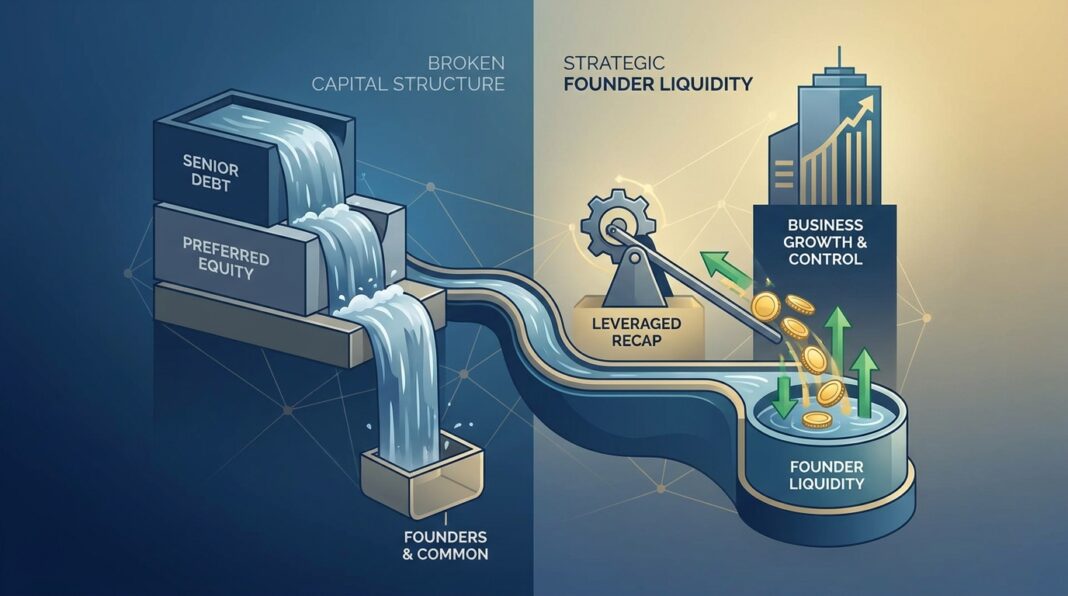
The Waterfall
In January 2025, Adena Hefets sat down to write one of the hardest letters of her career. The company she had co-founded (Divvy Homes, a rent-to-own proptech startup that had once been valued at $2.3 billion) was being sold to Brookfield Properties for approximately $1 billion. On paper, that sounds like a success story. A billion-dollar exit. A unicorn finding its acquirer.
Then came the waterfall.
In her letter to shareholders, Hefets explained that after repaying outstanding debt, covering transaction costs, and satisfying the liquidation preferences of preferred shareholders, neither common shareholders nor holders of the Series FF preferred stock, the class typically reserved for founders, would receive any proceeds from the sale. As The Real Deal reported, some VC investors were also expected to be “zero’d” from the deal entirely.
One industry insider described it simply: “A bloodbath for investors and employee equity.”
This is not a story about a bad business. Divvy helped create 2,000 homeowners. It had real traction, real investors, and a real mission. This is a story about capital structure, and how the wrong one can erase everything a founder builds, even in a billion-dollar outcome.
The Structure That Crushed the Outcome
To understand what happened at Divvy, you need to understand the stack it built over nearly a decade of hypergrowth fundraising.
Founded in 2016, Divvy raised more than $700 million in combined debt and equity from marquee names including Andreessen Horowitz, Tiger Global Management, and GGV Capital. Its last known funding round was a $200 million Series D in August 2021, led by Tiger Global, just six months after a $110 million Series C. At peak enthusiasm, the company sat at a $2.3 billion valuation.
Embedded in that structure was $735 million in senior debt, the first claimant on any proceeds in an exit scenario. On top of that sat layers of preferred equity, each carrying its own liquidation preference. The math was unforgiving: in a $1 billion acquisition, the debt alone consumed most of the proceeds before preferred shareholders even entered the conversation. Founders and common stockholders were structurally last in line, and nothing was left when the line ran out.
When mortgage interest rates surged in 2022, Divvy’s business model (which depended on affordable home acquisition costs and accessible mortgage markets for its customers) broke. Three rounds of layoffs followed. By 2023, new home acquisitions had paused entirely. The company had no leverage to renegotiate from. Every path forward was dictated by its creditors and preferred holders.
Hefets wrote that the sale “was not the ending I had hoped for.”
It rarely is, when the capital structure is designed for someone else’s return.
The Alternative Path: A Leveraged Recapitalization Done Right
⚠ Hypothetical Scenario, For Illustrative Purposes Only
Now consider a different version of this story, a hypothetical founder-led company we’ll call Vestry Property Partners, a mid-market operator managing a portfolio of rent-to-own homes generating $18 million in annual EBITDA and $12 million in stable, recurring free cash flow. Same sector. Similar mission. Different capital philosophy.
At the point Divvy was taking on its Series D round in 2021, Vestry’s founder, let’s call him Marcus, faced the same liquidity pressure. He had 90% of his net worth tied up in the business, no exit on the horizon, and real personal financial exposure. He was being courted by growth equity investors offering a $60 million round at a $200 million valuation. Standard terms: 20–25% dilution, new board seats, a liquidation preference, and a five-year exit clock ticking from day one.
Marcus declined.
Instead, he worked with a direct lender to structure a leveraged recapitalization: a $45 million senior secured term loan at SOFR + 575bps (approximately 11.25% all-in at the time), sized at 2.5x EBITDA, a conservative leverage multiple well within the lender’s credit box for an asset-backed, recurring-revenue business.
Of the $45 million:
- $30 million was paid directly to Marcus as a special dividend: personal liquidity, fully realized, with no equity surrendered.
- $10 million funded a bolt-on acquisition of a competing regional operator.
- $5 million was retained as a liquidity reserve on the balance sheet.
Marcus retained 100% of his equity. The company retained its independence. No new board seats. No preferred liquidation stack. No five-year exit mandate driven by a fund lifecycle.
Annual debt service on the term loan: approximately $5.1 million, comfortably covered at 2.4x by the company’s $12 million in free cash flow.
The Outcome: What the Numbers Actually Say
Three years later, Vestry (our hypothetical) has grown EBITDA to $27 million through the bolt-on and organic expansion. The loan is being amortized on schedule. Marcus has already banked $30 million: cash in hand, no dilution, no exit required. When the company eventually sells or recapitalizes again, the entire enterprise value flows to him.
Run the comparison:
| Scenario | Founder Liquidity Today | Ownership Retained | Exit Flexibility | New Board Control |
|---|---|---|---|---|
| Growth Equity Round ($60M @ $200M) | $0 (secondary not guaranteed) | ~75% | Clock starts; mandate for 5-year exit | Lost 1-2 seats |
| Leveraged Recap ($45M term loan) | $30M cash dividend | 100% | Fully on founder’s terms | None surrendered |
This is not a theoretical comparison. It is precisely the dynamic playing out across the middle market right now. The dividend recapitalization market generated over $70 billion in leveraged loan volume in 2025 alone, with nearly 30 transactions of $1 billion or more, according to PitchBook data. The market is not niche. It is institutional. And it is increasingly accessible to founder-led businesses well below the billion-dollar threshold.
Private credit’s structural advantage in this space is its ability to provide capital structure flexibility in ways that traditional bank financing cannot. While traditional lenders retreated from complex recapitalizations, private credit dominated refinancings and recaps throughout 2024 and 2025, precisely because direct lenders can underwrite to the nuanced objectives of individual owner-operators, not just balance sheet ratios.
The Lessons
1. Model the waterfall before you accept the term sheet.
The Divvy outcome was not a surprise to anyone who ran the math. A $735 million senior debt obligation on top of hundreds of millions in preferred equity with liquidation preferences meant that any exit below roughly $1.2 billion was going to zero out founders and common holders. That math was visible from the moment the debt was layered in. Every subsequent funding round made the situation worse, not better.
2. Equity is not free money: it is the most expensive capital you will ever raise.
Founders routinely recoil at the cost of debt, an 11% all-in yield feels expensive compared to an equity round that comes with no required cash outflow. But equity investors who hold liquidation preferences and board seats are not passive partners. They hold structural power over every future decision, including the terms of your exit. As one founder, Greg Holifield, put it: when debt carries no warrants, it is “truly fantastic money, and much cheaper than equity.”
3. A leveraged recap works best when the business generates predictable, durable free cash flow.
This is the gating condition. Vestry’s hypothetical recap was sized at 2.5x EBITDA and covered debt service at 2.4x. That cushion is the difference between a transformative liquidity event and a debt trap. Overleveraged recaps (done at 5x or 6x EBITDA on cyclical or rate-sensitive cash flows) carry exactly the risk that undid Divvy. The instrument is not inherently dangerous. The sizing is what matters.
4. Private credit has moved down-market, and founders should know it.
A decade ago, leveraged recapitalization financing was largely inaccessible to companies below $50 million in EBITDA. That has changed materially. Private credit funds are now routinely structuring dividend recapitalizations for family businesses and founder-led companies with as little as $10–25 million in EBITDA, executing transactions that traditional bank channels cannot accommodate. A third-generation family business in this EBITDA range can now access the same liquidity tools that were once reserved for much larger enterprises, without surrendering control or triggering a full sale event.
5. Liquidity and ownership are not mutually exclusive, but timing and structure are everything.
The question is never simply “debt or equity?” It is: which instrument best aligns with your exit range, your business model’s sensitivity to the macro environment, and your personal financial objectives? Marcus got $30 million in cash and kept his company. Adena Hefets sold hers for $1 billion and got nothing. The difference was not talent, market, or mission. It was the structure they each built, and what that structure demanded when the market shifted.
Key Insights
- The waterfall is not metaphorical. In any distressed or below-peak exit, debt holders collect first, preferred equity second, and founders last. Layering in $735M of senior debt before a rate-sensitive business proved resilient is a structural error, not a market one.
- A leveraged recap at 2.5x–3.0x EBITDA on a stable cash-flowing business can deliver eight figures of founder liquidity without surrendering a single share, a board seat, or an exit timeline.
- Private credit has democratized access. The dividend recap market deployed over $70 billion in leveraged loans in 2025 alone. Founder-led businesses with $10M+ in EBITDA now have institutional-grade options that were unavailable a decade ago.
- Debt service coverage is the discipline that makes recaps safe. Size leverage to free cash flow, not to EBITDA multiples in isolation. A 2.0x+ DSCR is the margin of safety that separates a transformative liquidity event from a debt trap.
- Founders who treat equity as “safe” capital are often confusing the absence of cash outflow with the absence of cost. Preferred liquidation stacks, board control, and exit mandates are the real price of venture equity, and that price compounds silently, round after round, until the exit arrives and the waterfall tells the truth.


