
The Story: Betting on Debt When Everyone Else Chased Equity
In early 2020, Francis Pedraza was staring down the barrel of startup failure. His company, Invisible Technologies (a hybrid AI-and-human outsourcing platform that helped businesses tackle complex, repetitive workflows) had burned through four co-founders, struggled to attract venture capital, and was operating on fumes from a small group of loyal angel investors. Silicon Valley’s conventional wisdom had dismissed him outright: services businesses don’t scale, they don’t deserve premium multiples, hard pass.
Then DoorDash called. The pandemic had exploded food delivery demand and DoorDash needed help fast: importing menus, managing restaurant data, onboarding partners at scale. The outsourcing shops that normally handled this work were shuttered. Invisible was ready. That contract became the inflection point. Two years later, OpenAI called with an even bigger problem: training data cleanup to reduce hallucinations in what would become ChatGPT. Contracts with Amazon, Microsoft, and AI unicorn Cohere followed.
By the time Invisible’s revenues had rocketed from $3 million in 2020 to $134 million in revenue with $15 million in EBITDA, Pedraza faced a very different kind of decision than the one most successful founders face. He wasn’t being asked to raise a Series C or prepare for an IPO. He was asking a far more radical question: What if I bought my investors out instead?
And critically, what if he borrowed the money to do it?
The Decision: Leverage as Liberation, Not Just Capital
Invisible Technologies had raised only $23 million in venture equity over its lifetime (from firms including Day One, Greycroft, and Backed) a fraction of what a company with $134 million in revenue and a profitable EBITDA margin might have taken in during the peak funding frenzy. That restraint was intentional. Pedraza had watched the VC merry-go-round spin from a distance and decided early that dilution was a slow tax on founder vision.
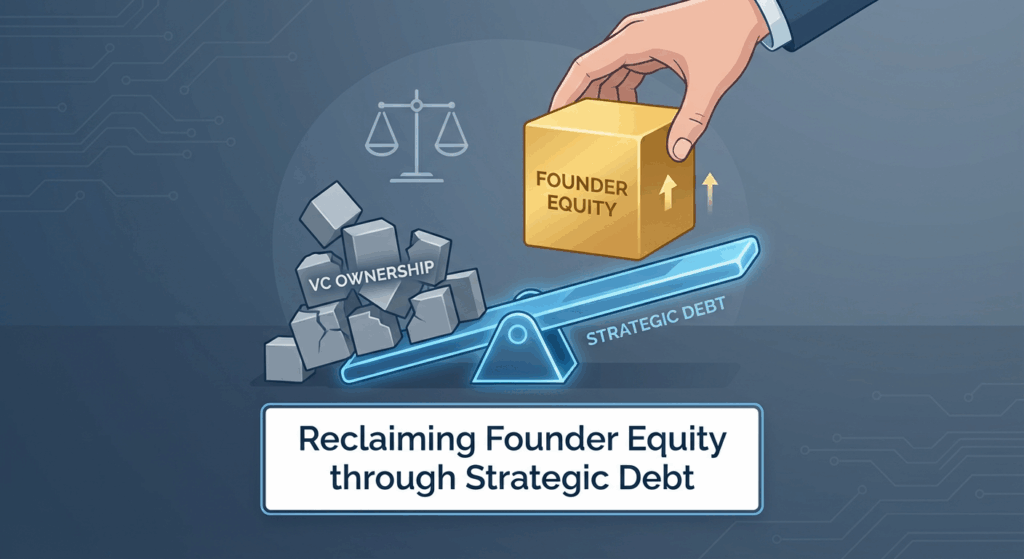
By early 2025, Pedraza had begun executing a plan to buy back shares from his venture investors, using the company’s own cash flows and debt facilities secured against the business. Rather than diluting further, raising a new equity round to fund buybacks, he was leveraging Invisible’s profitability and revenue predictability to borrow against the company’s future, reclaim equity, and concentrate ownership back in the hands of operators who intended to build for the long term.
The contrast with his nearest competitor is instructive. Scale AI, another AI data services company, raised $1 billion at a $14 billion valuation on $1 billion in annualized revenue. It was a landmark round, and a landmark dilution event. Pedraza’s response was pointed: “We could not be more different.”
The core structure Pedraza pursued was straightforward in principle, audacious in execution: use the company’s demonstrated profitability, $15 million EBITDA on $134 million revenue, as the collateral base for a credit facility, then deploy that credit to systematically repurchase VC-held shares. The result is a leveraged recapitalization executed by a founder, not a PE sponsor. Control stays with the builder. Upside accrues to those running the business, not those who wrote the first check.
The Outcome: What Debt Preservation Actually Looks Like
The numbers tell the story cleanly. Invisible Technologies raised $23 million in total equity. At a $134 million revenue run rate with a profitable operating margin, the company’s valuation, even at a conservative 3x to 5x revenue multiple, would place it somewhere between $400 million and $670 million. The VC investors who came in early at small check sizes with high dilution expectations are being bought out at returns that likely satisfy their fund economics, while Pedraza retakes meaningful equity at a basis far below where a new equity round would price the company.
The counterfactual is stark. Had Pedraza pursued the Scale AI path, raising $500 million to $1 billion in venture equity to accelerate growth, he might have commanded a higher nominal valuation, but at severe dilution. A founder who raises $500 million across multiple rounds at escalating valuations often exits owning 5% to 10% of a large number. Pedraza is engineering a path where he could own 30%, 40%, or more of a $500 million business, a far larger absolute outcome for the builder.
And here’s the cautionary tale sitting on the other side of the ledger: Divvy Homes. The rent-to-own startup raised over $400 million in venture equity and then, in October 2021, layered on approximately $735 million in debt financing. When interest rates surged in 2022, the model broke. Three rounds of layoffs followed. In January 2025, Brookfield acquired the business for roughly $1 billion, and after repaying outstanding debt and covering liquidation preferences for preferred shareholders, the founders received zero proceeds. A billion-dollar exit. $0 for the builders. As saastr.com noted in its analysis of the deal, this wasn’t a failure story; it was a capital structure story.
The difference between Divvy and Invisible isn’t simply debt vs. no debt. It’s the purpose of the debt, the underlying cash flow quality, and who holds control when things go sideways.
The Lessons: A Framework for Founders Considering the Leverage Path
The Invisible Technologies story, read alongside Divvy Homes and the broader landscape of non-dilutive financing, crystallizes a set of principles that any founder, family business owner, or operator-led company should internalize before making a capital decision.
1. Debt Is a Tool, Not a Strategy
Pedraza’s debt isn’t speculative, it’s secured against proven, recurring revenue and positive EBITDA. Divvy’s debt was used to fund asset purchases in an interest-rate-sensitive model with no durable cash flow cushion. The instrument is identical. The application is completely different. Debt works when cash flows service it comfortably and the purpose is control or growth acceleration, not survival or speculation.
2. The Real Cost of Equity Is Compounding Dilution
Founders are trained to fear debt. But equity has a cost that never appears on an income statement: the perpetual transfer of future upside to investors whose incentives may not align with yours beyond a 7-to-10-year fund cycle. A $10 million equity round at a $50 million valuation means 20% of every dollar you ever build, forever, belongs to someone else. Debt has a fixed cost. Equity has an infinite one.
3. The VC Buyout Is an Underused Strategy for Profitable Operators
Most founders don’t realize that once a business generates consistent, predictable cash flow, the same credit markets that finance PE buyouts are available to them. A founder with $10 million to $20 million in EBITDA and moderate leverage capacity can access private credit or bank facilities to repurchase VC equity, concentrating ownership without a dilutive new round. This is precisely what Pedraza executed. It is a repeatable playbook for profitable founder-led companies.
4. Non-Dilutive Capital Rewards Patient, Cash-Flow-Focused Builders
The SafePointe story reinforces the same principle at a smaller scale. Father-son founders Greg and Timothy Holifield used a $1 million non-dilutive debt facility from TIMIA Capital to triple their monthly recurring revenue within 12 months, setting up an acquisition by public safety tech firm SoundThinking without surrendering equity to get there. As timiacapital.com documented in its case study, this was the Holifields’ fourth successful exit using exactly this non-dilutive discipline.
5. Know Your Cash Flow Before You Know Your Capital Structure
The common thread across every success story in this framework is cash flow clarity. Vega’s Charles Chang, who bootstrapped a plant-based nutrition brand from his basement to a $550 million exit by WhiteWave Foods, understood before anyone else that his model generated real cash at scale. He never raised significant equity because he didn’t need to, the cash flow funded the growth. Debt, when used, was operational and manageable. The founders who use leverage successfully always know their unit economics intimately.
Key Insights
- Leveraged VC buybacks are a real, executable strategy for profitable founders who want to reclaim equity without selling the company, Invisible Technologies is the clearest recent example at scale.
- Debt kills when it funds speculation, not cash flow: Divvy Homes raised $735 million in debt against an interest-rate-sensitive model with no durable operating margin, and founders walked away with zero from a $1 billion sale.
- The cost of equity is infinite and compounding: every dilutive round permanently transfers future upside; debt has a fixed, finite cost that disappears once repaid.
- Non-dilutive capital at small scale works too: SafePointe used a $1 million debt facility to 3x MRR and achieve a strategic acquisition, proving the playbook isn’t reserved for $100 million revenue businesses.
- The founder who controls cash flow controls destiny: bootstrapped or debt-funded operators who understand their unit economics retain the leverage to choose their exit, their timeline, and their terms.


