
The Financing Challenge: Certainty vs. Cost
In the competitive landscape of middle-market M&A, the difference between winning and losing a platform acquisition often boils down to financing certainty. While traditional bank syndications may offer lower headline interest rates, the friction of arranging multiple tranches of capital can imperil deal timelines.
This reality has cemented unitranche financing as the dominant structure for sponsor-led buyouts in the $20M to $100M EBITDA range. By blending senior and subordinated risk into a single instrument, the unitranche structure solves for speed and simplicity. However, for operators and CFOs, understanding the "invisible" mechanics behind the single blended rate is crucial for negotiating flexibility and understanding the true cost of their capital.
Structure Breakdown: Components and Mechanics
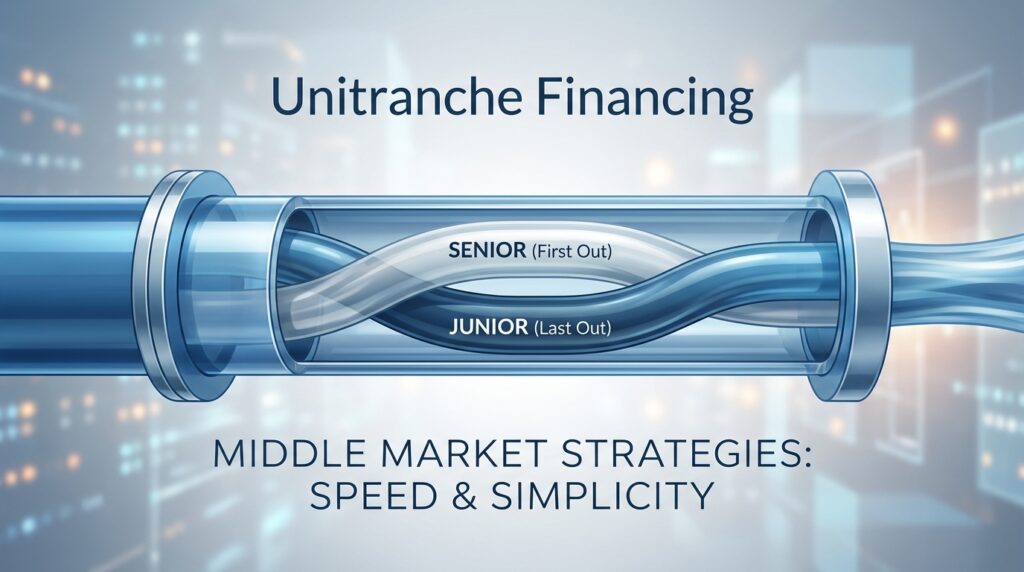
A unitranche facility is a single debt instrument with a single set of loan documents, a single agent, and a single blended interest rate. While it appears as one loan to the borrower, it is often bifurcated behind the scenes.
The Agreement Among Lenders (AAL)
The structural magic of a unitranche happens in the Agreement Among Lenders (AAL). This private contract, signed by the lenders but typically not the borrower, splits the loan into a "First Out" (senior) tranche and a "Last Out" (junior) tranche.
- First Out: Usually provided by a bank or a low-cost capital provider. They take the lowest risk (e.g., 0.0x to 3.0x leverage) and receive a lower coupon.
- Last Out: Provided by private credit funds. They take the higher risk attachment point (e.g., 3.0x to 5.5x leverage) and receive a higher yield.
The borrower, however, only interacts with the blended rate and the administrative agent.
Deal Example: $50M Unitranche for SaaS Buyout
Consider a Private Equity firm acquiring a B2B software company with $10M EBITDA at a $100M Enterprise Value (10x multiple). The deal requires $50M in debt financing (5.0x leverage).
Term Sheet Elements:
- Facility Size: $50M Unitranche Term Loan
- Interest Rate: SOFR + 575 bps (Blended)
- Original Issue Discount (OID): 98.0 (2% upfront fee)
- Amortization: 1.0% per annum
- Tenor: 6 years
- Covenants: Single maintenance covenant (Net Leverage Ratio < 6.5x)
Behind the scenes, the lender might structure it as:
- $30M First Out: Priced at SOFR + 300 bps
- $20M Last Out: Priced at SOFR + 975 bps
- Result: The blended cost to the borrower remains SOFR + 575 bps.
How It Compares: Unitranche vs. Senior-Mezzanine
The primary alternative to unitranche in the middle market is a bifurcated syndication involving a Senior Term Loan (bank) and a separate Mezzanine Note.
| Feature | Unitranche | Senior + Mezzanine |
|---|---|---|
| Documentation | Single Credit Agreement | Two Agreements + Intercreditor Deed |
| Speed to Close | ~45 Days | ~70 Days |
| Pricing (Spread) | SOFR + 475-575 bps | Senior: SOFR + 350 / Mezz: 12%+ |
| Amortization | Low (1% typical) | High Setup (Senior requires heavy amort) |
| Equity Dilution | Rarely includes warrants | Mezz often requires 5-15% warrant coverage |
The Trade-off: The unitranche borrower pays a premium (often 50-100 bps higher blended cost) to avoid the execution risk of two lenders and the complexity of intercreditor negotiations. In a Senior-Mezz structure, the median closing time drags to 70 days, compared to 45 days for unitranche, introducing "deal fatigue" risk.
Current Market Terms (2025-2026)
As the private credit market matures, terms have standardized, though they remain tighter than the frothy periods of 2021.
- Spreads: For middle-market borrowers ($10M-$50M EBITDA), spreads are hovering between SOFR + 475 to 575 basis points.
- Leverage Profiles: Lenders are comfortable writing checks up to 5.0x – 5.5x Total Net Leverage for resilient businesses (software, healthcare services), with Loan-to-Value (LTV) ratios generally capped at 60-65%.
- Fees: Upfront fees have stabilized at 1.5% to 2.0%.
- Covenants: The "covenant-lite" structures of the large-cap market rarely drift down to the middle market. Most deals feature at least one maintenance covenant (Leverage or Fixed Charge Coverage), but with generous headroom (approx. 25-35% cushion to plan).
According to recent private credit data, unitranche structures now finance roughly 80% of North American mid-market buyouts, confirming that sponsors are voting for speed over the potentially lower cost of syndicated bank debt.
Structuring Guidance
For Operators & Borrowers
- Negotiate the "Incremental": Since unitranche lenders are typically large asset managers, they have deep pockets. Negotiate a pre-baked "accordion" or incremental facility feature that allows you to draw additional debt for acquisitions without restriking the entire credit agreement.
- Scrutinize the Call Protection: Private credit funds hold debt to maturity. Expect strict call protection (e.g., 102, 101, par) for the first 2-3 years. Ensure you have "portability" clauses if a quick exit is a possibility.
For Investors & Lenders
- Focus on the AAL: If participating in a club unitranche, the Agreement Among Lenders is critical. Ensure voting rights on material amendments (like releasing collateral or increasing leverage) are not controlled solely by the majority holder if you are in the minority position.
Key Takeaways
- Speed Premium: Borrowers pay ~50-100bps extra in spread for a process that closes ~25 days faster than syndicated/mult-tranche options.
- The "Invisible" Waterfall: Risk is bifurcated via the Agreement Among Lenders (AAL), not public intercreditor agreements.
- Dilution Defense: Unitranche avoids the warrant coverage typically demanded by standalone mezzanine providers, preserving equity upside.
- Simplicity: "One neck to choke", a single agent and document simplifies post-close administration and amendment requests for buy-and-build strategies.
- Current Pricing: Expect SOFR + 475-575 bps and ~5.0x leverage for healthy middle-market credits in the current vintage.


