
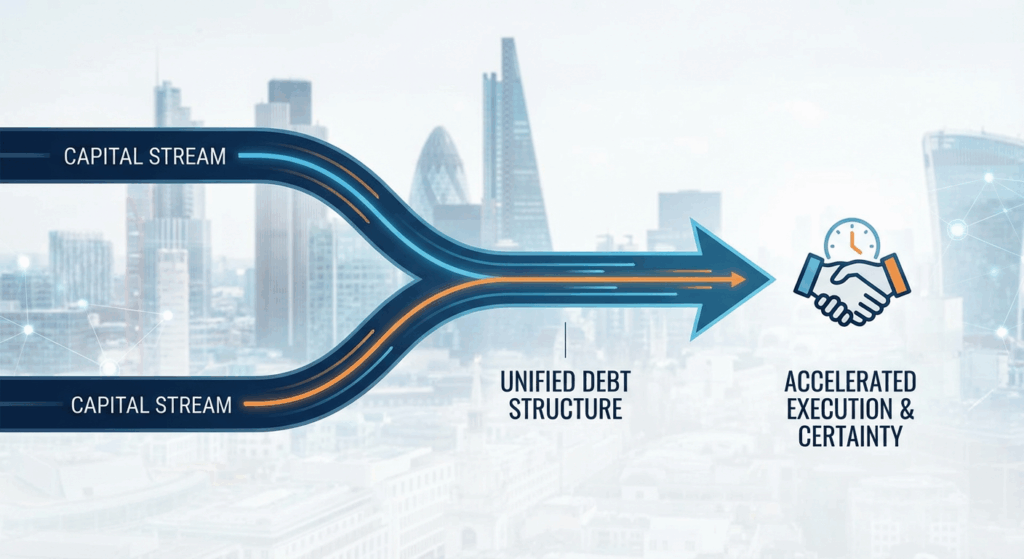
The Strategic Shift to Unitranche Financing
In the high-velocity environment of middle-market M&A, capital structure decisions often hinge on a trade-off between cost and certainty. While traditional bank debt combined with mezzanine financing historically offered a lower weighted average cost of capital (WACC), the unitranche facility has emerged as the dominant instrument for sponsor-led engaged buyouts in 2025 and 2026. This structure aggregates senior and subordinated debt risks into a single instrument, offering borrowers speed and operational flexibility in exchange for a blended pricing premium.
For operators and private equity sponsors, understanding the mechanics of a unitranche loan is critical. It is not merely a “convenience” product; it is a strategic tool that minimizes execution risk in competitive auction processes. By eliminating the friction of intercreditor negotiations between separate senior and junior lenders, unitranche structures can accelerate closing timelines by nearly a month compared to multi-layered capital stacks [privateequitybro.com].
Structure Breakdown: Components and Mechanics
A unitranche loan creates a hybrid debt structure through a single credit agreement between the borrower and a lender (or a small club of lenders). While it functions as a single tranche of debt for the borrower, the “unit” often masks an internal bifurcation of risk managed behind the scenes.
The “Agreement Among Lenders” (AAL)
The defining feature of a unitranche deal is the Agreement Among Lenders (AAL). In a bifurcated unitranche, the lender group splits the loan into “first-out” (senior) and “last-out” (junior) pieces. The borrower pays a single blended interest rate, but the AAL dictates that the first-out lenders receive a lower return for priority repayment, while last-out lenders capture a premium for taking on the junior risk. Crucially, the borrower is not a party to the AAL, simplifying their legal exposure [wallstreetprep.com].
Deal Example: $250M Acquisition Financing
Consider a software company with $50 million in EBITDA being acquired for $500 million (10x EV). The sponsor seeks 5.0x leverage ($250 million in total debt).
- Structure: Single $250M Unitranche Term Loan.
- Pricing: SOFR + 550 basis points (floating).
- Amortization: 1.0% per annum (minimal required principal repayment).
- Term: 5 to 7 years.
- Covenants: Focus on leverage ratios rather than strict maintenance tests, providing more “headroom” for volatility.
In this scenario, the sponsor avoids the complexity of raising a $150M senior loan from a bank and a $100M mezzanine note from a separate fund. Instead, a direct lender provides the full check, accelerating the timeline.
How It Compares: Unitranche vs. Senior-Mezzanine
The primary alternative to unitranche is the traditional Senior-Mezzanine structure. Understanding the differences is vital for choosing the right path.
- Speed of Execution: Data indicates a median “sign-to-fund” timeline of 45 days for unitranche deals versus 70 days for senior-mezzanine structures. This 25-day difference can be the deciding factor in winning a deal [financely-group.com].
- Cost of Capital: A senior loan (e.g., SOFR + 350 bps) blended with mezzanine debt (12% coupon + PIK) might offer a slightly lower all-in rate than a unitranche (SOFR + 550 bps). However, mezzanine debt frequently requires equity warrants (kickers) to juice returns, which dilutes the sponsor’s equity. Unitranche structures typically do not include warrants [breakwaterma.com].
- Intercreditor Dynamics: In a downturn, a senior-mezz structure involves two distinct groups of creditors with competing interests. Generally, senior lenders want to liquidate, while mezzanine lenders want to restructure. Unitranche aligns these interests under one agent, simplifying workouts.
Current Market Terms (2025-2026)
As of early 2026, the market for unitranche financing has stabilized with specific standard terms for middle-market issuers.
- Pricing Spreads: Typical spreads range from SOFR + 475 to 575 basis points. This reflects a risk premium over broadly syndicated loans but remains competitive for the certainty provided [financely-group.com].
- Leverage Profiles: Total leverage for sponsored deals is hovering around 5.0x EBITDA, with Loan-to-Value (LTV) ratios averaging between 55% and 65%.
- Upfront Fees: Borrowers should expect Original Issue Discount (OID) or upfront fees in the range of 1.5% to 2.0% of the facility amount.
- Mega-Unitranche Trend: The market has seen a rise in “mega-unitranche” facilities exceeding $2 billion, proving this structure is no longer limited to the lower middle market [privateequitybro.com].
Structuring Guidance and Negotiation
For operators and investors, the “headline rate” is only one variable. The real negotiation value lies in the flexibility of the structure.
For Borrowers (Operators/Sponsors):
- Accordion Facilities: Negotiate for an “incremental facility” or accordion feature that allows for additional borrowing (e.g., up to 1.0x EBITDA) for future acquisitions without refinancing the entire debt stack.
- Covenant Definitions: Scrutinize the definition of EBITDA. “Adjusted EBITDA” add-backs are the battleground where covenant headroom is won or lost. Ensure “cov-lite” terms regarding financial maintenance covenants are actually reflected in the documents.
For Lenders/Investors:
- Call Protection: In exchange for the simplified structure, lenders should secure robust call protection (e.g., 102/101 soft call premiums) to prevent the borrower from refinancing immediately if spreads tighten.
- Documentation Risk: In club deals, ensure the voting rights within the AAL protect minority lenders from being dragged into amendments that erode their security.
Key Takeaways
- Speed Premium: Unitranche deals close ~30-45 days faster than multi-tranche alternatives, a critical advantage in competitive auctions.
- Non-Dilutive: Unlike mezzanine financing, unitranche rarely requires equity warrants, preserving upside for shareholders.
- Simplified Governance: A single credit agreement and agent reduces administrative burden and legal costs compared to managing intercreditor agreements.
- Pricing Reality: Expect to pay a spread of SOFR + 475-575 bps; the premium covers the “convenience” of a one-stop financing solution.
- Scale: The structure has graduated from the lower middle market, with facilities now regularly exceeding $1 billion for large platform acquisitions.


