
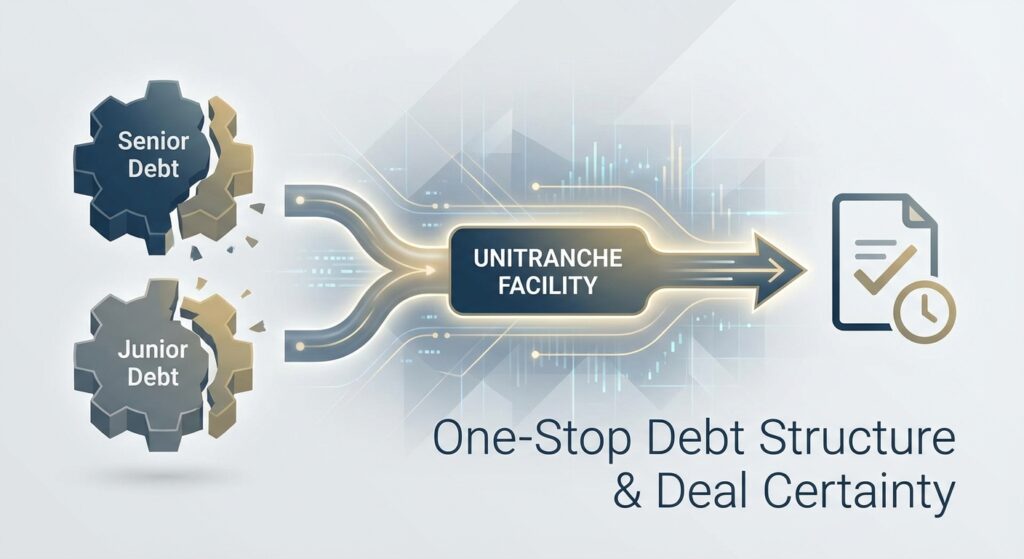
In the high-velocity deal environment of early 2026, financing certainty often trumps marginal cost savings. For middle-market sponsors and operators, the structural debate has shifted from “cheapest cost of capital” to “fastest path to close.” Enter the unitranche facility.
While traditional senior-subordinated structures have historically offered a lower weighted average cost of capital (WACC), the unitranche structure has solidified its dominance by solving for execution risk. With private credit volumes reaching record highs, exceeding $210 billion in middle-market issuances in recent years against a backdrop of bank consolidation, understanding the mechanics of a “one-stop” debt structure is critical for CFOs and deal partners alike.
This analysis breaks down the modern unitranche structure, compares it against the traditional bifurcated stack, and outlines current market terms for 2026.
The Anatomy of a Unitranche Deal
A unitranche facility combines senior and junior debt risk into a single instrument with a blended interest rate. Unlike a bifurcated structure (senior term loan + mezzanine notes), the borrower signs one credit agreement with one agent.
Behind the scenes, however, the risk is often tranched via an Agreement Among Lenders (AAL). This creates a “First Out / Last Out” (FOLO) structure invisible to the borrower but critical for the lenders:
- First Out (FO) Tranche: Typically held by a bank or low-cost institutional lender. They get paid first and hold a super-senior priority on collateral.
- Last Out (LO) Tranche: held by a private credit fund or BDC. They take the junior risk and receive a higher yield to compensate for the subordination.
Structural Example: $100M Acquisition financing
Consider a software company with $10 million in EBITDA being acquired for $100 million (10x EV). The sponsor needs $55 million in debt financing (5.5x leverage).
The Unitranche Approach:
- Total Facility: $55M Unitranche Term Loan
- Pricing: SOFR + 550 bps (Blended)
- Upfront Fee: 2.0%
- Amortization: 1.0% per annum
- Documents: Single Credit Agreement
Under the hood (The Lender’s View):
The $55M might be split into a $35M “First Out” piece pricing at SOFR + 350 bps, and a $20M “Last Out” piece pricing effectively at SOFR + 900 bps. The borrower only sees the blended SOFR + 550 bps rate.
Comparative Analysis: Unitranche vs. Senior-Mezz
When choosing between a unitranche and a traditional senior-mezzanine stack, the trade-off is almost always between complexity and cost.
1. Speed and Execution
Recent market data indicates a significant efficiency gap. Median time from “sign-to-fund” for unitranche deals currently hovers around 45 days, compared to 70 days for senior-mezz structures. In a competitive auction, saving 25 days can be the difference between winning and losing a deal.
2. Intercreditor Dynamics
In a senior-mezz deal, the borrower must negotiate an Intercreditor Agreement between the senior bank and the mezzanine fund. If the business underperforms, these two lender groups often have conflicting interests regarding liquidation vs. restructuring. In a unitranche, the borrower deals with a single agent. The conflicts between First Out and Last Out lenders are handled via the AAL, which typically restricts the First Out lender’s ability to stall a restructuring led by the Last Out lender (who is the “controlling class”).
3. Dilution and Cost
Mezzanine debt often requires an “equity kicker” (warrants) to boost returns, typically costing the sponsor 3-5% in ownership dilution. Unitranche facilities rarely include warrants. While the cash interest coupon on a unitranche (e.g., SOFR + 550) might be higher than a senior bank loan (SOFR + 375), it avoids the expensive PIK interest and equity dilution associated with the junior layer of a bifurcated stack.
Current Market Terms (Q1 2026)
Based on recent private credit data, here are the prevailing terms for middle-market unitranche facilities:
- Pricing Spreads: SOFR + 475–575 bps for healthy credits.
- Leverage (LTV): Lenders are comfortable up to 55–65% Loan-to-Value (LTV), whereas senior banks typically cap out at 40-50%.
- Upfront Fees: 1.5% – 2.0% of the facility amount.
- Covenants: Typically 1-2 financial maintenance covenants (e.g., Total Net Leverage Ratio), though large-cap unitranches ($500M+) are increasingly “covenant-lite.”
Sources indicate that unitranche volume has surged, partly because private credit funds have raised significant dry powder and can write cheks large enough to bypass the syndicated market entirely.
Structuring Guidance & Negotiation
For Operators & Sponsors
When negotiating a unitranche term sheet, focus on the “incremental facility” (accordion). Since you are locked into a single lender hierarchy, ensure the document allows you to raise additional debt for add-on acquisitions without punitive consent fees. Ask for “MFN” (Most Favored Nation) sunset provisions, so that if you raise cheaper debt later, you don’t automatically have to re-price the existing debt upwards.
For Lenders & Investors
The critical battleground is the Agreement Among Lenders (AAL). If you are a “Last Out” participant, you must ensure you retain the voting rights to control enforcement actions if the borrower defaults. Without this, the risk-averse “First Out” provider might force a liquidation that destroys the value of your junior position.
Key Takeaways
- Speed Premium: Unitranche closes ~35% faster than bifurcated debt structures.
- Dilution Defense: Choosing unitranche over mezzanine eliminates the need for equity warrants.
- Hidden Mechanics: The “First Out/Last Out” split drives lender economics but is invisible to the borrower.
- Leverage Capacity: Unitranche typically offers 1.0x-1.5x higher leverage turns than standalone senior bank debt.
- Market Standard: Spreads have settled in the SOFR + 500 bps range for solid middle-market credits.


