
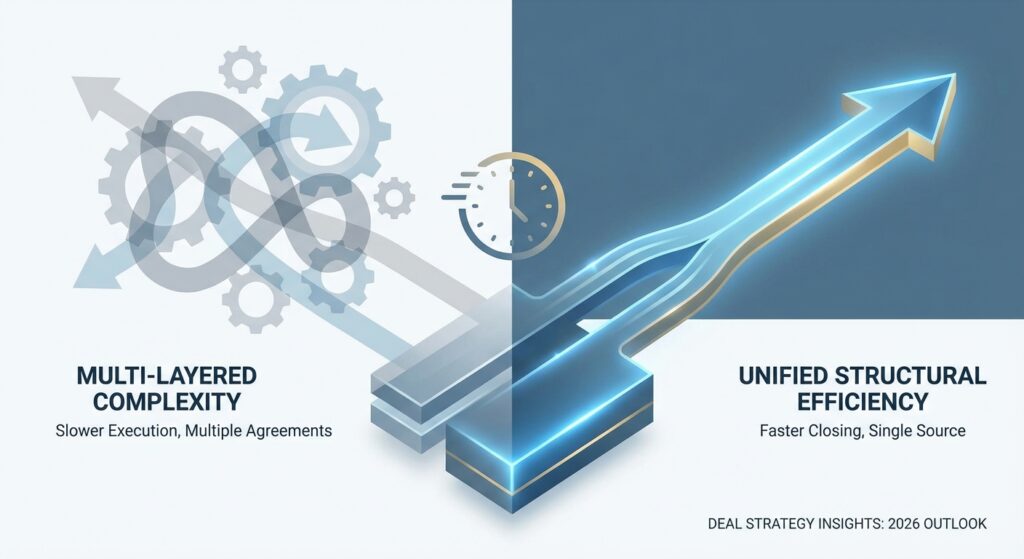
The Consolidation of Capital: Why Unitranche Dominates the Middle Market
In the high-velocity environment of middle-market M&A, financing certainty often outweighs marginal cost savings. By late 2026, the unitranche facility has cemented its position as the preferred debt structure for sponsor-backed buyouts, displacing the traditional senior-subordinated stacks that once defined leveraged finance. With private credit assets under management surpassing $2.1 trillion in 2025, the depth of the unitranche market now allows for execution on a scale previously reserved for the syndicated loan market.
For operators and sponsors, the appeal lies in simplicity and speed. A unitranche facility combines senior and junior debt risk into a single instrument with one blended interest rate and one set of governing documents. While the headline rate may appear higher than a senior bank loan, the structural efficiency (eliminating intercreditor negotiations and accelerating closing timelines) has made it the standard for competitive acquisitions.
Structure Breakdown: The Mechanics of a Blended Facility
A unitranche loan legally exists as a single first-lien term loan. However, economically, it is often a partnership between lenders with different risk appetites. The borrower signs one credit agreement, pays one blended coupon, and deals with one administrative agent.
Behind the scenes, lenders utilize an Agreement Among Lenders (AAL) to bifurcate the risk. This creates a “first-out” tranche (often held by banks or low-cost capital providers) and a “last-out” tranche (held by private credit funds). The borrower is generally agnostic to this split, seeing only the unified terms.
Deal Example: $100M Enterprise Value Software Buyout
Consider a hypothetical acquisition of a B2B software company with $10M EBITDA. The sponsor requires $55M in debt financing (5.5x leverage).
- Facility Size: $55 Million Term Loan
- Pricing: SOFR + 550 basis points (floating)
- Upfront Fee/OID: 2.0%
- Amortization: 1.0% per annum
- Tenor: 6 years
- Covenants: Single maintenance covenant (Total Net Leverage not to exceed 6.00x)
In this structure, the lender provides the full $55M. They might internally allocate $30M to a first-out bucket earning SOFR + 400 and $25M to a last-out bucket earning SOFR + 750, resulting in the blended rate of SOFR + 550. The borrower avoids managing two separate lender groups.
Comparative Analysis: Unitranche vs. Senior-Mezzanine
The primary alternative to unitranche is “stacking” capital: securing a senior term loan from a commercial bank and a mezzanine note from a subordinated lender. Each approach involves distinct trade-offs regarding cost, execution risk, and equity dilution.
1. Speed and Certainty
Data indicates a significant “speed premium.” Median unitranche deals move from signing to funding in approximately 45 days, compared to 70 days for senior-mezzanine structures. In competitive auctions, saving 3–4 weeks can be the difference between winning and losing a bid.
2. Cost vs. Dilution
A traditional senior loan might price at SOFR + 350-400 bps, which is cheaper than the unitranche’s SOFR + 550 bps. However, the mezzanine layer required to fill the leverage gap often charges 10–12% cash interest plus PIK (Payment-In-Kind) interest, and frequently demands equity warrants (often 5-15% coverage). When modeling the total cost of capital, including the value of diluted equity, the unitranche often proves more accretive to the sponsor’s returns despite the higher cash coupon.
3. Documentation and Governance
A stacked structure requires an Intercreditor Agreement to define the rights between senior and junior lenders. These negotiations can stall closings, particularly regarding standstill periods and payment blocks during distress. Unitranche structures eliminate this friction point for the borrower, as inter-lender disputes are handled privately via the AAL.
Current Market Terms (2025-2026)
As of late 2026, the market has stabilized following the volatility of previous years. Terms in the private credit sector reflect a borrower-friendly shift due to high levels of dry powder.
- Spreads: For middle-market issuers, unitranche spreads have tightened to SOFR + 475–575 bps.
- Leverage Profiles: Lenders are comfortable with 5.0x – 5.5x Total Leverage for quality assets, with some technology deals stretching to 6.0x recurring revenue structures.
- Loan-to-Value (LTV): Unitranche lenders typically advance up to 60-65% LTV, whereas senior banks often cap out at 40-50%, necessitating junior capital to reach full leverage.
- Covenants: The “covenant-lite” trend of the syndicated market has not fully permeated the lower middle market. Most unitranche deals still retain at least one financial maintenance covenant (usually leverage or debt service coverage), though “covenant-loose” structures with 25–30% headroom are common.
Structuring Guidance: Negotiation Strategies
For operators and CFOs entering a unitranche negotiation, the focus should extend beyond the interest rate.
1. Incremental Facilities (Accordions):
Negotiate pre-baked “accordion” features that allow you to raise additional debt for acquisitions up to a certain leverage cap (e.g., 1.0x turn of EBITDA) without paying new closing fees or renegotiating documents. This is critical for buy-and-build strategies.
2. Equity Cure Rights:
Ensure the term sheet includes adequate equity cure rights, typically allowing the sponsor to inject capital to “cure” a covenant breach. Market standard is often two cures in a trailing four-quarter period, with a cap of four or five over the life of the loan.
3. Portability:
While rare in smaller deals, ask for portability. This allows the debt to remain in place if the business is sold to another private equity firm, potentially increasing the asset’s attractiveness at exit by removing financing risk for the buyer.


