
The Financing Challenge: Certainty in a Fragmented Market
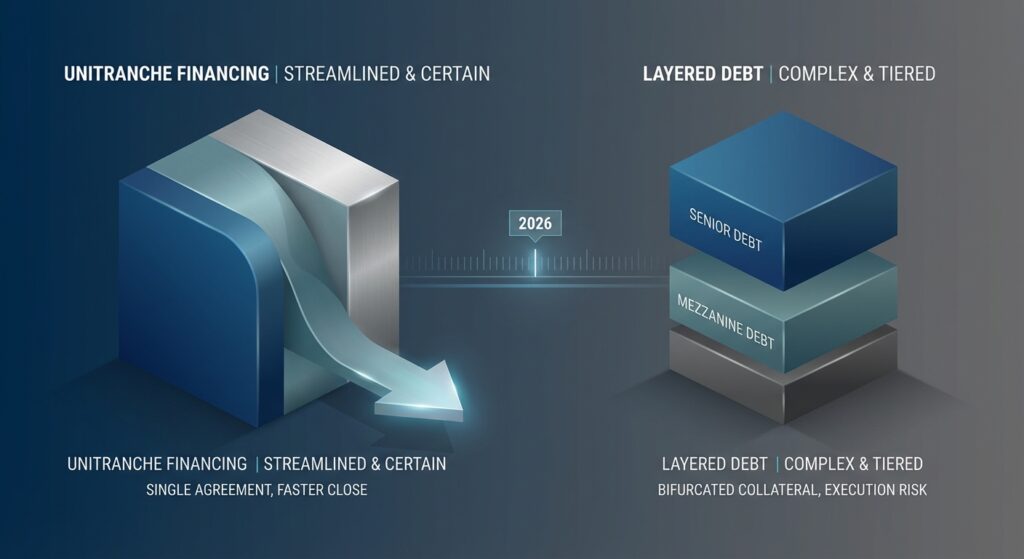
In the high-stakes environment of middle-market M&A, the “certainty of close” often trumps a fraction of a percentage point in interest rate savings. For private equity sponsors and corporate acquirers in 2026, the structural debate frequently centers on a singular choice: the streamlined simplicity of a unitranche facility versus the tiered cost efficiency of a traditional senior-plus-mezzanine stack.
While traditional bank debt remains the cost-leader, its rigidity and execution risk have driven borrowers toward private credit solutions. The unitranche structure (a single debt instrument blending senior and junior risk) has evolved from a niche product to the dominant financing tool for sponsor-led buyouts, particularly for assets with $10M to $50M in EBITDA. This analysis breaks down the mechanics, economics, and strategic trade-offs of the unitranche structure in the current market.
Structure Breakdown: Mechanics and The “Synthetic” Split
A unitranche facility collapses the capital stack into one loan agreement with a single blended interest rate. To the borrower, there is one lender (or agent), one set of covenants, and one amortization schedule. However, behind the scenes, the risk may be sliced differently.
The “Agreement Among Lenders” (AAL)
In many unitranche deals, an Agreement Among Lenders (AAL) creates a synthetic seniority structure invisible to the borrower. A “First-Out” lender (often a bank or low-cost credit fund) takes the lower-risk, lower-return portion, while a “Last-Out” lender (typically a private credit fund) absorbs higher risk for higher yield. Crucially, the borrower does not negotiate an intercreditor agreement, significantly reducing legal friction.
Deal Example: $100M Enterprise Value Software Buyout
Consider a sponsor acquiring a SaaS platform with $10M EBITDA at a 10x multiple ($100M EV). The capital structure requires 5.5x leverage ($55M total debt).
The Unitranche Term Sheet:
- Facility Size: $55M (5.5x leverage)
- Pricing: SOFR + 550 bps (blended rate)
- Amortization: 1.0% per annum
- Covenants: Single maintenance covenant (Net Leverage Ratio < 6.5x)
- Equity Kicker: None
- Time to Close: 40 days
In this structure, the sponsor avoids the complexity of bifurcated collateral. The lender provides a singular $55M check, offering speed and a simplified post-close relationship.
How It Compares: Unitranche vs. Senior-Mezzanine
Alternative structures usually involve layering a senior bank loan (lower cost, strict covenants) with mezzanine debt (high cost, unsecured). Here is how the trade-offs play out:
1. Speed and Execution
According to 2025 market data, the median sign-to-fund timeline for unitranche deals was approximately 45 days, compared to 70 days for senior-mezzanine stacks. The delay in layered structures often stems from negotiating the intercreditor agreement, which creates friction between senior and junior lenders regarding payment priority and enforcement rights.
2. Cost vs. Dilution
A senior-mezzanine stack might offer a lower weighted average cost of capital (WACC) on paper. For instance, a senior loan at SOFR + 350 bps combined with mezzanine debt at 12% creates a lower blended rate than the unitranche’s SOFR + 550 bps. However, mezzanine lenders frequently require equity warrants (often 5–15% coverage) or PIK (Payment-in-Kind) interest to juice returns. Financely Group notes that avoiding this warrant dilution can often economically outweigh the higher cash interest cost of a unitranche.
3. Covenants and Flexibility
Traditional senior lenders generally impose maintenance covenants (e.g., quarterly leverage and fixed charge coverage tests). If a borrower misses a quarter, they are in default. Unitranche lenders, focused on the entirety of the enterprise value, often provide “covenant-lite” terms or set covenants with significantly more headroom (e.g., 25–30% cushion to model).
Current Market Terms (2026 Context)
The private credit market has matured significantly, with total assets under management exceeding $2 trillion. As of early 2026, standard terms for middle-market unitranche facilities include:
- Spreads: SOFR + 475 to 575 basis points.
- Upfront Fees (OID): 1.5% to 2.5%.
- Leverage Profiles: Total leverage continues to hover around 4.5x to 5.5x EBITDA, with Loan-to-Value (LTV) ratios averaging 55–60%.
- Documentation: Adoption of “portability” clauses (allowing debt to stay in place upon sale) is becoming a negotiated point in premium credits, though lenders remain selective.
Data from PE Bro Official indicates that private lenders are increasingly arranging “mega-unitranche” facilities (deals >$1B), proving the structure’s viability moving upstream from the middle market.
Structuring Guidance
For Sponsors and Operators:
When negotiating a unitranche, focus on the incremental cost of leverage. While the blended rate is higher, calculate the “break-even” against the dilution saved from avoiding mezzanine warrants. Additionally, verify the lender’s ability to provide “delayed draw term loans” (DDTL) to fund future acquisitions without restriking the entire credit agreement.
For Investors and Lenders:
Scrutinize the Agreement Among Lenders (AAL). If you are a participant in a syndicated unitranche, understand your voting rights in a workout scenario. Unlike statutory intercreditor agreements, AALs are private contracts; ambiguity here can lead to “lender-on-lender” violence during restructuring events.
Key Takeaways
- Speed Premium: Unitranche structures close ~30% faster than layered debt, reducing deal execution risk.
- Dilution Defense: Higher cash interest rates in unitranche are often offset by the elimination of equity warrants common in mezzanine debt.
- Covenant Headroom: Borrowers gain operational flexibility with typically only one leverage-based maintenance covenant.
- Market Pricing: Expect SOFR + 475–575 bps in the current 2026 vintage.
- Streamlined Relationship: One agent and one credit agreement simplify post-close administration and M&A add-on approvals.


