
The Dilemma of Summer 2025
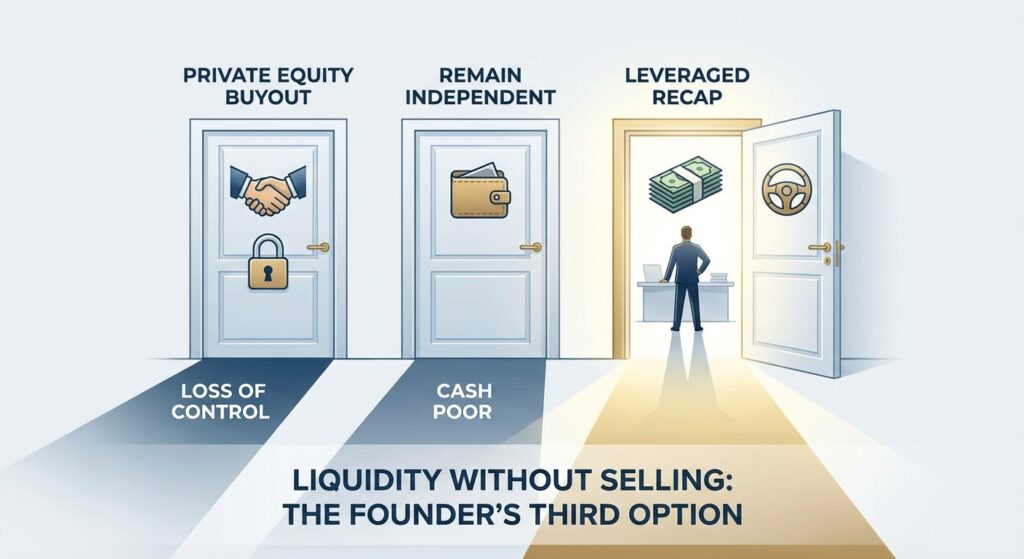
By mid-2025, the capital markets had shifted efficiently, albeit quietly, in favor of operators. While the headlines were dominated by mega-cap deals, like Thoma Bravo’s $10.6 billion acquisition of Jeppesen, a different narrative was playing out in the middle market. Founders who had spent a decade bootstrapping their companies arrived at a familiar crossroads: sell to Private Equity and lose control, or stay independent and remain "cash poor" despite high valuations.
However, a third door opened wide in late 2025. Driven by intense competition between direct lenders and the broadly syndicated market, private credit firms began offering unprecedented terms to win deals. According to reporting from Bloomberg in July 2025, direct lenders started pitching higher leverage ratios specifically to fund dividend payouts for shareholders. For founders, this changed the calculus of ownership entirely.
Case Study Example: The "Radius" Recap
Note: The following is a hypothetical case study based on deal structures observed in the 2025-2026 market cycle.
Consider "Radius Logistics," a hypothetical tech-enabled logistics firm with $40 million in EBITDA. By late 2025, the founder, Sarah, faced pressure to provide liquidity for early family investors. She received a compelling buyout offer from a Tier-1 Private Equity firm: a 12x multiple ($480 million enterprise value). The catch? She would have to sell a controlling stake, roll 20% of her equity, and accept a new board dominated by the PE firm.
Historically, Sarah’s only other option was a modest bank loan that focused heavily on amortization and covenants. But in the 2025 credit boom, private credit funds needed to deploy capital. Approaches changed. Several direct lenders offered a "Dividend Recap" structure that would allow Sarah to take substantial chips off the table without selling a single share.
The Decision Matrix
Sarah weighed two competing term sheets:
- Option A (The PE Buyout): Sell 80% at a $480M valuation. Sarah nets ~$380M pre-tax but becomes an employee in her own company, answering to a new owner with a 5-year exit clock.
- Option B (The Leveraged Recap): Raise $220 million in debt (5.5x leverage) from a direct lender. The proceeds are used to refinance existing small debt and pay a one-time $200 million dividend to shareholders. Sarah retains 100% ownership and full operating control.
The risks in Option B were real. The company would now carry significant interest expense, reducing free cash flow. However, market reporting from Bloomberg noted that lenders were offering "flexibility," often including PIK (payment-in-kind) toggles or lighter covenants to win the business against banks. Sarah chose Option B.
The Outcome: Control vs. Cash
In this scenario, by choosing the debt route, the founder secured $200 million in immediate liquidity, generational wealth by any standard, while keeping the upside of the next phase of growth. If Radius Logistics grows EBITDA to $60 million over the next three years, the equity value (even net of the new debt) grows significantly, and she captures 100% of that appreciation.
This strategy mirrors the aggression seen at the top of the market. For instance, in April 2025, Clearlake Capital utilized a $5.75 billion bridge loan to secure its acquisition of Dun & Bradstreet, bypassing traditional financing timelines to move fast (Bloomberg Tax). While Clearlake is an institutional giant, the principle trickled down: debt is a tool for speed and control.
Conversely, had Sarah sold to PE, she would have reduced her risk profile to zero but capped her upside. The PE firm would have likely levered the company anyway to boost their returns. The recap allowed the founder to utilize that same leverage for her benefit.
The Lessons for 2026
The "Radius" example illustrates a shift in how founders view their balance sheets. Debt is no longer just for distress or working capital; it is a strategic alternative to equity dilution.
1. The Cost of Equity vs. Debt: Even with interest rates elevated compared to the 2010s, the cost of debt (10-12%) is often cheaper than the cost of equity (selling 20-30% of future growth to a VC or PE firm).
2. Discipline as a Feature: High leverage forces operational discipline. In the Fortune profile of Ares Management, the dominance of private credit is attributed to sophisticated underwriting. Lenders are partners, but they are strict. For a founder like Sarah, the debt load acts as a governor against wasteful spending, mimicking the discipline a PE firm would impose, but without the boardroom interference.
3. Timing the Credit Cycle: This strategy works best when lenders are hungry. The "borrower’s market" of mid-2025 created terms that may not exist in tighter cycles. Founders must act when the window is open.
Key Insights
- Liquidity ≠ Exit: You can achieve massive liquidity events (9 figures) without triggering a change of control or selling equity.
- Leverage Transfer: In a buyout, the PE firm uses debt to boost their IRR. In a recap, the founder uses debt to boost their actual cash-on-cash return.
- The "Sleep at Night" Factor: Recaps introduce bankruptcy risk. Buyouts remove it. This path is only for operators confident in their cash flow stability.
- Lender Selection Matters: In 2025, firms like Ares and Blue Owl pitched flexibility. Choosing a partner who understands the business is as critical as the interest rate.
- Valuation Validation: A successful recap validates the company’s enterprise value to the market, setting a floor for future IPO or M&A discussions.


