
The Consolidation of Capital: Deconstructing the Unitranche Facility
In the landscape of middle-market buyouts, the unitranche facility has evolved from a niche product into the dominant financing instrument for financial sponsors. By 2025, global private credit assets surged to approximately $2.1 trillion, with unitranche structures driving the majority of sponsor-led leveraged buyouts (LBOs). The appeal lies in a structural tradeoff: borrowers pay a premium on pricing in exchange for execution speed, certainty, and administrative simplicity.
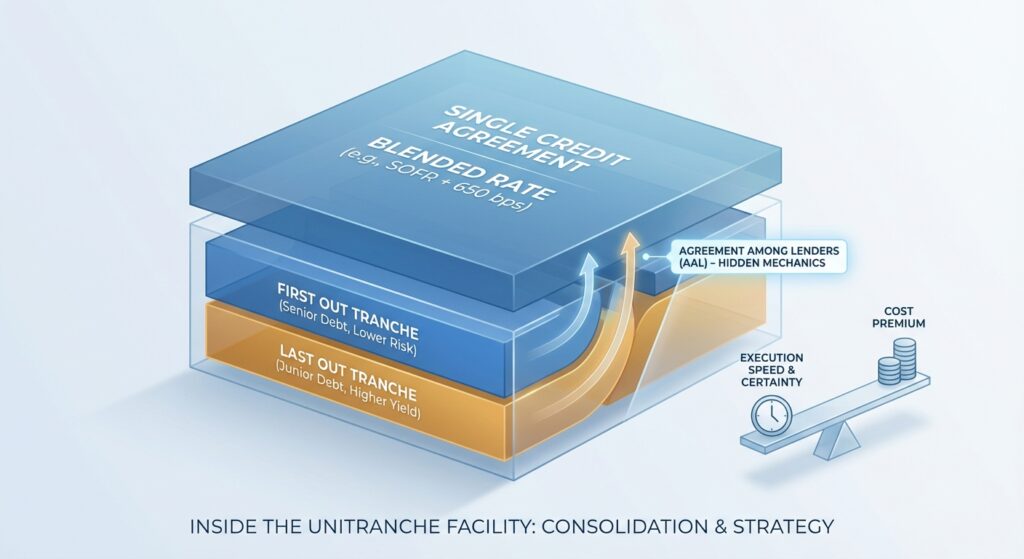
For operators and CFOs, understanding the mechanics beyond the headline interest rate is crucial. A unitranche loan is not merely a “blended” rate; it is a sophisticated consolidation of risk tranches that operates under a single credit agreement, masking complex inter-lender dynamics that usually sit behind the scenes.
Structure Breakdown: Mechanics of the “One-Stop” Solution
A unitranche facility combines senior debt (first lien) and subordinated debt (junior/mezzanine) into a single debt instrument with one set of loan documents and one interest rate. While the borrower interfaces with a single agent and pays a blended coupon, the lenders typically bifurcate the loan internally.
The “First Out / Last Out” Waterfall
Behind the single credit agreement, lenders utilize an Agreement Among Lenders (AAL). This private contract, invisible to the borrower, splits the loan into:
- First Out Tranche: Resembles traditional senior bank debt with lower risk and lower return.
- Last Out Tranche: Absorbs the higher risk, similar to mezzanine debt, providing the yield enhancement for the lender group.
Deal Example: Project Apex
Consider a hypothetical $100M Enterprise Value (EV) software company seeking a buyout financing. A Direct Lender proposes a $50M Unitranche Facility.
- Total Leverage: 5.0x EBITDA
- Pricing: SOFR + 650 bps (Blended)
- OID (Original Issue Discount): 98.0
Under the Hood (The AAL Structure):
The lender might internally structure this as $35M “First Out” at SOFR + 475 bps and $15M “Last Out” effectively earning SOFR + 1050 bps. The borrower simply pays the blended SOFR + 650 bps. This eliminates the need for the borrower to negotiate an intercreditor agreement between two warring classes of lenders.
How It Compares: Unitranche vs. Traditional Structures
The choice between unitranche and a traditional Senior/Mezzanine split often comes down to the value of certainty versus the cost of capital.
1. Execution Speed and Certainty
Traditional syndicated loans or bifurcated senior/mezz structures require coordinating multiple creditor classes. Each class has its own counsel, credit committee, and intercreditor negotiation. Recent analysis suggests unitranche financing can close 30 to 45 days faster than syndicated alternatives. In competitive auctions, this speed allows sponsors to bid with legally binding financing commitments, avoiding the “market flex” risk where terms change right before closing.
2. The Cost Premium
The trade-off is pricing. Borrowers typically pay a spread premium of 50 to 100 basis points over a comparable syndicated solution. However, this premium essentially buys insurance against “broken syndication”, the risk that a bank cannot sell the debt and forces terms to change (flex) to clear the market.
3. Documentation Simplicity
Unlike a First Lien/Second Lien structure, which requires a public-style Intercreditor Agreement, unitranche deals use a single credit agreement. This streamlines post-closing amendments and waivers, as the borrower deals with one agent rather than herding two distinct lender groups.
Current Market Terms & Standards
Based on private credit market data through late 2024 and 2025, the following terms define the current standard for middle-market unitranche deals:
- All-in Yields: New private credit deals have priced with average all-in yields between 12% and 13%, driven by elevated base rates.
- Leverage Profiles: Total leverage for sponsored unitranche deals has hovered around 5.0x EBITDA, with lenders increasingly focused on interest coverage ratios and free cash flow rather than just gross leverage multiples.
- Mega-Unitranche Trend: The market has seen a rise in “jumbo” unitranche facilities exceeding $2 billion, proving this structure is no longer limited to the lower middle market.
Sources indicate that while pricing has tightened slightly due to competition among direct lenders, the structural protections (covenants) remain tighter than broadly syndicated loans (BSL), which are often “covenant-lite.”
Structuring Guidance: Negotiation & Strategy
For Operators and Borrowers
Evaluate the “AAL” Risk: While you are not a party to the Agreement Among Lenders, its existence matters during bankruptcy or restructuring. Ensure your credit agreement clearly defines amendment voting thresholds so the “Last Out” lender cannot block reasonable waivers.
Negotiate Scalability: Since unitranche lenders are typically hold-to-maturity investors, negotiate incremental facilities (accordions) upfront. This allows you to draw additional capital for add-on acquisitions without re-opening the entire credit agreement.
For Investors and Lenders
Focus on Attachment Points: In a bifurcated structure, the “Last Out” position is highly sensitive to the attachment point (where its risk begins). In a 5.0x leverage deal, if the First Out attaches at 3.5x, the Last Out is taking purely equity-like risk if EBITDA contracts by 30%.
Bankruptcy Enhancements: Unlike traditional mezzanine debt, unitranche lenders under an AAL may have varying rights in bankruptcy court, as AALs are less tested than standard Intercreditor Agreements. Lenders must rigorously assess the enforceability of “silent seconds” provisions within the AAL.
Key Takeaways
- Integration: Unitranche blends senior and junior risk into one instrument, offering borrowers speed and simplicity for a price premium.
- Hidden Mechanics: The internal “First Out/Last Out” split allows lenders to engineer returns while presenting a unified face to the borrower.
- The Speed Trade: Borrowers often accept 50-100 bps higher costs to close 30+ days faster and eliminate syndication risk.
- Market Depth: With deals surpassing $2B, unitranche is now a viable alternative to High Yield bonds and BSL for large corporate borrowers.
- Documentation: The lack of a public intercreditor agreement simplifies operations but obscures lender-on-lender rights in distress scenarios.


