
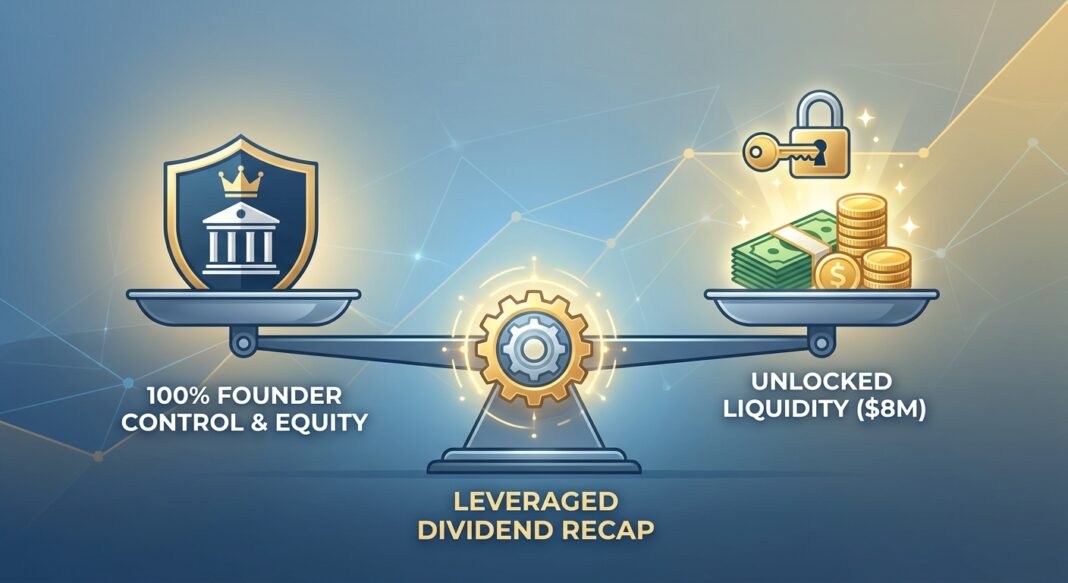
The Story: Twelve Years In, and Still No Exit in Sight
Note: The founder profile and company details below represent a Hypothetical Case Study: a composite scenario constructed to illustrate real market mechanics. All structural figures, market data, and deal benchmarks cited are drawn from publicly available sources and are documented throughout.
Imagine you have spent twelve years building a commercial landscaping and facilities management business across three mid-sized U.S. cities. You started with a truck, a few subcontractors, and a handful of municipal contracts. By 2024, you are running $18 million in annual revenue, generating $3.2 million in EBITDA, and employing 110 people. The business is healthy. You are not. Not financially, anyway.
Nearly every dollar of your net worth, call it $14 million on paper, is locked inside the company. Your spouse has asked about the house. Your kids are approaching college age. You have watched three potential acquirers kick the tires over the past four years and walk away for reasons that had nothing to do with your company’s performance: one ran out of acquisition capital, one pivoted its strategy, one simply ghosted. The exit market, as anyone in the lower middle market knows, is not a faucet you can turn on at will.
You are not ready to sell. You still believe the business can be worth $22 to $28 million in three to five years if you execute on a regional expansion plan. But you also cannot afford to wait another five years to see a dollar of personal liquidity. You need a third option, something between selling everything and selling nothing.
That third option has a name: the leveraged dividend recapitalization.
The Decision: What Were the Real Options on the Table?
At $3.2 million EBITDA, our hypothetical founder had a clean set of choices. Each came with a different price tag: paid not in dollars, but in ownership, control, and future upside.
Option A: Sell to Private Equity
At a reasonable 6x EBITDA multiple, a full sale would generate approximately $19.2 million. After taxes on the gain, the founder might net $13 to $14 million and walk away permanently, or agree to a two-year earnout under a new PE owner’s oversight. The upside of the next five years of growth? Gone.
Option B: Take on a PE Minority Partner (Recap)
A partial sale of 60% to a PE firm at a 5.5x multiple would generate roughly $10.6 million in cash today, while the founder retains a 40% rollover stake in the recapitalized entity. Common use cases see the founder retaining 20–49% equity, staying on as CEO, and participating in a larger second exit three to seven years later. The governance trade-off is real: a PE majority owner now controls the board.
Option C: Leveraged Dividend Recapitalization (No Sale)
The company borrows against its own cash flows, typically in the range of 3x to 5x EBITDA in the lower middle market, and pays the proceeds directly to the founder as a dividend. No equity changes hands. No new co-owner appears at the board table. The founder remains 100% owner, 100% in control.
In our scenario, at a conservative 2.5x EBITDA debt load (prudent for a services business with seasonal cash flow), the company could raise $8 million in a unitranche or senior secured term loan. That $8 million goes to the founder as a dividend. Annual debt service at an all-in rate of approximately 8.5% would total roughly $680,000 per year, a manageable 21% of EBITDA, well within lender comfort thresholds.
The founder chose Option C. And the numbers explain why.
The Outcome: Liquidity Today, Upside Tomorrow
The mechanics of the dividend recap are straightforward once you see them side by side with the alternatives:
| Scenario | Cash Today | Equity Retained | Control Retained | Future Upside (Est.) |
|---|---|---|---|---|
| Full Sale at 6x | ~$13–14M (after tax) | 0% | None | $0 |
| PE Minority Recap (40% rollover) | ~$10.6M | 40% | Shared / Board-driven | 40% of next exit |
| Dividend Recap (No Sale) | $8M | 100% | Full | 100% of future value |
The founder takes home $8 million: enough to pay off the family home, fund the college accounts, and diversify a portion into liquid assets. The company continues operating under the same leadership, same strategy, and same growth plan. Debt goes on the balance sheet. Cash goes in the owner’s pocket. The company keeps operating under the same leadership.
Now fast-forward three years. The expansion into a fourth market has added $900,000 in incremental EBITDA. The business generates $4.1 million in EBITDA. At a 6x market multiple, it is now worth $24.6 million, and the founder still owns all of it. The debt balance has been paid down to roughly $5.5 million through normal amortization. Net equity value: approximately $19 million. Add the $8 million already banked, and the founder’s total realized value approaches $27 million, more than the $19.2 million a full sale would have generated at the beginning, and achieved without surrendering a single share.
The dividend recap market that enabled this move has been booming. PitchBook LCD tracked roughly $76 billion in dividend recap loans during 2024, the third-highest annual total on record, a 240% jump versus 2023. In the year to September 30, 2025, PE sponsors alone pulled $34.7 billion out of companies they own through dividends financed by the leveraged loan market. Founders are increasingly learning to use the same playbook.
The Cautionary Mirror: When Leverage Is the Weapon, Not the Tool
The founder’s story above only works because leverage was sized to cash flow, not to ambition. The history of private equity is littered with cautionary tales that illustrate what happens when the calculus is inverted.
Consider Party City. The large amount of debt used to finance the LBO added to Party City’s financial burdens. Following the LBO, Party City had an extremely high debt-to-equity ratio relative to its retail peers, and the company’s interest coverage ratio became extremely low. The result: in 2023 Party City filed for Chapter 11 bankruptcy protection, and in 2024 it announced it was winding down operations and permanently closing all of its stores.
Or look at the Toys “R” Us acquisition, acquired for $6.6 billion by KKR, Bain Capital, and Vornado Realty Trust, saddled with significant debt. Despite efforts to revive the business, the debt burden proved too heavy, and the company filed for bankruptcy in 2017. The lesson illustrates the danger of overleveraging and the importance of aligning capital structure with the company’s ability to generate cash flow.
The difference between these failures and our founder’s success is not leverage itself; it is leverage calibrated to cash flow, used as a precision instrument rather than a blunt maximization tool.
The Lessons: A Framework for Operators Facing the Same Choice
The leveraged dividend recap is not for every business. But it is dramatically underused by the founder class, in large part because nobody outside of financial advisory circles talks about it plainly. Here is the framework that determines whether it belongs in your toolkit:
✅ When a Dividend Recap Works
- Stable, predictable cash flows. Dividend recaps are best suited for businesses with strong cash flow, stable margins, and predictable revenue. Services, SaaS, distribution, and healthcare services businesses tend to qualify. Cyclical or highly seasonal businesses face tighter scrutiny.
- Leverage sized to serviceability. The 3x to 5x EBITDA range cited by the Pepperdine Private Capital Markets Report (2024) is the guardrail, not the target. Conservative founders often stop at 2.5x to 3x, preserving covenant headroom.
- The founder still has a growth thesis. The founder de-risks their personal financial situation while retaining control and upside, and when the company eventually sells, both participate in the larger outcome. If you do not believe the business will be worth more in five years, a full sale may be the cleaner answer.
- Personal diversification need is acute. Operators who have been through both situations report that financial desperation, not comfort, is what produces the worst decisions in a downturn. A founder who has banked liquidity is a better decision-maker than one who is betting the entire household balance sheet on a single illiquid asset.
⚠️ When It Doesn’t
- Revenue concentration risk. If two customers represent 40% of revenue, lenders will either decline or price the risk prohibitively.
- Compressed margins. Low-margin businesses cannot absorb meaningful debt service without squeezing operations. This is precisely the Party City lesson, companies desirable for leveraged transactions must be able to generate steady operating cash flows.
- Near-term capital need for growth. If the business needs reinvestment capital, layering debt service on top of capex requirements can create a damaging squeeze. In those cases, the structure may need a growth equity component alongside (or instead of) the recap.
The Market Window Right Now
Availability of capital in the private credit markets has increased competition among lenders and put downward pressure on spreads, with unitranche pricing generally trending downward across borrower sizes. Private credit has evolved from a niche segment to a foundational pillar of global capital markets, with AUM reaching approximately $1.5 trillion as of early 2024 and projections estimating a rise to $2.6 trillion by 2029. For qualified operators, the lender competition is real, and it is creating meaningfully better terms than existed two years ago.
Key Insights
- 💡 Liquidity and ownership are not a trade-off, if you use the right instrument. A leveraged dividend recap lets a founder extract significant personal cash without transferring a single share or ceding board control.
- 💡 The market for this tool is at an all-time high. Dividend recap issuance hit $76 billion in 2024, the third-largest annual total on record, and private credit competition is pushing spreads down, improving terms for borrowers.
- 💡 Cash flow, not ambition, sets the leverage ceiling. The most destructive LBO failures (Toys “R” Us, Party City, Energy Future Holdings) shared one pathology: debt sized to a hoped-for outcome rather than to demonstrated cash flow capacity.
- 💡 Personal financial security makes founders better operators. A founder who has already diversified personal wealth makes fewer panic-driven decisions when the next downturn arrives, and that rational clarity compounds into enterprise value.
- 💡 The “second bite” math often beats the clean exit math. Selling 100% today at 6x trades away all future appreciation. A founder who recaps at 2.5x debt, retains 100% equity, grows EBITDA, and exits at 6x three years later will frequently generate more total wealth, particularly in a private credit environment where the cost of that debt is competitive.


