
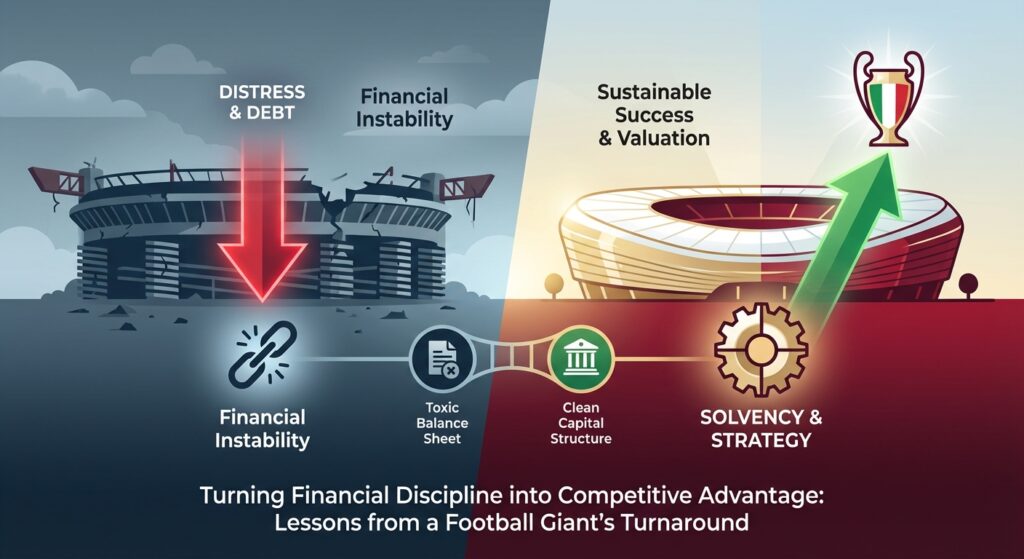
The Story: A Giant in Distress
In the summer of 2018, AC Milan, one of the most decorated football clubs in history, was effectively bankrupt. The club had just spent a chaotic year under the ownership of Chinese businessman Li Yonghong, who had acquired the team using high-interest loans from total return fund Elliott Management. When Li missed a €32 million repayment deadline, the collateral was seized.
Suddenly, a New York hedge fund known for distressed sovereign debt battles owned seven-time European champions. The narrative in the Italian press was grim: the "vultures" had landed. Fans feared asset stripping and a fire sale.
But the reality of what followed offers a masterclass in how capital structure dictates operational capability. The club wasn’t suffering from a lack of revenue potential; it was suffocated by a toxic balance sheet and an unsustainable cost base that exceeded its income. The "capital decision" here wasn’t just about debt vs. equity, it was about choosing financial sustainability over the vanity spending that plagues the industry.
The Decision: Solvency as Strategy
Elliott Management faced a fork in the road common to private equity turnarounds: maintain the status quo of high spending in hopes of quick success (and a quick flip), or perform a deep "financial reengineering."
They chose the latter, implementing a strategy that many founders and operators can learn from:
- De-leveraging the Asset: Rather than saddling the club with more LBO debt, Elliott injected equity to stabilize the balance sheet. This reduced interest expenses, freeing up cash flow for operations.
- Strict Cost Discipline: They imposed a strict wage cap. While competitors like Juventus and Inter Milan leveraged up to buy superstars (exemplified by the Cristiano Ronaldo era), Milan focused on young, undervalued talent with high resale potential, a financial "Moneyball" approach.
- The "Virtuous Cycle" Thesis: Elliott’s hypothesis was that financial stability forces better operational decision-making. As noted in recent 2026 retrospective analyses, "financial stability is not merely a prerequisite for survival, but a foundation for sporting success."
This was a contrarian bet. In European football, the prevailing wisdom was that you had to spend irrationally to win.
The Outcome: The "Scudetto" of Solvency
The results vindicated the strategy faster than expected. By the 2021/22 season, a lean, young AC Milan squad won the Serie A title (the Scudetto), their first in 11 years.
More importantly for the capital story, the club returned to profitability, a rarity in top-flight football. The cleanup operation made the asset attractive to institutional capital. In 2022, Elliott sold the club to RedBird Capital Partners for €1.2 billion, generating a massive return on their initial distressed entry point.
As of March 2026, the club continues to operate under RedBird’s platform, which emphasizes sustainable revenue streams over owner handouts. The turnaround proved that "the correlation between financial strength and competitive success has long been evident," but defined ‘strength’ not as unlimited cash, but as a self-sustaining business model.
The Lessons: Capital Structure is Destiny
The AC Milan case serves as a powerful proxy for any business facing a capitalization crossroads. Here are the principles for founders and CFOs:
1. Bad Leverage Kills Options; Good Equity Restores Them
Under the previous owner, high-interest debt forced short-term thinking. Management had to gamble on immediate success to service loans. By swapping debt for equity, Elliott bought the management team time, the most valuable asset in a turnaround.
2. Constraint Drives Innovation
When capital is unlimited (as seen in the "Roman Abramovich era" cited in recent reports), inefficiencies bloat the P&L. When capital is constrained but stable, operators are forced to be better. Milan’s scouting network outperformed wealthier rivals specifically because they couldn’t afford mistakes.
3. Sustainable Growth Valuations Premium
RedBird paid €1.2 billion not just for the brand, but for the cleanliness of the business. A company generating €50M EBITDA with zero debt is worth significantly more than a company generating €100M EBITDA with unmanageable leverage and liquidity risks. The exit multiple proves that the market values sustainability.
Key Insights
- Stability Precedes Performance: Operational turnarounds often stall without a fixed balance sheet. Fix the capital structure first.
- The Valuation Gap: Buyers pay a premium for self-sustaining cash flows compared to assets dependent on owner injections.
- Cost of Capital Matters: Replacing high-cost distressed debt with patient equity changed the management horizon from "next month" to "next 3 years."
- Discipline is a Moat: In industries addicted to cheap leverage (like 2020-era tech or football), fiscal discipline becomes a competitive differentiator when rates rise.
- Alignment of Interest: The turnaround worked because the capital provider (Elliott) and management were aligned on exiting via a sale of a healthy business, not stripping cash.


