
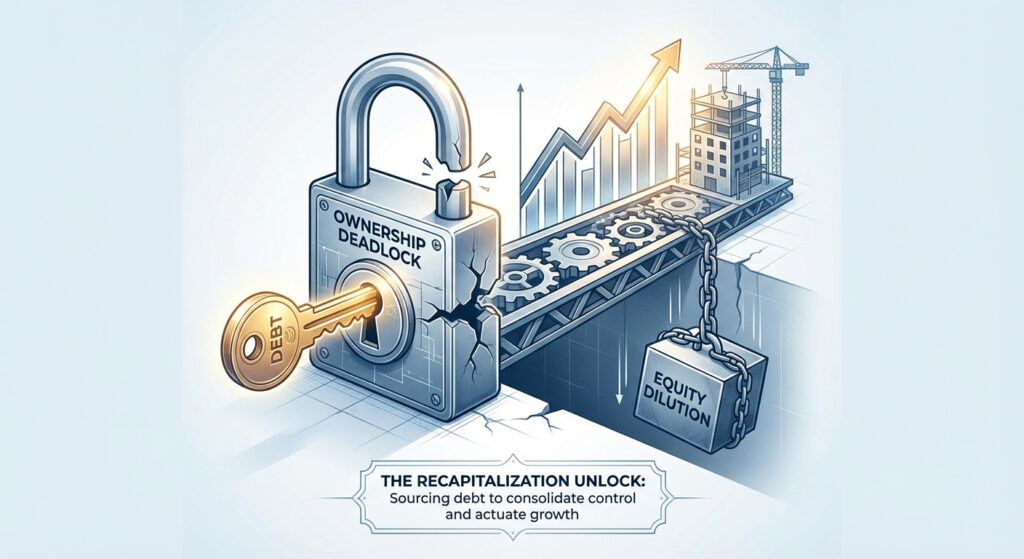
The Deadlock: When an Equity Partner Becomes a Growth Anchor
In the world of private business, ownership deadlocks are often more dangerous than declining revenue. This was the precise situation facing a leading building products manufacturer in early 2026. Following an acquisition in 2023, the business had stabilized, but its ownership structure had become a liability.
As detailed in a recent transaction analysis by Fora Financial, the company faced a critical divergence: one equity partner wanted a clean exit, while the remaining owners wanted to double down. The stakes were high, a high-profile luxury condominium development had just tapped the manufacturer for a multi-million-dollar contract. To fulfill it, the company needed massive working capital.
The problem? The company’s existing bank relationships were frozen. The lenders refused to unlock a new, larger Asset-Based Lending (ABL) facility, essential for buying the raw materials for the condo project, until the ownership dispute was resolved. The partner’s exit wasn’t just a governance issue; it was a liquidity dam.
The Decision: Cleaning the Cap Table with Debt Throughput
The remaining owners faced a classic “cost of capital” dilemma. To buy out the exiting partner, they could:
- Raise outside equity: Bring in a private equity firm. This would solve the cash problem but likely cost the founders control and 20-30% of their upside right before a major growth spurt.
- Drain working capital: Use cash from the balance sheet. This was impossible; every dollar was needed for the upcoming production cycle.
- Leverage the balance sheet: Use a specialized debt facility to effectuate the buyout.
The operators chose option three. They structured a $5 million strategic recapitalization. This wasn’t cheap bank debt; it was speed capital. The deal was structured to close rapidly, with $600,000 released immediately to initiate the buyout process and the remaining $4.4 million following within five days.
The logic was strategic sequencing: The expensive capital ($5M debt) was used to remove the obstacle (the exiting partner), which immediately allowed the company to access cheap capital (the ABL facility).
The Outcome: Unlocked Liquidity
The execution of this recapitalization had an immediate domino effect on the business’s operations:
- Ownership Consolidation: The dissenting partner was bought out completely, leaving the operating team with full strategic control and 100% of the equity upside.
- The ABL Trigger: With the cap table cleaned, the company successfully activated the new Asset-Based Lending facility.
- Commercial Execution: The liquidity from the ABL allowed them to purchase materials immediately. They met the rigid shipping deadlines for the luxury condo development, securing their position as a supplier for future high-volume pipelines.
By using debt instead of selling equity, the owners retained the value created by the new contract. If they had sold 30% of the company to a PE firm to fund the buyout, they would have permanently diluted their share of the profits from the very growth they were generating.
The Lessons: Sequencing Your Capital Stack
This case illustrates a fundamental principle for operators: Capital has a hierarchy of utility, not just cost.
Many founders obsess over the interest rate of a single loan. However, in this scenario, paying a higher rate for the $5 million buyout facility was mathematically superior to the alternative because of what it unlocked. The bridge capital served a specific functional purpose, clearing the path for the lower-cost commercial banking facility.
The Framework for Founders:
- Identify the Bottleneck: Is your growth stalled by cash or by structure? Here, structure (ownership) was blocking cash (ABL).
- Match the Instrument to the Problem: Use permanent equity for permanent uncertainty. Use debt for solvable, finite transition events like buyouts.
- Calculate the “All-in” Cost: The cost of the debt included interest. The cost of equity would have included a permanent claim on future cash flows. For a company about to sign a massive contract, equity is the most expensive currency to use.
Key Insights
- Debt as a Governance Tool: Leverage can be an effective mechanism to consolidate ownership and resolve partner disputes without selling the company.
- The Unlock Effect: Sometimes “expensive” mezzanine or private credit is necessary to satisfy the conditions of “cheap” senior bank debt.
- Speed is Value: The ability to close the $5M facility in under a week prevented the loss of the commercial contract, a return on investment that far outweighed the interest expense.
- Non-Dilutive Growth: By avoiding energetic equity fundraising during a recap, founders keep the compounding benefits of their future wins.
- Asset-Based Synergy: Recapitalizations work best when there are hard assets (inventory, receivables) waiting to be leveraged once the governance issues are solved.


