
The Story: Twelve Years In, and Still Not Ready to Let Go
By 2024, Marcus had built something real. His B2B compliance software company, let’s call it RegTrack (a hypothetical scenario based on real market deal structures), served over 340 mid-market customers in financial services, generated $6.2M in EBITDA on $18M of recurring annual revenue, and hadn’t taken a dollar of outside equity since its Series A in 2016. Marcus owned 91% of the company outright. The business was profitable, growing at 18% annually, and had a renewal rate above 94%.
But Marcus had a problem that many founders quietly share: nearly all of his net worth, somewhere north of $14M on paper, was locked inside a single operating business he ran every day. His house, his kids’ college funds, his retirement: all of it was one bad sales cycle away from looking very different.
His advisors started asking the obvious question. “Have you thought about a process?” In the language of M&A, a “process” means one thing: find a buyer, hand over control, and cash out. A strategic acquirer might pay 7–8x EBITDA, call it $43–$50M. A private equity recap would be structured similarly. Either way, Marcus would step off the bridge he’d spent twelve years building.
He wasn’t ready. The business still had a decade of runway. He knew the market better than any acquirer would. And he had no interest in a five-year earnout working for someone else’s return targets.
What Marcus needed wasn’t an exit. He needed liquidity, and those are not the same thing.
The Decision: Debt as a Liquidity Tool, Not a Rescue Signal
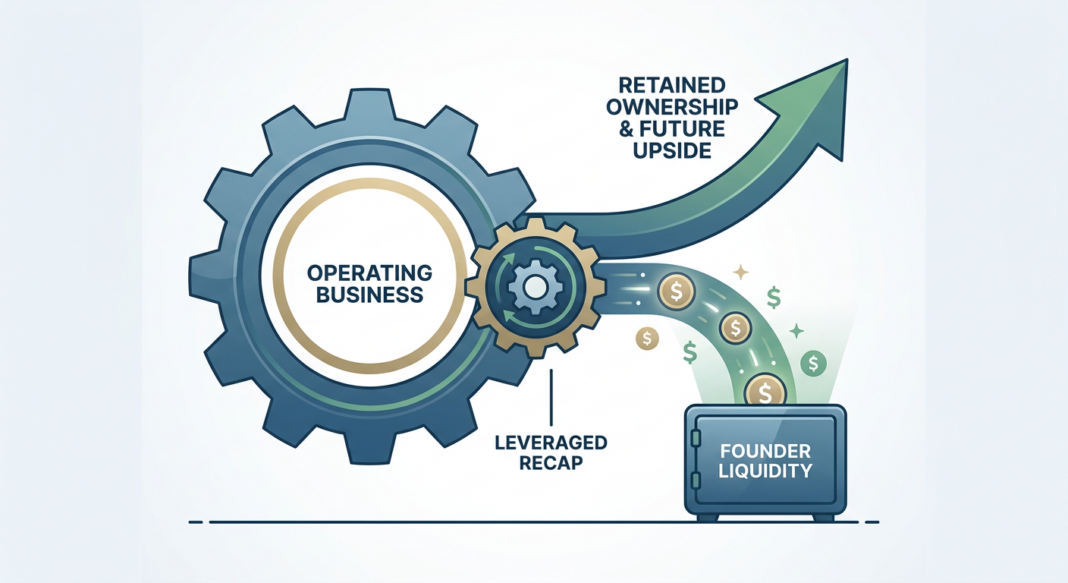
Marcus’s M&A advisor introduced him to the mechanics of a sponsored leveraged recapitalization. The concept was straightforward: RegTrack’s strong, recurring cash flows could support a meaningful debt load. A private equity firm would buy a 65% stake, structuring the transaction with roughly 4x EBITDA in senior debt from a direct lender, in line with current market benchmarks where lower-middle-market transactions typically carry between 3.5x to 4.5x EBITDA in total leverage. The equity check from the PE firm would fund the rest.
The deal structure that landed on the table looked like this:
- Enterprise Value: $44M (7.1x EBITDA)
- Senior Debt (Unitranche): $25M at SOFR + 450 bps (all-in ~9.8%)
- PE Equity Check: $11.5M for 65% ownership
- Marcus Rollover: 35% retained equity, implied value ~$7.7M
- Cash to Marcus at Close: ~$8.2M after fees and taxes on the sold portion
The alternative Marcus declined was a clean institutional equity raise: a growth equity firm offering $10M for a 28% stake at a $35M post-money valuation. That path would have left Marcus with 65% of a more richly capitalized business, but with a new board seat, a preferred liquidation stack, drag-along provisions, and a clock ticking toward a forced exit in five to seven years. His ownership would have been diluted again at the next round, and again after that.
The recap path was cleaner on the control and ownership math. Marcus kept operational day-to-day authority. He converted illiquid wealth into diversified assets. And he retained upside on 35% of whatever RegTrack becomes worth at the next exit, a “second bite” with institutional capital accelerating growth behind him.
The Outcome: Two Bites, Both Real
Eighteen months after close, RegTrack had grown revenue from $18M to $23.4M, aided by two add-on acquisitions sourced by the PE sponsor. EBITDA expanded to $8.1M as the platform scaled. The unitranche debt, now at 3.1x EBITDA versus the original 4.0x, was comfortably covered by cash flow, with a fixed-charge coverage ratio well above 1.5x.
Marcus had diversified $8.2M into a portfolio of liquid assets outside the business. His net worth was no longer a single-company bet. And he still owned 35% of a company now valued, based on the same 7x multiple, at roughly $56.7M. His retained stake had grown in implied value from $7.7M to $19.8M.
Compare this to the equity raise alternative: Had Marcus taken the $10M growth equity round at a $35M post-money, his 65% stake would have been worth $22.75M at the same $56.7M exit, but only if that outcome materialized cleanly, with no additional dilution from a subsequent round, no preferred liquidation stack ahead of him, and no forced timeline pressure from a GP managing fund life cycles. In practice, by Series B or C, founder ownership regularly erodes below 50% before exit. The equity path would likely have delivered a similar or smaller personal outcome, with considerably more constraints on how and when Marcus could run his business.
The recap delivered personal liquidity, retained control, preserved upside, and aligned incentives between Marcus and the PE sponsor around one shared outcome: a great exit at a great multiple, on Marcus’s timeline, not a fund’s.
The Lessons: When the Recap Is the Right Tool
The RegTrack scenario is a hypothetical, but its mechanics are drawn directly from the real market. Dividend recap volume reached $76 billion in 2024, the third-highest annual total on record, and surged further in early 2025, with Q1 alone producing $31 billion in issuance, putting the full year on pace to challenge the 2021 peak. The surge isn’t random: it reflects a structural mismatch between illiquid founder and PE equity and a credit market actively willing to provide liquidity solutions.
The recap works (and works well) under a specific set of conditions. Lenders look for stable, recurring revenue; strong EBITDA margins; non-cyclical demand; and a clear path to debt service coverage. Businesses like RegTrack, with 94%+ renewal rates and SaaS-like revenue predictability, are precisely the profile that earns the most competitive debt terms. Software and healthcare services companies, for instance, have consistently commanded the upper end of leverage ranges because their recurring revenue models can reliably support 5x+ debt multiples.
But the approach carries real risks that founders must underwrite honestly. Higher debt service reduces operating flexibility. A covenant breach can hand effective control to lenders. Academic research on PE-sponsored dividend recaps found that large leverage increases can materially raise the probability of financial distress, a reminder that the tool works cleanly when the underlying business is genuinely strong, and punishes over-extension in volatile operating environments. The key test: does the business generate enough reliable free cash flow that debt service feels like overhead rather than existential risk?
A Framework for Founders Facing This Decision
- Liquidity vs. Exit: If you want cash but not a new boss, a recap is the instrument, not a sale.
- Ownership Math: Model the equity raise scenario through to exit, including two more rounds of dilution and a preferred stack. The recap’s retained equity often wins on an after-dilution, after-preference basis.
- Debt Capacity First: The recap only works if your business can support 3–5x EBITDA in debt service. That discipline is the filter. If it doesn’t pass, the business likely needs equity, not debt.
- Sponsor Alignment: Not all PE partners are equal. A recap with a firm that earns its return by growing your EBITDA is structurally aligned. Avoid sponsors whose primary return mechanism is financial engineering.
- Second Bite Modeling: Founders who roll equity at 35% into a PE-backed platform frequently receive 1.5x–3.0x on that rollover basis at the second exit. That math is often more powerful than the first-close proceeds.
Key Insights
- Liquidity is not the same as an exit. A leveraged recap lets founders convert illiquid, concentrated equity into diversified personal wealth, without surrendering operational control or triggering a change of ownership.
- The private credit market is purpose-built for this moment. With full-year 2025 U.S. direct lending volumes reaching $380 billion and a private credit market projected to grow to $2.8 trillion by 2028, founder-owned businesses now have access to institutional debt capital on genuinely competitive terms, without needing a VC intermediary.
- Equity dilution compounds invisibly. A growth equity raise at Series A looks benign. Add a Series B, a preference stack, and an anti-dilution provision, and a founder who started at 91% ownership can arrive at an exit owning less than 30%, with preferred investors ahead of them in the waterfall.
- The “second bite” is often bigger than the first. Founders who roll equity into a PE-backed recap and stay involved typically receive a second liquidity event (at a higher multiple, driven by add-on acquisitions and EBITDA expansion) that exceeds their first-close proceeds.
- Debt imposes discipline; equity imposes a clock. A lender wants interest coverage and covenant compliance. A PE sponsor wants an exit in five to seven years on their fund timeline. Founders who want to run their business on their own terms often find that structured debt is a more aligned partner than institutional equity.


