
July 12, 2026 | Bond Capital Editorial Desk
The Story
Marcus had spent seventeen years building something real. His company (a regional industrial maintenance and staffing services firm based in the Carolinas, serving chemical plants, paper mills, and manufacturing facilities) had grown from a two-van operation into a business with 140 employees, recurring service contracts, and $4.2 million in annual EBITDA. He owned 100% of it. He had never taken outside capital. He had never needed to.
But at 54, Marcus found himself at a specific kind of crossroads that has no clean name: he was cash-rich on paper and cash-tight in practice. His net worth, almost entirely concentrated in the business, was somewhere north of $20 million, depending on who was doing the valuing. Meanwhile, his daughter was finishing her MBA and had expressed genuine interest in eventually running the firm. His business partner of twelve years wanted to retire, and buying him out would require real money. And quietly, Marcus had been watching a competitor two states over acquire three firms in eighteen months using outside capital.
Marcus needed liquidity. He needed growth capital. And he needed both without walking away from a business he had bled to build. He had two obvious paths in front of him. Neither was perfect. The one he chose, though, turned out to be transformative, not just for the balance sheet, but for how he thought about capital forever.
The Decision
Option A: Sell a Majority Stake to a Private Equity Firm
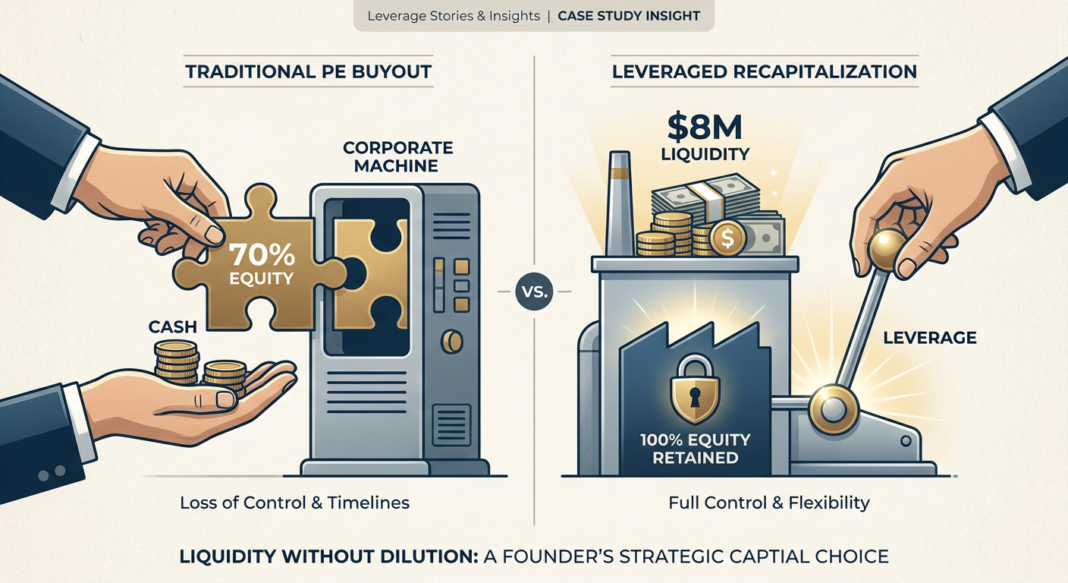
Marcus was approached by a lower middle market PE firm that had done four roll-ups in industrial services. The offer: buy 70% of the business at a 6.5x EBITDA multiple, a valuation of roughly $27.3 million, leaving Marcus with a 30% rollover equity stake, a seat at the table, and somewhere around $16 million in pre-tax proceeds before fees and taxes. The firm would install a CFO, pursue bolt-on acquisitions, and target a sale or recapitalization in four to six years.
On paper, it looked attractive. But Marcus ran the numbers on what he was actually giving up. He would own 30% of a business he currently owned 100% of. The PE firm would have board control, approval rights on capital decisions, and a contractual obligation to exit within a fund lifecycle that had nothing to do with Marcus’s timeline. The PE firm expected IRRs north of 25%, which meant the firm’s financial engineering would shape every operational decision for the next half-decade. As one industry advisor framed it: if Marcus missed EBITDA targets for two quarters, the conversation about control would change fast.
Option B: Leveraged Recapitalization via Private Credit
Marcus’s banker proposed a different structure: a leveraged recapitalization using a senior secured term loan from a direct lender. The structure was clean. Against his $4.2 million in EBITDA, a direct lender was willing to underwrite 3.75x leverage, in line with where the lower middle market was pricing in 2025, where GF Data reported total debt for smaller sponsored transactions running at approximately 4.0x EBITDA. The result: a $15.75 million term loan, structured as a five-year facility with a floating rate of SOFR plus roughly 400 basis points, consistent with pricing data showing all-in coupons north of 9% for lower middle market borrowers at the time.
The use of proceeds: $8 million as a special dividend to Marcus (personal liquidity), $4.5 million to buy out his retiring partner at a clean negotiated price, and $3.25 million held as a growth reserve for a targeted acquisition he had been eyeing in Georgia. Marcus retained 100% equity ownership. He answered to no new board member. He set his own timeline.
The annual debt service on $15.75 million at a 9.3% all-in rate was approximately $1.46 million per year, a fixed charge coverage ratio comfortably above 2.0x on a $4.2 million EBITDA base, with room to absorb normal seasonal cash flow variation.
The Outcome
Marcus closed the recap. Eighteen months later, his Georgia acquisition was integrated and contributing an estimated $900,000 in incremental EBITDA, pushing the consolidated run-rate toward $5.1 million. The debt balance had been reduced modestly through scheduled amortization, improving his leverage ratio from 3.75x to approximately 3.1x, well inside typical covenant thresholds. His business remained wholly owned. His daughter had joined the firm in a business development role.
Now consider the counterfactual. Had Marcus taken the PE deal, his 30% rollover stake on a $5.1 million EBITDA business, assuming the same 6.5x multiple at exit, would be worth approximately $9.9 million. That is the optimistic scenario: clean execution, no value drag from deal processes, and no multiple compression. Against the $16 million in initial PE proceeds, the total cash-on-cash outcome looks similar on the surface. But Marcus kept 100% of an asset now worth north of $33 million (at 6.5x the current EBITDA), versus owning 30% of the same business under someone else’s governance and exit timeline. The equity preservation math was decisive.
The contrast also holds in the context of the broader market. As Capstone Partners noted in a 2026 analysis, the average DPI multiple for PE vintage years since 2016 has remained below 1.0x, meaning many founders who traded equity for PE backing are still waiting for the promised second bite. For Marcus, there was no waiting. The first bite was his. The second bite would be too.
The Lessons
1. Leverage Is Not the Opposite of Stability: Misapplied Leverage Is
Marcus’s recap worked because the structure fit the business. His contracts were largely recurring, his customer base was diversified across industries, and his EBITDA had not contracted in a decade. The leverage ratio of 3.75x sat inside what the lower middle market was comfortably absorbing, well below the 5.5x+ multiples that characterize over-engineered LBOs. The key distinction is coverage, not leverage in the abstract. As long as the business generates cash comfortably above its debt service, debt is a tool, not a threat.
2. Equity Has a Price That Is Often Hidden
When founders evaluate a PE deal, they see the headline valuation. What they often miss is the total cost of that equity: governance rights surrendered, exit timeline transferred, and strategic optionality permanently constrained. Selling 70% of a business to fund a $16 million payout is not free capital; it is expensive capital with delayed and contingent terms. The leveraged recap’s debt service is explicit and fixed. The cost of equity dilution compounds invisibly across every future decision.
3. The Private Credit Market Is Structurally Suited for This
The mechanics of Marcus’s deal were made possible by a direct lending market that has fundamentally changed how smaller businesses access capital. Direct lending now captures the dominant share of middle market LBO financing, with private credit funds offering speed, deal certainty, and flexibility that traditional bank syndications cannot match. For businesses with $2 million to $10 million in EBITDA, the product set (unitranche loans, delayed-draw facilities, PIK toggles) is far richer than it was a decade ago.
4. The Recap Is Not a One-Time Tool: It Is a Capital Lifecycle Strategy
Marcus did not just solve a liquidity problem. He used the recap to fund a succession transition, remove a partnership overhang, and make an accretive acquisition, all without a single new equity investor entering his cap table. The leveraged recap is best understood not as a transaction, but as a capital structure decision that preserves every subsequent strategic option. A founder who keeps 100% of their equity entering a recap retains 100% of the upside from everything that follows.
The Framework: When Does a Leveraged Recap Make Sense?
- Strong, stable cash flows: Recurring revenue, diversified customers, and EBITDA that has survived at least one economic cycle.
- Conservative leverage sizing: Total debt at 3.0x–4.5x EBITDA for lower middle market businesses, with fixed charge coverage comfortably above 1.5x.
- Clear use of proceeds: Personal liquidity, partner buyout, succession funding, or targeted acquisition, not speculative expansion.
- No immediate exit imperative: The recap is a hold strategy. If a full sale is the near-term goal, a full sale is the right answer.
- Lender alignment: Covenant structures should be negotiated carefully. Maintenance covenants, typically quarterly leverage tests, are standard in private credit and require disciplined financial management post-close.
Key Insights
- Liquidity without dilution is real and available today. The leveraged recapitalization is not a niche instrument; it is a mainstream lower middle market tool that allows founders and owner-operators to extract personal liquidity, fund partner transitions, and finance acquisitions without surrendering equity or control.
- The PE deal’s true cost is hidden in governance and timeline. Headline valuations in PE recapitalizations look attractive, but the transfer of board control, exit decision-making, and fund lifecycle pressure represent a permanent structural cost that compound over years, not quarters.
- Market data supports conservative leverage for smaller businesses. Lower middle market sponsored transactions averaged approximately 4.0x total debt to EBITDA in H1 2025, and deals in the $10M–$25M enterprise value range averaged just 5.9x entry multiples, structurally different from the headline leverage seen in large-cap LBOs.
- The dividend recap market is large and active, but discipline is required. Dividend recap loan volume climbed significantly through 2024 and 2025, driven by stalled exit markets and sponsor urgency. The cautionary cases (like Steward Health Care, which paid out hundreds of millions in dividend recaps before filing for bankruptcy) remind us that structure without cash flow coverage is financial engineering in the worst sense.
- Equity preservation creates compounding optionality. Every percentage point of equity retained is a percentage point of upside from every future value creation event: whether that is a bolt-on acquisition, a multiple expansion, or an eventual full exit on the founder’s own timeline. The founder who keeps their equity today keeps every chip on every future hand.


